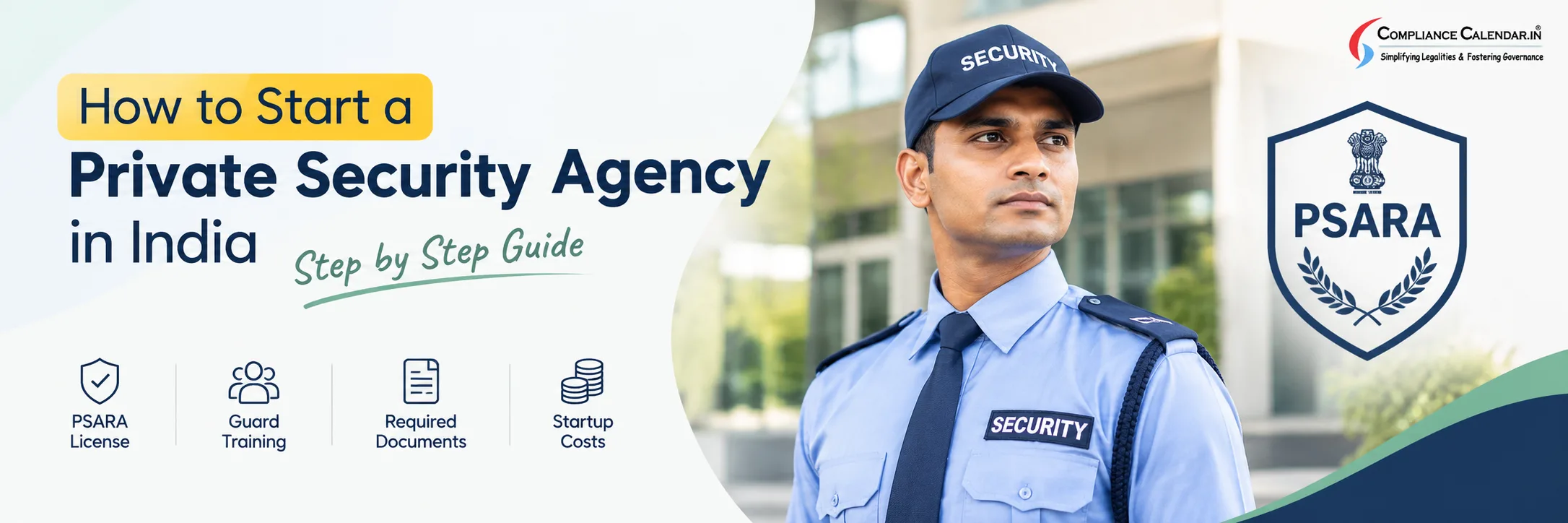
The demand for private security services is growing in India. Offices, factories, residential societies, shopping malls, hospitals and other businesses need trained security guards to protect their people and property. This has created good business opportunities for entrepreneurs who want to start their own security agencies. However, before providing security services to clients, it is important to understand the legal requirements.
The Government of India introduced the Private Security Agencies Regulation Act, 2005 (PSARA) to regulate private security agencies. Under this Act, businesses that provide private security services generally need a PSARA license from the concerned state or Union Territory authority. This license helps ensure that security agencies follow proper rules for hiring, training and managing security guards. Let us understand the PSARA license process, eligibility, documents, fees and other important details.
What Is a PSARA License?
A PSARA license is government permission required to run a private security agency in India. It allows an eligible business to provide security guards, supervisors and other permitted security services in the area mentioned in its license.
The PSARA Act sets rules for how private security agencies should work. These rules cover the background checks of employees, their training, uniforms, identity cards and the general management of the agency.
One important thing to remember is that a PSARA license is issued by the state or Union Territory licensing authority. It is not one common license that automatically allows an agency to operate across India. If an agency wants to provide services in more than one state, it may need separate licenses as required by the rules of those states.
Who Needs a PSARA License?
A person or business that wants to run a private security agency and provide security services to clients generally needs a PSARA license before starting operations.
It is commonly required for agencies providing security guards or supervisors to:
- Corporate offices and business buildings
- Factories and industrial units
- Residential societies and apartments
- Shopping malls and retail stores
- Hospitals and educational institutions
- Hotels, warehouses and construction sites
- Events and other commercial locations
Does every business that hires security guards need a PSARA license?
No. A company that hires guards only to protect its own office, factory or property is not automatically treated as a private security agency. The requirement mainly applies to businesses that provide private security services to other people or organisations. The actual nature of the business should be checked before applying.
Eligibility Criteria for a PSARA License
An applicant must meet the conditions given under the PSARA Act and the applicable state rules. The licensing authority checks the applicant's background, business details and ability to follow the required security standards.
Some important eligibility conditions include:
- The applicant must meet the legal requirements under the PSARA Act.
- The applicant and relevant management personnel must not have disqualifying criminal convictions or other legal restrictions under the Act.
- The agency must have a proper business structure and registered office details.
- The agency must make arrangements for the required training of security guards and supervisors.
- The agency must be able to follow the rules for employee verification, records and supervision.
The exact conditions may vary from one state to another. Therefore, applicants should check the requirements of the state where they plan to provide security services.
Documents Required for PSARA License
The documents required for a PSARA license may vary depending on the state and business structure. However, applicants generally need the following documents:
- PAN Card: PAN details of the applicant or business.
- Aadhaar Card or Other ID Proof: Identity proof of the applicant, directors or partners, as applicable.
- Address Proof: Proof of the registered office address of the agency.
- Certificate of Incorporation: Required if the applicant is a registered company.
- Partnership Deed: Required if the agency is operated as a partnership firm.
- LLP Registration Documents: Required if the business is registered as an LLP.
- Director or Partner Details: Names and details of the people managing the business.
- Photographs: Recent photographs of the applicant and other relevant persons, as required.
- Training Arrangement Details: Information about the training institute or facility arranged for security guards.
- Affidavits and Declarations: Required declarations and affidavits as prescribed by the licensing authority.
The licensing authority may ask for additional documents depending on the state and the applicant's business structure. Make sure all documents contain correct and matching details. Missing documents or incorrect information can lead to application queries and delays.
How to Apply for a PSARA License in India?
The PSARA license application is submitted to the licensing authority of the concerned state or Union Territory. The application process may differ depending on the state, but the main steps are generally similar.
Step 1: Decide Your Area of Operation
First, decide where you want to provide security services. You may apply for the area permitted under the relevant state rules, such as a district or a wider area. The selected area is important because it determines the licensing authority and may also affect the government fee.
Step 2: Set Up Your Business
Choose a suitable business structure, such as a proprietorship, partnership, LLP or private limited company. Keep the business registration documents, PAN and office address proof ready before starting the application.
Step 3: Arrange Security Training
A private security agency must ensure that its guards and supervisors receive the prescribed training. The applicant should make suitable arrangements with a training institute or facility recognised under the applicable state rules.
Step 4: Prepare the Application
Fill in the prescribed application form and collect all the required documents. Check the applicant's details, business address and other information carefully before submission.
Step 5: Submit the Application and Fee
Submit the application along with the required documents and government fee to the concerned licensing authority. Follow the official submission method prescribed by that state.
Step 6: Complete Verification
The licensing authority examines the application and may conduct police verification or other background checks. If any information is missing, the authority may ask for additional documents or clarification.
Step 7: Receive the License
If the application meets the required conditions, the authority may grant the PSARA license. Before starting operations, check the license details, validity and permitted area of operation.
PSARA License Fees and Validity
The government fee for a PSARA license depends on the state and the area for which the agency is applying. The fee may differ for a single district, multiple districts or the entire state, depending on the applicable rules.
Area of operationFee detailsOne district5000More than one district10000Entire state25000Applicants should check the latest fee schedule with the licensing authority before making payment. Other expenses, such as documentation, training arrangements and professional assistance, may be separate from the government fee.
A PSARA license is generally valid for five years, subject to the applicable provisions and state rules. Agencies that want to continue their business after the license expires must apply for renewal within the prescribed period. Renewal should not be left until the last moment.
Responsibilities After Getting a PSARA License
Getting a PSARA license does not mean that an agency has completed all its legal responsibilities. It must continue to follow the PSARA Act and the applicable state rules while providing security services.
Some important responsibilities include:
- Hiring eligible guards: Recruit security personnel who meet the prescribed conditions.
- Employee verification: Complete the required background checks before assigning guards to duty.
- Proper training: Ensure that guards and supervisors receive the prescribed training.
- Uniform and identity cards: Follow the applicable rules for uniforms and identification.
- Employee records: Maintain proper records of guards, supervisors and other required details.
- Following license conditions: Provide services only within the permitted area and follow the conditions mentioned in the license.
- Reporting changes: Inform the authority or seek approval when required for changes in business details or management.
If an agency fails to follow the Act or the conditions of its license, the licensing authority may take action. This can include suspension or cancellation of the license, depending on the violation and applicable law.
Why Is a PSARA License Important for Security Agencies?
A PSARA license helps establish that a private security agency has received the required government permission to operate in its licensed area. It also encourages agencies to maintain proper standards for hiring, training and managing security personnel.
For customers, choosing a licensed agency can provide greater confidence when hiring security services. Many companies, factories, residential societies and other organisations may ask for a valid PSARA license before entering into a service agreement. For business owners, obtaining the license and following the rules can help build trust, avoid legal problems and support long-term business growth.
Get Professional Assistance for PSARA License Registration
Applying for a PSARA license involves several requirements, including business documents, training arrangements, background verification and state-specific application rules. Understanding these requirements before applying can help reduce mistakes and avoid unnecessary delays.
Businesses planning to start a private security agency can seek professional help to understand the process and prepare the required documents. Compliance Calendar provides assistance with PSARA License Registration in India , helping applicants understand the applicable requirements and application procedure. Applicants should always confirm the latest rules and instructions with the concerned state licensing authority before submitting an application.
For more information Kindly Visit : PSARA License Registration in India
Frequently Asked Questions About PSARA License
1. What is the full form of PSARA?
PSARA stands for the Private Security Agencies Regulation Act. It is the law introduced in 2005 to regulate private security agencies in India.
2. Is a PSARA license compulsory in India?
Yes. A business that operates a private security agency generally needs a PSARA license from the concerned state or Union Territory authority before providing security services.
3. Can I start a security agency without a PSARA license?
No. An agency covered under the PSARA Act must obtain the required license before starting its private security business.
4. Is a PSARA license valid throughout India?
No. A PSARA license is issued for the permitted area under the concerned state's rules. An agency planning to work in another state should check whether a separate license is required.
5. How long is a PSARA license valid?
A PSARA license is generally valid for five years, subject to the applicable provisions and state rules. The agency must apply for renewal within the prescribed time.
6. What is the fee for a PSARA license?
The government fee varies by state and area of operation. Applicants should check the latest fee schedule issued by the concerned licensing authority.
7. Is police verification required for a PSARA license?
Background verification is an important part of the process. The licensing authority may conduct police verification or other checks as required under the Act and state rules.
8. Can an individual apply for a PSARA license?
An individual may apply if they meet the eligibility conditions under the PSARA Act and applicable state rules. They must also submit the required documents and declarations.
9. Is training compulsory for security guards?
Yes. Private security agencies must ensure that their guards and supervisors receive the prescribed training through arrangements that meet the applicable state requirements.
10. Can a PSARA license be cancelled?
Yes. The licensing authority may suspend or cancel a license if the agency violates the PSARA Act or the conditions of its license, as permitted under the law.