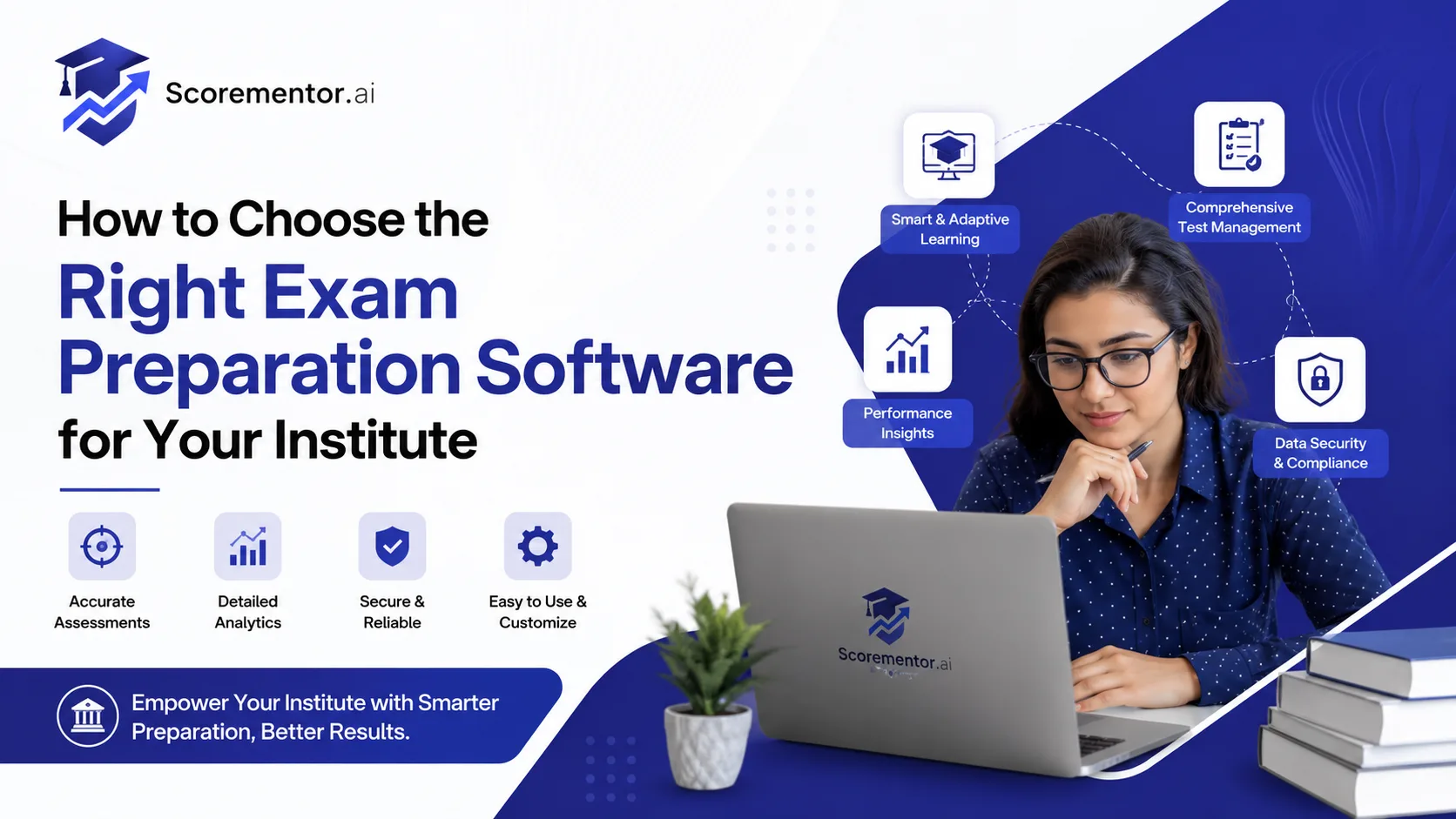
If you're evaluating exam preparation software for your institute, the software you pick will do more to shape your pass rates than any single teacher, textbook, or lecture. I've watched institutes with mediocre course content outperform better-run competitors simply because their students practiced on a platform that mirrored the real exam. That's the single biggest thing to get right before you sign a contract.
I work closely with coaching institutes evaluating exam prep platforms, and I keep seeing the same pattern: owners shortlist software based on price and a flashy demo, then discover six months later that the tool doesn't actually simulate the real test, or that it can't scale past one branch. This guide walks through what exam preparation software actually is, how it's different from generic "exam software," what to look for in software for institutes, and since PTE is where I get asked the most questions, a specific breakdown of what good PTE software for institutes looks like.
What Is Exam Preparation Software, and Why Do Institutes Actually Need It?
Exam preparation software is a digital platform that lets students practice for a specific exam PTE, IELTS, GRE, GMAT, SAT, and so on under conditions that mimic the real test, then get scored and receive feedback on where they're losing marks. It's different from a learning management system (LMS) or a general quiz tool because the questions, timing, interface, and scoring logic are built around one exam's actual format.
Institutes need this because manual test prep doesn't scale. A teacher can mark 15 essays in an evening; software can score 1,500 in the same time, and it does it consistently, without fatigue-driven grading drift. I've seen institutes cut their per-student review time by more than half just by moving mock test evaluation off a teacher's desk and onto AI-based scoring.
What's the Real Difference Between Exam Software and Exam Preparation Software?
This is where a lot of institute owners get confused during research, because search results for "exam software" mostly point to tools like proctoring and assessment platforms software built to conduct exams (schools running a midterm, a company running a certification test). That's a different job entirely from software built to help someone prepare for an external, high-stakes exam like PTE or IELTS.
Exam Conducting SoftwareExam Preparation SoftwarePrimary jobDeliver and proctor a testTrain students before test dayQuestion sourceInstitute-authoredModeled on the real exam's official formatScoringSimple right/wrong or manualAI-based, skill-wise (fluency, pronunciation, grammar, content)Used bySchools, HR, certification bodiesCoaching institutes, language schools, tutorsSuccess metricExam completed securelyStudent's real-world exam score improvesIf your institute trains students for PTE, IELTS, OET, or similar exams, you don't need a generic exam-conducting tool, you need purpose-built exam preparation software that's aligned to that specific test's scoring rubric.
What Should You Look for in Software for Institutes?
Software built for individual learners and software built for institutes are not the same product with a different price tag; they need fundamentally different infrastructure. When you're evaluating software for institutes specifically, here's what separates a tool that scales from one that becomes a bottleneck at 200 students.
Core criteria checklist
CriterionWhy it matters for an instituteMulti-branch / multi-batch managementYou need one dashboard across locations, not separate logins per branchRole-based accessAdmins, teachers, and students need different permission levelsWhite-label brandingYour institute's logo and domain build trust, not a third-party brandBulk student onboardingAdding 50 students one-by-one isn't viable during peak enrollment seasonBatch-level and individual analyticsYou need to compare cohorts, not just track single studentsQuestion bank depth and refresh rateStale questions get memorized and stop testing real skillSupport and onboardingYour teachers, not just IT staff, need to be able to run itI'd add one thing most checklists miss: ask how the vendor handles question bank updates when the real exam changes its format. Exams like PTE and IELTS do update periodically, and software that isn't kept current becomes a liability rather than an asset.
Why Do PTE Institutes Need Purpose-Built PTE Software Instead of Generic Tools?
PTE Academic is scored almost entirely by AI across integrated skills; a single "Describe Image" response, for example, is evaluated on content, pronunciation, oral fluency, and vocabulary simultaneously. A generic quiz tool with multiple-choice logic simply can't replicate that. This is why PTE software for institutes exists as its own category rather than a feature bolted onto a general LMS.
I've noticed the institutes that struggle most are the ones still using PDFs and recorded lectures as their primary "practice" method. Students walk into test day having never touched the actual interface, and the unfamiliarity costs them marks that have nothing to do with their English ability. Pearson's own test format guidance confirms PTE Academic runs for a fixed two hours across three parts, and Pearson itself points candidates toward practicing questions and building format familiarity as a core part of preparation which is exactly the gap PTE software is designed to close.
What Features Separate the Best PTE Software for Institutes from the Rest?
Once you're comparing PTE-specific platforms, most vendors will claim "AI scoring" and "real exam simulation" ; those two phrases show up on almost every product page in this space. The differentiators are in the details.
1. AI-Powered Mock Test Platform
Look for timed, full-length mock tests with automatic, skill-wise scoring across Speaking, Writing, Reading, and Listening, not just an overall number.
2. Real Exam Simulation
The interface, timing, and question sequencing should mirror the actual Pearson test screen-for-screen. This is the single feature that most affects student confidence on test day.
3. Centralized Institute Dashboard
One login to manage every batch, branch, and teacher, with the ability to generate performance reports without exporting data manually.
4. Analytics That Predict, Not Just Report
The better platforms don't just show past scores, they flag which weak skills are most likely to hold a student's overall band down, so teachers can prioritize coaching time.
5. White-Label Branding and Revenue Tools
For institutes running this as part of their business model, the ability to sell mock test packages under your own brand rather than a vendor matters for both credibility and margin.
I looked closely at how Scorementor.AI's PTE Academic software is positioned for institutes, and its approach is a reasonable reference point for this category: it bundles an AI-powered scoring engine, real exam simulation, and detailed performance analytics into one institute platform rather than treating them as separate add-ons. Its dedicated PTE Academic software program is built specifically around institute, agent, and teacher use cases which matters, because a platform designed only for individual students usually lacks the batch-management layer institutes actually need day to day.
How Do You Evaluate PTE Software for Institutes Before You Buy?
This is the part most institute owners skip, and it's the reason so many end up switching vendors within a year. Treat this like any other operational decision run a structured trial, not a five-minute sales demo.
- Request a live demo with your own sample students, not the vendor's pre-loaded showcase account. Watch how a real student with a mid-range skill level gets scored.
- Take a full mock test yourself, start to finish, timed. If you find the interface confusing as an adult native or fluent speaker, your students will too.
- Cross-check AI scoring against a human evaluator on the same response. A gap of more than half a band on Speaking or Writing is a red flag.
- Test the admin side, not just the student side. Add a batch, assign a test, and pull a report this is what your staff will do daily.
- Ask for churn or retention data from existing institute partners, not just glowing testimonials. Vendors that are confident in retention usually share this.
- Confirm question bank update frequency in writing, especially around exam format changes.
- Check onboarding time. If it takes more than a week to get your first batch live, that's time and enrollment revenue lost.
What Mistakes Do Institutes Commonly Make When Choosing PTE Software?
The most common mistake I see is picking software based on the lowest price per student license without factoring in what happens at scale. Some platforms get noticeably slower or harder to manage past a few hundred concurrent users. The second most common mistake is skipping the branding question entirely, then realizing a year in that students associate their exam prep experience with the software vendor's name, not the institute's.
A third mistake worth naming: choosing a platform that only supports PTE when your institute is likely to add IELTS, CELPIP, or OET students within a year or two. Migrating to a new system later is far more disruptive than picking a platform that already supports multiple exams from day one.
How Much Should PTE Software for Institutes Cost and What's the ROI?
Pricing in this category typically follows a per-student or per-batch licensing model, sometimes with tiered plans based on branch count or feature access (analytics, white-labeling, and API integrations usually sit in higher tiers). I'd encourage institute owners to think about this less as a cost line and more as a margin driver: if AI scoring cuts your teachers' manual grading time meaningfully, that time gets redirected into more paid coaching hours or a larger student intake without hiring more staff.
The ROI question to ask a vendor directly is simple: what's the realistic student score improvement they've seen across partner institutes, and can they show it with data rather than a single testimonial. A platform that can't answer that clearly probably hasn't tracked outcomes rigorously enough to be trusted with your student pass rates.
What a Well-Built PTE Software Platform Looks Like in Practice
To make this concrete: a well-built PTE software for institutes setup typically looks like an admin dashboard where a center director adds a new batch of 40 students in minutes, assigns a full-length mock test, and by the next morning has a report showing which five students are weakest in Speaking fluency without a single teacher manually reviewing an audio file. Institutes exploring Scorementor.AI can see this workflow across its exam categories, since the platform is built around the same institute dashboard and AI scoring approach for PTE, IELTS, NAATI, and other tests rather than treating each exam as a separate product.
What's Your Final Checklist Before You Commit to PTE Software for Institutes?
Before signing anything, confirm you have clear answers on:
- Does the mock test interface match the real exam screen-for-screen?
- Can you white-label it under your institute's name and domain?
- Does it support multi-branch and multi-batch management out of the box?
- How current is the question bank, and how often is it refreshed?
- What's the realistic onboarding timeline for your staff?
- Can it expand to other exams (IELTS, OET, CELPIP) if your institute grows?
- What outcome data can the vendor show, beyond testimonials?
Skimmable summary: A short, specific checklist beats a long feature comparison sheet. If a vendor can't answer these seven questions clearly, that's information in itself.
Frequently Asked Questions
Is PTE software for institutes worth the investment compared to traditional coaching methods?
Yes, in almost every case I've seen, because manual mock test evaluation simply cannot scale the way AI scoring can. A single teacher grading essays and audio responses by hand caps how many students an institute can serve well; software removes that ceiling. I've seen institutes take on double their previous student intake without adding grading staff, purely because AI scoring handled the volume.
What's the difference between PTE software and general exam preparation software?
PTE software is built specifically around PTE Academic's format, timing, and AI-based skill scoring, while general exam preparation software might cover multiple exam types with shallower, less accurate coverage of any one of them. If your institute's core business is PTE, a dedicated PTE tool will almost always out-perform a generalized platform on scoring accuracy and exam-day realism.
Can PTE software for institutes be branded under my own institute's name?
Most established vendors offer white-labeling, meaning your logo, colors, and domain appear throughout the platform instead of the vendor's branding. I'd treat this as a non-negotiable requirement rather than a nice-to-have students trust and remember the institute they enrolled with, not a third-party software name buried in the login screen.
How long does it typically take to set up exam preparation software for an institute?
Onboarding usually ranges from a few days to about two weeks, depending on how much custom branding and staff training you need. I'd be cautious of any vendor promising same-day full deployment for a multi-branch setup that usually means shallow admin configuration that causes problems later.
Does PTE software work for institutes running both online and offline coaching?
Yes, and this is one of the more underrated benefits a good platform lets offline classroom teaching stay exactly as it is while giving students 24/7 access to mock tests and practice outside class hours. I've found this hybrid model tends to improve outcomes more than either pure online or pure offline coaching alone, since students get structured classroom guidance plus unlimited independent practice reps.
How accurate is AI scoring compared to human evaluators for PTE preparation?
On well-built platforms, AI scoring for PTE-style tasks is generally close to human evaluator scores, particularly for objective components like Reading and Listening, and reasonably close on Speaking and Writing when the underlying model is trained specifically on that exam's rubric. I'd still recommend spot-checking a handful of responses against a human evaluator before fully trusting a new platform, especially in the first few weeks of use.