
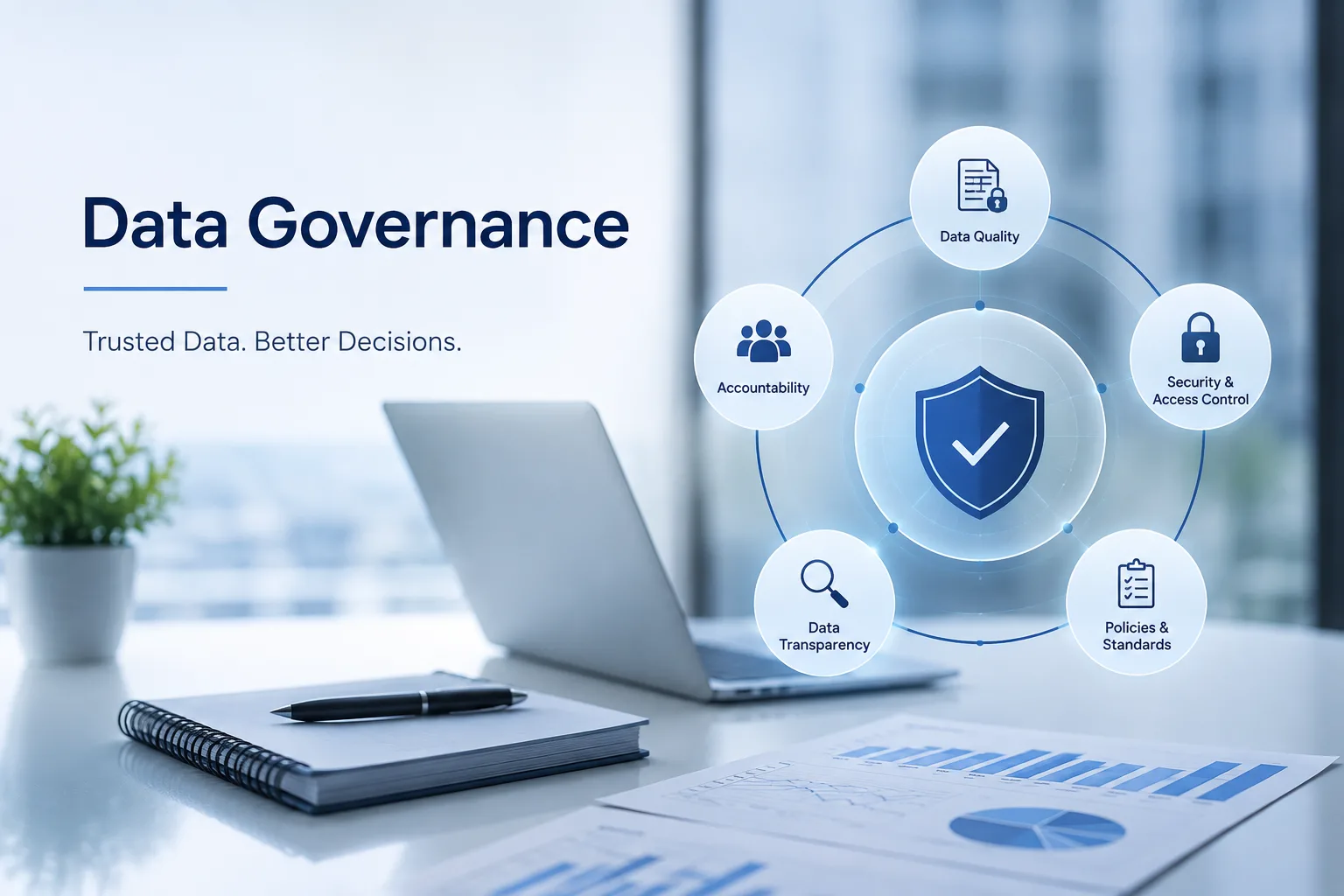
Every large organization sits on a growing mountain of data, customer records, financial transactions, operational logs, and increasingly, the training and output data behind AI systems. Without a clear structure for managing that data, even the most sophisticated analytics initiative collapses under duplicate records, inconsistent definitions, and unclear ownership. This is where enterprise data governance comes in: a formal system of policies, roles, and processes that ensures data across the organization is accurate, secure, consistent, and used responsibly.
Building a governance framework from scratch can feel overwhelming, especially for organizations juggling multi-cloud environments, regulatory requirements, and fast-moving AI adoption. This guide walks through what an enterprise data governance framework actually looks like, why it matters more than ever in 2026, and how to build one step by step, including where data governance consulting services and cloud data security solutions fit into the picture.
What Is Enterprise Data Governance?
Enterprise data governance is the set of rules, roles, standards, and processes an organization uses to manage the availability, integrity, security, and usability of its data. It answers foundational questions like: Who owns this dataset? Who can access it? How is quality measured? What happens when data is misused or breached?
Unlike simple data management, which focuses on the technical mechanics of storing and moving data, governance is about accountability. It defines the "who" and "why" behind every dataset, while data management handles the "how."
A mature governance framework typically covers:
- Data ownership and stewardship, assigning clear accountability for each data domain
- Data quality standards, defining accuracy, completeness, and consistency benchmarks
- Access controls and security policies, determining who can view, edit, or export data
- Regulatory compliance, aligning with laws like GDPR, HIPAA, or industry-specific mandates
- Metadata and cataloging, making data discoverable and understandable across teams
Why Enterprise Data Governance Matters Now
A few forces are pushing governance from a "nice to have" into a business necessity:
AI adoption raises the stakes. Machine learning models and AI agents are only as reliable as the data feeding them. Ungoverned, inconsistent data leads directly to flawed predictions and compliance risk.
Regulatory pressure keeps increasing. Data privacy laws continue to expand globally, and non-compliance penalties can be severe. A governance framework provides the audit trail and controls regulators expect.
Multi-cloud complexity demands structure. Most enterprises now run workloads across several cloud providers. Without governance, data scattered across platforms becomes duplicated, inconsistent, or exposed to security gaps, which is exactly why pairing governance with cloud data security solutions has become a standard practice rather than an afterthought.
Trust drives adoption. Business teams only rely on dashboards and analytics they trust. Governance is what makes that trust possible at scale.
Step-by-Step: Building an Enterprise Data Governance Framework
1. Secure Executive Sponsorship
Governance initiatives fail when they're treated as an IT-only project. Successful frameworks start with a sponsor at the executive level, often a Chief Data Officer or Chief Data and Analytics Officer, who can allocate budget, resolve cross-department conflicts, and keep governance aligned with business strategy.
2. Define Scope and Objectives
Not every organization needs to govern every dataset on day one. Start by identifying high-value, high-risk data domains: customer PII, financial records, and data feeding AI models are common starting points. Define clear objectives: Are you solving a compliance gap? Reducing duplicate reporting? Preparing data for AI initiatives? Specific goals keep the framework from becoming an abstract exercise.
3. Establish a Governance Structure
Most enterprise frameworks rely on a three-tier structure:
- Governance council, senior leaders who set policy and resolve escalations
- Data stewards, subject-matter owners responsible for specific data domains
- Data custodians, technical staff who implement controls and maintain systems
This structure distributes accountability so governance doesn't bottleneck through a single team.
4. Create Data Policies and Standards
Document clear, enforceable policies covering data quality thresholds, naming conventions, retention schedules, and access rules. These standards should be specific enough to be actionable, vague guidelines rarely survive contact with real operational pressure.
5. Build a Data Catalog and Metadata Layer
A searchable data catalog lets teams find, understand, and trust the data they're working with. Metadata (descriptions, lineage, ownership tags) turns a catalog from a simple inventory into a genuinely useful governance tool, and increasingly underpins the automated policy enforcement seen in modern data governance solutions.
6. Implement Access Controls and Security
Governance and security are deeply linked. Role-based access control, encryption, and monitoring should map directly to the data classification tiers defined in your policies. For organizations running on Microsoft's ecosystem, this is often where Azure cloud security services come into play, providing identity management, encryption, and threat detection that align governance policy with technical enforcement across cloud workloads.
7. Monitor, Audit, and Iterate
Governance isn't a one-time project. It's an ongoing discipline. Regular audits catch policy drift, data quality regressions, and unauthorized access before they become larger problems. Automated monitoring tools can flag anomalies in near real time, reducing the manual burden on data stewards.
8. Invest in Training and Culture
Even the best framework fails if employees don't understand or follow it. Ongoing training, clear documentation, and visible executive support help embed governance into everyday behavior rather than treating it as a compliance checkbox.
Where Data Governance Consulting Services Add Value
Building a framework internally is possible, but many organizations, especially those without a mature data team, turn to data governance consulting services to accelerate the process. External consultants bring:
- Proven frameworks and templates rather than starting from a blank page
- Experience navigating industry-specific regulatory requirements
- Objective assessment of current data maturity and gaps
- Guidance on selecting and implementing the right data governance solutions and tooling for your environment
This is particularly valuable when governance needs to be stood up quickly to support a major initiative, such as a cloud migration or an enterprise-wide AI rollout.
Choosing the Right Data Governance Solutions
The market for governance tooling has matured considerably, but selecting the right platform depends on your specific environment:
- Cloud-native governance, if your data lives primarily in one cloud provider, native tools (like those bundled into Azure, AWS, or Google Cloud) often integrate most smoothly
- Multi-cloud governance platforms, organizations spanning multiple providers typically need a unifying catalog and policy layer that works across environments
- Security-first solutions, for regulated industries, prioritize cloud data security solutions with strong encryption, access auditing, and compliance certifications
The right choice depends less on brand recognition and more on fit: how well the tool integrates with your existing data stack, how easily business users can adopt it, and whether it scales with your data volume.
Final Thoughts
An enterprise data governance framework isn't a one-time IT project. It's an ongoing operating model that touches every team using data. Getting it right requires executive buy-in, clear ownership, practical policies, and the right mix of technology and human oversight. Whether you build the framework internally, bring in data governance consulting services, or combine both with dedicated cloud data security solutions, the payoff is the same: data your organization can actually trust, at the scale modern analytics and AI demand.