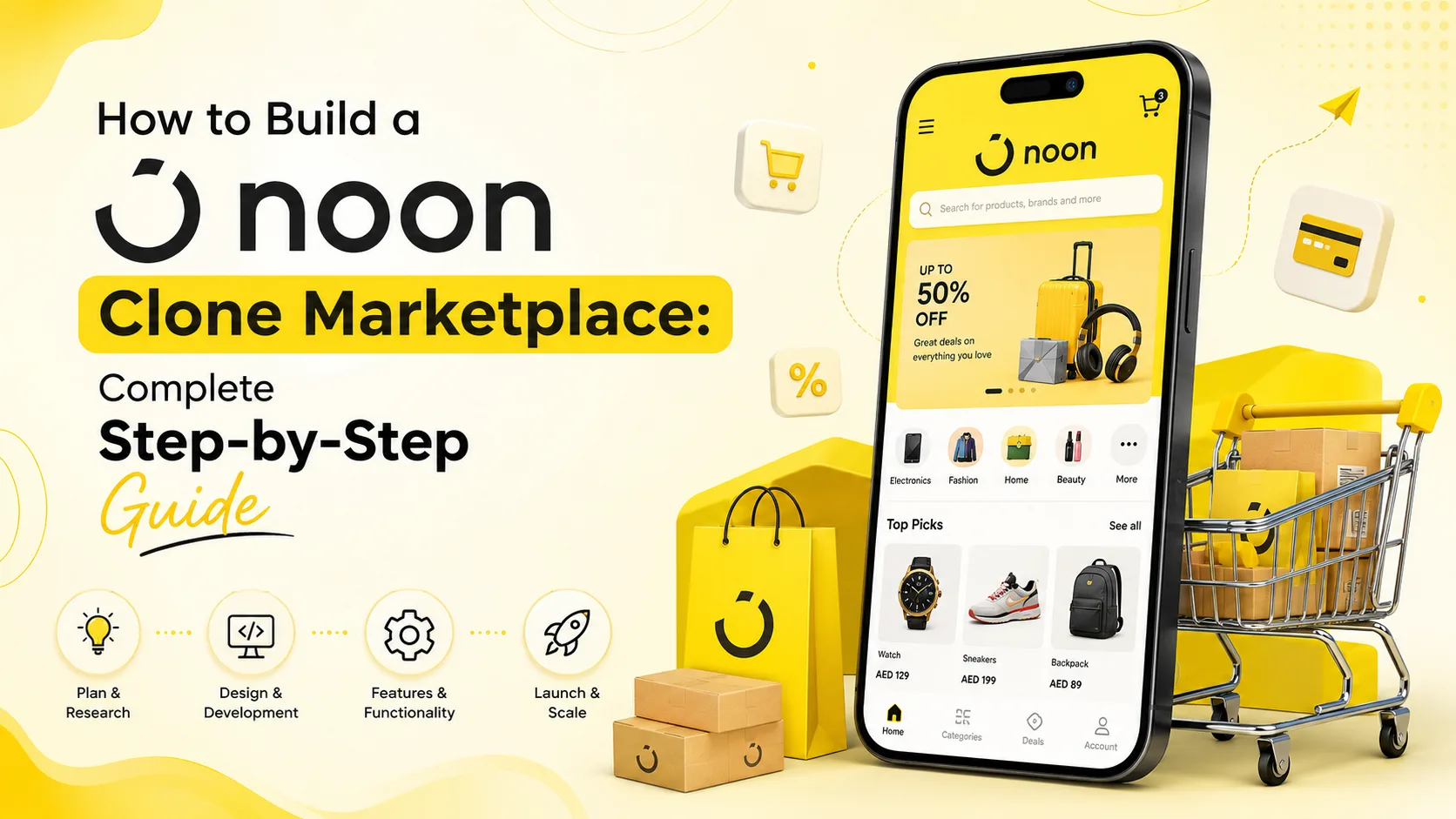
The eCommerce marketplace industry has transformed the way people shop online. Instead of visiting multiple websites to compare products, customers now prefer platforms where they can browse thousands of products from different sellers in one place. This shift has fueled the success of leading multi-vendor marketplaces like Noon, making the business model increasingly attractive to entrepreneurs around the world.
If you've been considering launching your own online marketplace, building a Noon clone marketplace can be a smart way to enter the rapidly growing eCommerce industry. Whether you're targeting electronics, fashion, beauty products, groceries, or a niche product category, a marketplace inspired by Noon allows you to connect multiple vendors with customers while generating revenue through commissions, subscriptions, advertising, and other monetization models.
In this guide, you'll learn what a Noon clone marketplace is, why entrepreneurs are investing in this business model, how to evaluate market opportunities, and the key planning steps before development begins.
What Is a Noon Clone Marketplace?
A Noon clone marketplace is a multi-vendor eCommerce platform that replicates the core functionality of Noon while allowing businesses to customize the platform according to their unique business requirements. Instead of copying Noon exactly, these solutions provide a proven marketplace framework that can be tailored with custom branding, features, and workflows.
Like Noon, a clone marketplace enables multiple sellers to register, list products, manage inventory, process orders, and communicate with customers through a centralized platform. Customers benefit from a wide product selection, competitive pricing, and the convenience of shopping from multiple vendors in one place.
Most modern Noon clone scripts include features such as:
- Multi-vendor management
- Product catalog management
- Secure payment gateway integration
- Advanced order management
- Real-time inventory management
- Product search and filtering
- Vendor dashboards
- Customer accounts
- Customer reviews and ratings
- Mobile-responsive design
- Promotions and discount management
- Analytics and reporting
These built-in capabilities allow businesses to launch a marketplace faster than developing every feature from scratch.
Why Build a Noon Clone Marketplace?
The popularity of online marketplaces continues to grow because they offer significant advantages over traditional online stores.
Lower Inventory Risk
Unlike single-vendor eCommerce stores, marketplace owners don't need to stock every product themselves. Independent vendors manage their own inventory, reducing operational costs and financial risk.
Multiple Revenue Streams
A Noon clone marketplace can generate revenue in several ways, including:
- Commission on every sale
- Vendor subscription plans
- Featured product listings
- Sponsored advertisements
- Premium seller memberships
- Promotional campaigns
Diversifying revenue sources creates a more sustainable business model.
Wider Product Selection
Because multiple vendors contribute products, your marketplace can quickly expand its catalog without requiring large inventory investments. A larger product selection often attracts more customers while encouraging repeat purchases.
Better Customer Experience
Customers appreciate having multiple brands, competitive pricing, flexible payment options, and verified customer reviews available on one platform. This convenience improves user satisfaction and strengthens marketplace credibility.
Long-Term Marketplace Scalability
One of the biggest advantages of the marketplace model is marketplace scalability. As new vendors join, your platform can grow organically by expanding product categories, increasing inventory, and reaching new customer segments without dramatically increasing operational costs.
Understanding the Market Opportunity
The continued growth of online shopping has created enormous opportunities for entrepreneurs launching marketplace businesses.
Consumers increasingly prefer marketplaces because they offer:
- Greater product variety
- Competitive pricing
- Faster product comparisons
- Convenient shopping experiences
- Trusted seller ratings
- Flexible payment options
At the same time, small and medium-sized businesses are actively looking for new online sales channels beyond traditional eCommerce websites. This creates an opportunity for entrepreneurs to build specialized marketplaces focused on particular industries, regions, or customer communities.
Instead of competing directly with global marketplace giants, many successful businesses focus on niche markets such as:
- Fashion
- Electronics
- Beauty products
- Furniture
- Automotive parts
- Handmade products
- Industrial equipment
- Baby products
- Sports goods
- Sustainable products
Choosing a niche often makes customer acquisition easier while helping vendors reach highly targeted audiences.
Planning Your Noon Clone Marketplace
Proper planning is one of the most important stages of marketplace development. Defining your goals before development begins helps avoid unnecessary expenses and ensures the platform meets both business and customer expectations.
Define Your Business Model
The first decision involves selecting the type of marketplace you want to build.
Popular marketplace models include:
- B2C (Business-to-Consumer)
- B2B (Business-to-Business)
- C2C (Customer-to-Customer)
- Hybrid Marketplace
Each model requires different workflows, vendor management processes, and revenue strategies.
Identify Your Target Audience
Understanding your customers helps determine the marketplace's features, user interface, and marketing strategy.
Consider questions such as:
- Which products will you sell?
- Who are your ideal buyers?
- What challenges do they face?
- Which devices do they use most?
- What payment methods do they prefer?
Answering these questions early creates a stronger foundation for development.
Research Your Competitors
Competitor research isn't about copying existing marketplaces—it's about identifying opportunities to deliver a better experience.
Evaluate competing platforms based on:
- Product categories
- Pricing strategy
- Vendor onboarding
- Checkout experience
- Mobile usability
- Delivery options
- Customer support
- Customer reviews
Look for gaps that your marketplace can fill to create a unique value proposition.
Prioritize Essential Features
Many entrepreneurs attempt to build every possible feature before launch, leading to unnecessary costs and delayed releases.
Instead, prioritize features that directly improve marketplace functionality, including:
- Vendor registration
- Product management
- Secure payments
- Order management
- Inventory management
- Customer messaging
- Search functionality
- Mobile responsiveness
Additional features such as AI recommendations, loyalty programs, and advanced analytics can be introduced after launch based on customer feedback.
Choose the Right Technology Partner
Whether you decide on custom development or ready-made Noon clone software, selecting an experienced marketplace development company is critical.
Look for a technology partner that offers:
- Proven marketplace expertise
- Customization capabilities
- Strong technical support
- Secure architecture
- Ongoing maintenance
- Flexible white-label marketplace software
- Future marketplace scalability
Working with the right development partner not only accelerates your launch but also ensures your marketplace is prepared to grow alongside your business.
This first part naturally integrates high-value keywords such as Noon clone marketplace, Noon clone software, Noon clone script, order management, inventory management, customer reviews, marketplace scalability, marketplace development company, and white-label marketplace software, while maintaining a conversational, authoritative tone suitable for search engines and AI-powered search experiences.
Step-by-Step Process to Build a Noon Clone Marketplace
Once you've validated your business idea and planned your marketplace, the next step is turning your vision into a fully functional platform. Following a structured development process helps reduce risks, streamline development, and ensure a successful launch.
Step 1: Define Your Marketplace Requirements
Start by documenting your business requirements. This includes identifying the features, user roles, and workflows your marketplace will need.
Ask yourself questions such as:
- Will the marketplace support multiple product categories?
- Will vendors have individual storefronts?
- Will you offer fixed-price products, auctions, or both?
- Which payment gateways will you support?
- Do you need multilingual and multi-currency functionality?
Having clear requirements helps your development team estimate costs accurately and prevents scope changes later in the project.
Step 2: Choose the Right Marketplace Software
The technology you choose plays a major role in your marketplace's performance and long-term growth.
Many entrepreneurs prefer Noon clone software because it includes essential marketplace features, reducing both development time and costs. Others opt for custom development when they require highly specialized functionality.
When evaluating marketplace software, consider:
- Source code ownership
- Customization capabilities
- Security
- Vendor management
- Mobile responsiveness
- Third-party integrations
- Future marketplace scalability
Selecting the right platform early can save significant time and money as your business grows.
Step 3: Design an Intuitive User Experience
A successful marketplace should be easy to navigate for both buyers and sellers.
Your design should prioritize:
- Simple navigation
- Fast product discovery
- Responsive layouts
- Easy vendor registration
- Streamlined checkout
- Clear product categories
A clean and user-friendly interface improves customer satisfaction while encouraging repeat purchases.
Step 4: Develop Core Marketplace Features
After the design phase, developers begin building the marketplace's core functionality.
Essential components include:
- Buyer accounts
- Seller dashboards
- Product listings
- Shopping cart
- Secure checkout
- Payment processing
- Shipping management
- Notifications
This stage also includes implementing advanced order management and inventory management systems that allow vendors to efficiently process sales, track stock levels, and manage customer orders.
Step 5: Integrate Third-Party Services
Modern marketplaces rely on external services to deliver a seamless shopping experience.
Common integrations include:
- Payment gateways
- Shipping providers
- Tax calculation tools
- CRM software
- Email marketing platforms
- Analytics tools
- Live chat support
Choosing reliable integrations improves operational efficiency while reducing manual tasks for administrators and vendors.
Step 6: Test Your Marketplace Thoroughly
Before launching, every feature should be thoroughly tested to ensure the marketplace performs as expected.
Testing typically covers:
- Functional testing
- Security testing
- Mobile responsiveness
- Performance testing
- Payment verification
- User acceptance testing
Comprehensive testing helps identify and resolve issues before customers encounter them.
Step 7: Launch and Continuously Improve
Marketplace development doesn't end after launch.
Successful businesses continuously monitor:
- User feedback
- Vendor satisfaction
- Website performance
- Conversion rates
- Customer behavior
- Customer reviews
Regular updates, new features, and performance improvements help maintain customer engagement while supporting long-term business growth.
Must-Have Features for a Noon Clone Marketplace
The success of your marketplace depends heavily on the features you provide to buyers, sellers, and administrators.
Below are some of the most important capabilities every modern Noon clone marketplace should include.
Multi-Vendor Management
Allow multiple vendors to register, create stores, upload products, and manage their businesses independently through dedicated dashboards.
Product Catalog Management
Enable vendors to organize products using categories, filters, images, descriptions, pricing, and inventory controls.
Advanced Order Management
An efficient order management system helps vendors track purchases, process returns, manage shipments, update order statuses, and improve customer satisfaction.
Real-Time Inventory Management
Accurate inventory management ensures product availability remains up to date while preventing overselling and stock discrepancies.
Secure Payment Processing
Support multiple payment gateways while maintaining secure transactions through encryption and fraud prevention measures.
Customer Reviews and Ratings
Transparent customer reviews build trust, improve purchase confidence, and encourage sellers to maintain high-quality products and services.
Search and Product Filters
Advanced search functionality enables customers to quickly locate products using keywords, categories, brands, prices, and other filters.
Mobile-Responsive Design
With a growing number of customers shopping on smartphones, responsive design is essential for delivering a consistent user experience across devices.
Analytics and Reporting
Comprehensive reporting tools provide marketplace owners with valuable insights into sales performance, vendor activity, customer behavior, and revenue trends.
Choosing the Right Technology Stack
The technology stack you choose directly affects your marketplace's performance, security, and scalability.
A modern marketplace typically includes:
Frontend
- React
- Vue.js
- Angular
These frameworks create fast, interactive, and responsive user interfaces.
Backend
Popular backend technologies include:
- Laravel
- Node.js
- Django
- ASP.NET
The backend handles authentication, business logic, product management, payments, and APIs.
Database
Reliable database options include:
- MySQL
- PostgreSQL
- MongoDB
The database stores user accounts, product information, transactions, and vendor data.
Cloud Hosting
Cloud infrastructure improves performance while supporting future marketplace scalability.
Popular hosting providers include AWS, Microsoft Azure, and Google Cloud.
Security
A secure marketplace should include:
- SSL encryption
- Two-factor authentication
- Data encryption
- Firewall protection
- Regular security updates
Strong security protects customer information while building trust among buyers and sellers.
Ready-Made Software vs Custom Development
One of the biggest decisions entrepreneurs face is choosing between ready-made Noon clone software and custom marketplace development.
Ready-Made Marketplace Software
Ready-made solutions provide pre-built marketplace functionality, allowing businesses to launch much faster than custom development.
Advantages
- Lower development costs
- Faster deployment
- Proven marketplace features
- Easier maintenance
- Regular software updates
- Lower technical risk
- Built-in order management and inventory management
This option is ideal for startups and businesses looking to validate their marketplace concept quickly.
Custom Marketplace Development
Custom development involves building the marketplace from the ground up based on unique business requirements.
Advantages
- Unlimited customization
- Complete design flexibility
- Tailored workflows
- Unique feature development
However, custom development generally requires a larger budget, longer timelines, and continuous maintenance after launch.
Which Option Is Better?
The right choice depends on your business goals.
If your priority is launching quickly while keeping development costs under control, ready-made white-label marketplace software is often the more practical solution. Businesses can customize branding and functionality without starting from scratch.
If your marketplace requires highly specialized workflows or proprietary features that existing platforms cannot support, custom development may be the better investment.
For many startups and growing businesses, partnering with an experienced marketplace development company that offers scalable ready-made solutions provides the ideal balance between affordability, customization, and long-term growth.
Monetization Strategies for a Noon Clone Marketplace
Building a successful marketplace is only the first step. To create a sustainable business, you need a monetization strategy that generates recurring revenue while delivering value to both buyers and sellers. Fortunately, a Noon clone marketplace supports multiple revenue models, allowing you to diversify your income instead of relying on a single source.
Commission on Sales
The commission model is the most widely used monetization strategy for multi-vendor marketplaces. Whenever a seller completes a transaction, the marketplace owner earns a fixed fee or a percentage of the order value.
This model works well because your revenue grows alongside your vendors' sales, creating a win-win relationship.
Vendor Subscription Plans
Offer monthly or annual subscription packages that provide sellers with access to premium marketplace features.
Subscription plans can include:
- Higher product listing limits
- Reduced commission rates
- Advanced analytics
- Promotional tools
- Priority customer support
Recurring subscription revenue helps create predictable monthly income.
Featured Listings
Allow vendors to pay for increased visibility by featuring their products on the homepage, category pages, or search results.
This advertising model benefits both the marketplace owner and sellers looking to increase product exposure.
Sponsored Advertisements
As your marketplace grows, brands and vendors may pay to display banner ads or sponsored products throughout the platform.
Advertising becomes an additional revenue stream without affecting the customer experience.
Premium Buyer Memberships
Introduce optional membership programs that offer benefits such as:
- Exclusive discounts
- Early access to sales
- Faster customer support
- Free or discounted shipping
- Reward points
Membership programs improve customer retention while generating recurring revenue.
How Much Does It Cost to Build a Noon Clone Marketplace?
The total cost of building a Noon clone marketplace depends on your business requirements, development approach, customization level, and feature set.
Below is a general cost estimate:
Marketplace TypeEstimated CostTimelineMVP Marketplace$10,000–$25,0002–4 MonthsStartup Marketplace$25,000–$60,0003–6 MonthsMedium Marketplace$60,000–$120,0006–9 MonthsEnterprise Marketplace$120,000+9–18 MonthsBusinesses that choose Noon clone software or white-label marketplace software can typically reduce both development costs and launch timelines because essential marketplace features are already available.
When budgeting for your project, consider not only development expenses but also hosting, maintenance, security updates, third-party integrations, and future enhancements.
Common Mistakes to Avoid When Building a Noon Clone Marketplace
Many marketplace projects exceed their budgets or fail to achieve long-term growth because of avoidable mistakes. Understanding these challenges before development begins can save both time and money.
Ignoring Market Research
Launching a marketplace without validating demand often results in low user adoption. Research your niche, analyze competitors, and identify customer pain points before investing in development.
Trying to Build Too Many Features
Many entrepreneurs attempt to include every possible feature before launch.
Instead, focus on core marketplace functionality such as:
- Vendor management
- Product catalog
- Secure payments
- Order management
- Inventory management
- Customer reviews
Additional features can be introduced as your business grows.
Choosing Technology Based Only on Price
The cheapest solution isn't always the most cost-effective.
Evaluate software based on:
- Security
- Performance
- Customization
- Technical support
- Future marketplace scalability
A scalable solution reduces long-term operational costs.
Overlooking Mobile Users
A significant percentage of online shopping now occurs on mobile devices.
Ensure your marketplace delivers a responsive experience across smartphones, tablets, and desktops.
Neglecting Vendor Experience
The success of a marketplace depends on attracting and retaining quality vendors.
Simplify vendor registration, product uploads, commission management, and dashboard usability to encourage seller participation.
Frequently Asked Questions
What is a Noon clone marketplace?
A Noon clone marketplace is a multi-vendor eCommerce platform inspired by Noon that enables multiple sellers to list and sell products through a single online marketplace. It includes features such as vendor management, secure payments, order management, and inventory management.
Can I customize a Noon clone script?
Yes. Most self-hosted Noon clone scripts offer extensive customization options, allowing businesses to modify the design, workflows, integrations, and branding according to their specific requirements.
How long does it take to build a Noon clone marketplace?
The development timeline depends on the chosen approach.
A ready-made marketplace solution can often be launched within a few weeks, while custom marketplace development may require several months depending on project complexity.
Is ready-made software better than custom development?
For many startups and SMEs, ready-made Noon clone software offers faster deployment, lower development costs, and proven marketplace functionality.
Custom development is more suitable for businesses requiring highly specialized workflows or unique platform features.
Which features are essential for a Noon clone marketplace?
Some of the most important features include:
- Multi-vendor management
- Product catalog management
- Secure payment gateways
- Order management
- Inventory management
- Customer reviews
- Search and filtering
- Mobile responsiveness
- Analytics and reporting
Conclusion
Building a Noon clone marketplace presents an excellent opportunity for entrepreneurs looking to enter the growing multi-vendor eCommerce industry. However, long-term success depends on more than simply launching a marketplace—it requires selecting the right technology, delivering a seamless user experience, and implementing a sustainable business model.
Whether you're targeting a niche audience or planning a large-scale marketplace, investing in scalable technology from the beginning can significantly reduce future development costs. Features such as efficient order management, centralized inventory management, secure payment processing, and transparent customer reviews are essential for creating a marketplace that both buyers and sellers trust.
For businesses seeking a faster and more cost-effective route to market, white-label marketplace software provides a practical alternative to custom development. Solutions like Yo!Kart offer built-in multi-vendor functionality, source code ownership, extensive customization options, and strong marketplace scalability, allowing businesses to launch quickly while maintaining the flexibility to grow over time.