Modern machinery increasingly demands components that can operate reliably while reducing maintenance requirements. Linear motion systems are widely used in automation equipment, packaging machinery, laboratory systems and material-handling applications, where components may move repeatedly throughout the production cycle. Engineers looking for reliable motion solutions need to consider friction, wear, contamination, installation space and service requirements when selecting the appropriate technology. A well-designed linear bearing system can help create quieter, cleaner and more efficient machines.
Understanding Linear Motion
Linear motion occurs whenever one component travels along a defined path relative to another. Examples include a carriage moving along a rail, an actuator positioning a component or a machine table moving back and forth during a production process.
Although the movement may appear simple, the mechanical interface between the moving and stationary components can have a significant influence on system performance.
Traditional linear systems may use rolling elements and require regular lubrication. Other designs can use sliding components made from engineered polymers that are intended for dry operation.
The choice depends on the application's load, speed, accuracy, environment and expected service life.
The Role of a Shaft Guide
A shaft guide provides a controlled way to guide a moving component along a cylindrical shaft.
These systems can be useful where a compact and lightweight linear arrangement is required. A typical configuration consists of a shaft, bearing or liner and a housing or support structure.
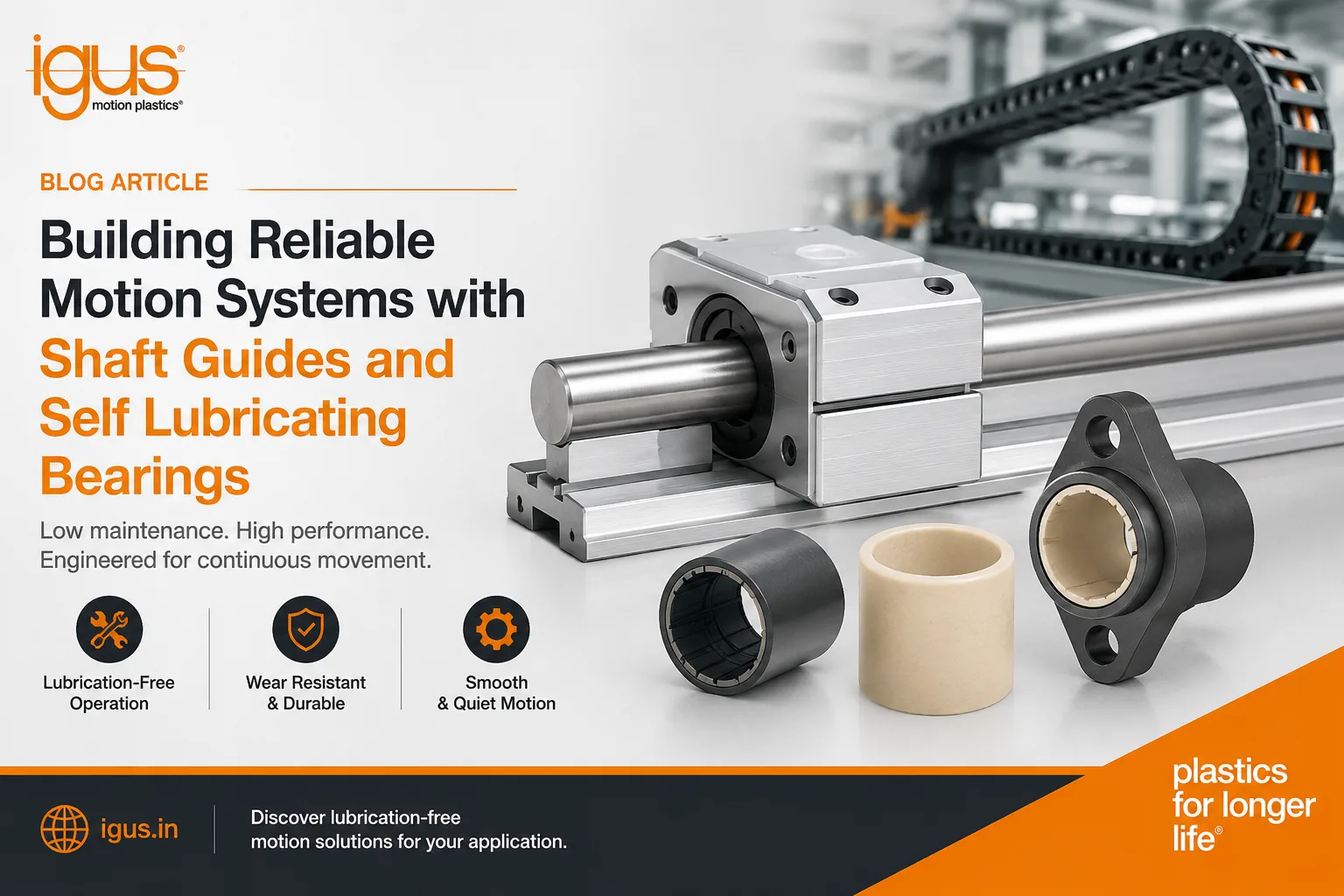
igus drylin R shaft guides are based on wear-resistant polymers and are designed for lubrication-free linear movement. The dimensions are compatible with standard shaft-guide arrangements, making them useful where engineers want an alternative to conventional rolling-element systems.
Why Shaft Guides Can Be Useful
One benefit of a shaft-guided arrangement is design flexibility. Engineers can select different shaft materials, diameters and bearing configurations according to the application.
The system can also be relatively lightweight compared with some conventional linear mechanisms.
Another advantage is operation in environments where grease or oil can attract dust and contamination. A dry-running solution can help avoid introducing additional lubricant into the moving interface.
How Plain Bearings Work
A plain bearing creates a sliding interface between moving components and is designed to reduce friction and wear.
Unlike rolling bearings, which use balls or rollers between surfaces, plain bearings work through sliding contact.
The material used for the sliding surface is therefore particularly important.
Modern engineering plastics can be formulated with properties that support low friction and wear resistance without requiring continuous external lubrication.
igus iglidur plain bearings are made from tribologically optimised high-performance polymers. According to the manufacturer's technical information, the materials contain solid lubricants that are released in very small quantities during operation, helping the bearing run without additional lubrication.
Benefits of Dry-Running Plain Bearings
Eliminating external lubrication can provide several practical benefits.
- Reduced routine maintenance
- No need for regular grease application
- Cleaner operation
- Lower risk of lubricant contamination
- Potentially simpler machine design
- Reduced maintenance access requirements
These characteristics can be valuable in machines where bearing points are difficult to access.
Material Selection Matters
Not every polymer bearing material behaves in exactly the same way.
Different applications can involve different loads, speeds, temperatures and environmental conditions. Engineers therefore need to select a material that matches the operating requirements.
For example, an application involving high temperatures may require a material with appropriate thermal resistance. A machine operating around water or chemicals may need a material with suitable media resistance.
Applications involving higher loads can also require specialised bearing materials.
Self-Lubrication and Maintenance Reduction
A self lubricating bearing can reduce the need for external lubrication by using materials containing solid lubricants within the bearing structure.
This can change the maintenance requirements of a machine.
Instead of scheduling regular lubrication at individual bearing points, engineers can use suitable dry-running components designed for the expected operating conditions.
Reducing lubrication requirements can be particularly useful in automated equipment with many bearing points.
Why Maintenance-Free Operation Can Matter
Maintenance activities can require machine access, production stoppages and technician time.
If a bearing point is located inside a guarded machine or difficult-to-reach assembly, lubrication can be inconvenient.
In such cases, a dry-running bearing solution can help simplify the maintenance strategy.
However, maintenance-free does not mean that the component can be selected without engineering analysis. Load, speed, temperature and environmental conditions still need to be considered when determining expected service life.
Contamination and Industrial Environments
Dust, dirt and other contaminants can affect mechanical components.
Traditional lubricated systems may collect particles around the lubricated interface, depending on the environment and machine design.
Dry-running polymer systems can offer advantages in applications where contamination is a concern.
igus states that its drylin R shaft guides use lubrication-free sliding elements that help push dirt away from the running surfaces of the shafts.
This can make the technology useful in machinery exposed to dust, particles or other challenging conditions.
Quiet and Smooth Movement
Noise can be an important consideration in equipment installed near operators or in indoor production environments.
Sliding polymer components can provide relatively quiet movement compared with some mechanical systems that use rolling elements.
This can be useful in laboratory equipment, inspection systems, office equipment and other applications where low operating noise is desirable.
However, the complete machine design still influences acoustic performance. Shaft surface quality, bearing clearance, load and movement speed can all affect the final result.
Designing the Shaft and Bearing Together
A linear bearing should not be selected independently from its mating shaft.
The shaft material, surface condition, diameter and hardness can all influence friction and wear.
Engineers should also consider the mounting arrangement.
Parallel shafts require particular attention because misalignment can introduce additional forces into the linear system.
Floating or self-adjusting bearing arrangements can help compensate for certain parallelism errors in suitable applications.
Load and Speed Considerations
Before selecting a bearing, engineers should define the expected operating conditions.
- Radial load
- Travel speed
- Acceleration
- Stroke length
- Operating temperature
- Environmental exposure
- Expected cycle count
These parameters influence bearing life and should be considered together rather than independently.
Applications in Industrial Equipment
Linear bearing technology can be applied across many industries.
Automation systems can use shaft-guided movement for positioning and handling. Packaging machines can use dry-running components in adjustment mechanisms. Laboratory equipment can benefit from low-maintenance linear movement. Material-handling equipment can use polymer guides where resistance to dirt and corrosion is important.
The flexibility of polymer materials also allows engineers to select different material grades for different operating conditions.
Reducing Total Maintenance Effort
Maintenance costs extend beyond the price of replacement parts.
Technicians need time to inspect, lubricate and replace components. Production equipment may need to be stopped during maintenance activities.
A lubrication-free bearing strategy can reduce some of these recurring activities.
This can be especially valuable when a machine contains many individual bearing points.
Designing for Long-Term Reliability
Reliable linear motion begins with correct component selection.
Engineers should evaluate the shaft, bearing material, housing and movement profile as one system.
The operating environment should also be included in the design calculation.
Testing and service-life calculation can provide additional information when the application involves demanding loads or high cycle counts.
Conclusion
Linear bearing technology can provide practical advantages for machines that require reliable movement with reduced maintenance.
A shaft guide can provide a compact method of guiding components along cylindrical shafts. Plain bearings can reduce friction through controlled sliding contact, while self-lubricating bearing materials can reduce dependence on external lubrication.
The most suitable solution depends on the application's actual requirements. Load, speed, temperature, contamination, shaft material, alignment and expected service life should all be evaluated before selecting the final design.
By considering these factors during the early stages of machine development, engineers can create linear motion systems that are easier to maintain, quieter in operation and better suited to long-term industrial use.