Recruitment in 2026 is about more than reviewing resumes and scheduling interviews. Artificial intelligence is changing how candidates apply for jobs, how recruiters evaluate applications, and how organizations identify people with the right skills. While these developments can help hiring teams work more efficiently, they also raise important questions about candidate authenticity, assessment quality, and fairness.
For HR professionals, the challenge is to benefit from new technology without losing sight of what recruitment is meant to achieve: finding people who can perform the job effectively.
This is where AI in recruitment becomes especially relevant. Modern hiring requires more than polished applications. Recruiters need meaningful evidence of a candidate's abilities, supported by structured assessments and informed human judgment.
1. Recruitment Is Moving Beyond Resume Screening
Resumes remain useful for understanding a candidate's employment history, qualifications, and experience. However, generative AI can help applicants produce professional summaries, improve their wording, and tailor their applications to individual vacancies.
As a result, a well-written resume may not always provide enough evidence of practical ability.
Recruiters can respond by combining resume reviews with job-related assessments, structured interviews, and relevant work samples. These methods help employers explore whether applicants can apply their knowledge in realistic situations.
HireValid supports this approach through assessments designed to evaluate cognitive ability, practical skills, technical knowledge, and language proficiency. Recruiters can use the results as an additional source of evidence when deciding whom to interview.
2. AI Is Changing the Meaning of Candidate Assessment
Candidate assessments have traditionally helped employers measure skills before making hiring decisions. Today, those assessments must account for the fact that applicants may have access to AI assistants while completing online tasks.
This does not mean every use of AI should be prohibited. Some jobs require employees to work with AI tools, and candidates may reasonably use them when an employer explicitly permits it.
The important distinction is between authorized assistance and undisclosed help that conflicts with the assessment rules.
HR teams should establish clear instructions before testing begins. They should explain which tools are allowed, what skills are being measured, and whether candidates are expected to complete tasks independently.
HireValid combines job-relevant tests with assessment-integrity signals, helping recruiters examine both candidate performance and the context in which the assessment was completed.
3. Skills-Based Hiring Is Becoming a Practical Priority
Hiring based mainly on qualifications or years of experience can leave gaps in the evaluation process. Two applicants may have similar backgrounds but demonstrate different levels of proficiency when performing the same task.
Skills-based hiring gives employers another way to compare candidates against the actual requirements of a role.
For example:
- A customer support applicant may complete a situational judgment assessment.
- An administrative candidate may demonstrate spreadsheet and attention-to-detail skills.
- A software applicant may complete a programming assessment.
- A role involving international communication may require an evaluation of workplace language proficiency.
HireValid offers assessments across several of these categories, allowing employers to select tests that fit the position rather than relying on a generic evaluation for every vacancy.
For HR teams, the key is to select assessments that measure relevant job requirements and interpret the results alongside other evidence.
4. Protecting Assessment Integrity Without Making Hiring Unfair
One of the most significant challenges in AI-assisted recruitment is determining whether an assessment reflects a candidate's own abilities.
A candidate might receive unauthorized assistance from a chatbot or another digital tool. However, an unusual event during a test does not automatically prove misconduct. A notification, connectivity issue, or accessibility tool can also affect a candidate's activity.
HireValid uses multiple signals to help recruiters review assessment attempts. Depending on the test configuration, these may include tab changes, pasted text, unusually fast responses, full-screen exits, and optional camera checks with appropriate notice and consent.
The purpose of these signals is to provide context for review, not to replace the recruiter's judgment.
A fair process should allow recruiters to investigate concerns, ask candidates reasonable follow-up questions, and consider explanations before making decisions.
5. Using Assessment Data to Improve Shortlisting
Recruiters frequently face high application volumes, particularly when advertising popular vacancies. Reviewing every applicant through multiple interview rounds may be impractical.
Structured assessments can help organize candidate information and reveal which applicants demonstrate the skills required for the role. This can give hiring managers a clearer starting point for shortlisting.
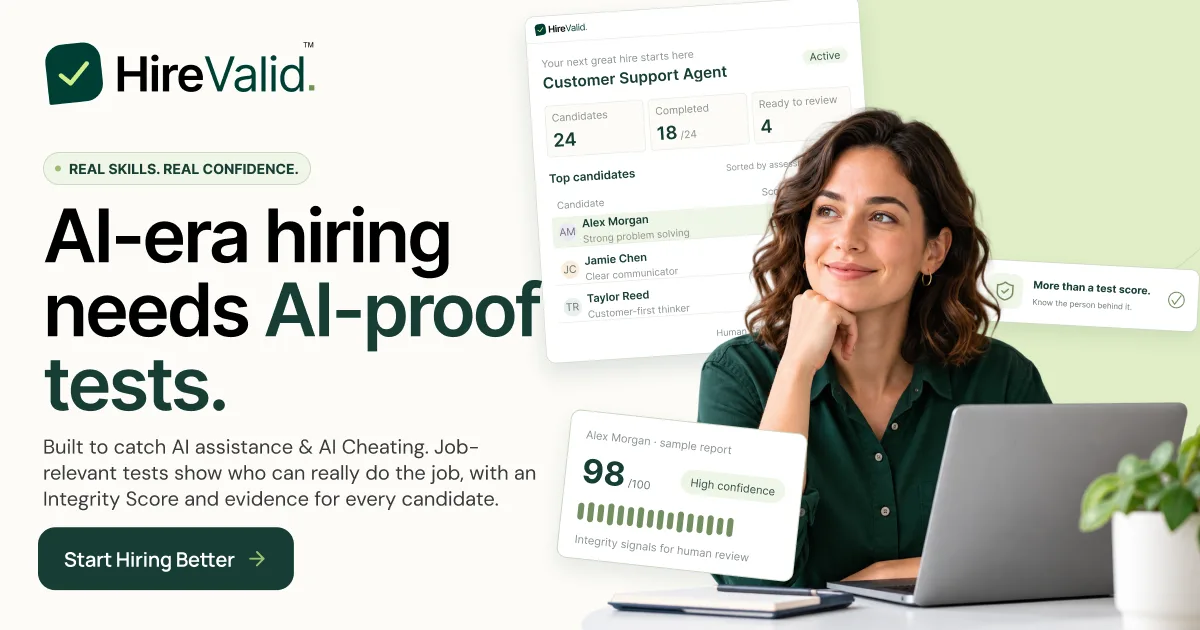
HireValid presents assessment results alongside an Integrity Score and related evidence. Recruiters can review this information to identify strengths, understand potential concerns, and prepare relevant interview questions.
Nevertheless, an assessment score should not be the sole basis for hiring. Experience, communication, motivation, relevant qualifications, and the ability to work with a team may also matter.
The most useful recruitment process combines consistent assessment criteria with a broader understanding of each candidate.
6. Human Judgment Still Matters in AI-Assisted Hiring
AI-enabled tools can help organize information and highlight patterns, but they cannot fully capture every quality that matters in a workplace.
A candidate might perform poorly because of an unfamiliar test format, a technical interruption, or an accessibility barrier. Another candidate might achieve a strong score but struggle to explain their approach during an interview.
These situations demonstrate why recruiters should evaluate evidence in context.
HireValid's published approach keeps the final decision with a person. Its integrity signals are intended to support review rather than automatically reject candidates.
For HR professionals, this means using technology to improve the quality of decisions while maintaining accountability, consistency, and appropriate opportunities for candidates to explain their performance.
7. Candidate Experience Is Part of Recruitment Quality
An efficient hiring process should also be understandable and respectful. Candidates need clear instructions, realistic expectations, and information about what an assessment involves.
Employers can improve the experience by communicating the purpose of each test, explaining permitted tools, providing practice questions where appropriate, and offering a route to request accommodations.
Recruiters should also explain any monitoring measures before an assessment begins. Where camera checks are used, candidates should receive appropriate notice and consent arrangements.
HireValid's assessment approach includes candidate instructions and a way for applicants to raise accommodation needs with the employer. These measures help make the process clearer for candidates while supporting consistent evaluation.
8. What HR Teams Should Do Next
Organizations do not need to automate their entire recruitment process to benefit from AI-related tools. A better starting point is to identify the areas where additional evidence or improved workflow would make the greatest difference.
HR professionals can begin with these steps:
- Review which stages of recruitment consume the most time.
- Identify the essential skills required for each role.
- Select assessments that directly measure those skills.
- Define acceptable and unacceptable AI use in advance.
- Establish consistent criteria for reviewing results.
- Investigate integrity concerns rather than assuming misconduct.
- Protect candidate information and explain assessment practices.
- Monitor hiring outcomes to identify possible inconsistencies or unfair barriers.
These actions can help employers build a recruitment process that uses technology purposefully rather than adopting tools simply because they are available.
Conclusion
AI is changing recruitment by influencing how candidates prepare applications, complete assessments, and demonstrate their abilities. For HR professionals and recruiters, the opportunity lies in using technology to gather better evidence while maintaining a fair and transparent hiring process.
AI in recruitment is most valuable when it supports better decisions rather than replacing human judgment. By combining job-related skills assessments, clear assessment rules, careful integrity reviews, and structured interviews, organizations can develop a more reliable understanding of candidate suitability.
HireValid helps recruiters bring these elements together through skills testing and assessment-integrity evidence. Ultimately, successful recruitment in 2026 is not simply about processing applications faster. It is about making informed hiring decisions based on relevant skills, credible evidence, and a fair evaluation of every candidate.