
How does an rfid tag work? An RFID tag works by receiving radio frequency energy from an RFID reader, activating its chip, and transmitting stored identification data back through electromagnetic signals. Unlike barcode systems, RFID tags can be read without direct alignment, enabling fast automatic identification in industrial, retail, logistics, and asset tracking environments.
Understanding the Basic Working Principle of an RFID Tag
From years of working with RFID deployment projects, I have found that the most common misunderstanding is treating an RFID tag as a simple “wireless barcode.” It is not. An RFID tag is a miniature electronic identification device containing an antenna and an integrated circuit (IC) that communicates through radio waves.
At Cykeo, our RFID engineers have tested tags and readers in environments ranging from European manufacturing workshops to warehouse corridors where metal interference, dense inventory, and moving vehicles affect reading performance. The difference between a laboratory test and a real deployment often comes down to antenna design, frequency selection, tag orientation, and reader configuration.
An RFID system usually contains three essential components:
ComponentFunctionRFID TagStores identification data and communicates with readersRFID ReaderSends radio frequency signals and receives tag responsesSoftware PlatformProcesses tag information for tracking and managementWhen an RFID reader sends an electromagnetic signal, the RFID tag antenna captures the energy. Passive RFID tags use this energy to power their chip temporarily. The chip then processes stored information and sends a response containing its unique identifier.
How RFID Tags Communicate With Readers
how RFID tags communicate with readers
The communication process happens within milliseconds, but several technical steps occur in sequence.
- Reader generates radio frequency energy
The RFID reader creates a radio field through its antenna. - Tag receives and activates
Passive RFID tags do not contain batteries. They harvest energy from the reader signal through electromagnetic coupling. - Chip processes stored information
The RFID integrated circuit retrieves stored data, usually including an Electronic Product Code (EPC) or unique identification number. - Tag sends a response signal
The tag reflects or transmits a modified signal back to the reader. - System converts data into usable information
The software platform links the RFID identity with inventory, assets, personnel, or operational records.
According to the RFID industry association GS1, EPC-enabled RFID technology is designed to provide unique identification for physical objects across global supply chains. GS1 explains that EPC RFID allows organizations to identify individual items rather than only product categories.
Passive RFID Tag vs Active RFID Tag: What Is the Difference?
passive RFID tag technology
Not all RFID tags operate the same way. During project design, selecting the correct tag type is often more important than choosing the reader itself.
RFID TypePower SourceTypical RangeCommon ApplicationsPassive RFID TagPowered by reader signalSeveral centimeters to more than 10 meters depending on frequency and antennaInventory, retail, tools, logisticsActive RFID TagInternal batteryTens to hundreds of metersVehicle tracking, large asset monitoringSemi-passive RFID TagBattery-assisted chipLonger range with sensor capabilityCold chain, industrial monitoringThe majority of supply chain RFID deployments use passive UHF RFID technology because it provides a balance between cost, reading speed, and scalability.
According to a report from Auburn University RFID Lab, RFID technology has demonstrated extremely high read accuracy in controlled supply chain environments, especially when compared with manual inventory processes.
Real Field Experience: Why RFID Tag Performance Changes in Real Environments
During an RFID installation for industrial tool tracking, I observed a situation that rarely appears in product brochures. The RFID tags could be read perfectly on a testing table, but performance dropped when tools were placed inside metal drawers.
The reason was simple: metal surfaces changed the electromagnetic environment.
This is why professional RFID solutions often require:
- On-metal RFID tags for metal equipment
- Correct antenna polarization settings
- Reader power adjustment
- Optimized tag placement
- Environmental testing before deployment
A successful RFID project is not only about reading distance. It is about maintaining reliable identification when products move, rotate, stack, or enter complex environments.
Cykeo engineers typically evaluate:
- Tag material compatibility
- Frequency requirements
- Reader installation position
- Required reading speed
- Data integration method
This practical approach helps companies avoid the common mistake of selecting RFID hardware based only on maximum advertised distance.

An RFID reader activates tagged products and captures identification data automatically in a modern industrial environment.
How Far Can RFID Tags Be Read?
UHF RFID tag working principle
Reading distance depends on:
- RFID frequency
- Antenna design
- Reader output power
- Tag sensitivity
- Installation environment
For UHF RFID systems operating under EPC Gen2 standards, professional fixed readers can often achieve several meters of reading distance, while specialized systems may extend beyond 10 meters under suitable conditions.
The UHF RFID standard is defined under EPCglobal Class 1 Gen 2 / ISO 18000-63 specifications, which describe air interface communication between readers and tags.
Cykeo UHF RFID solutions support industrial applications where multiple tags need to be identified quickly, including warehouse inventory, tool management, and production tracking.
RFID Tag Applications Across Industries
RFID tracking system applications
RFID tags are now used in many industries because they remove manual identification steps.
IndustryRFID ApplicationManufacturingProduction tracking and work-in-process managementLogisticsPallet and shipment identificationRetailInventory visibility and loss preventionHealthcareMedical equipment trackingAviationTool and maintenance managementLibrariesAutomated borrowing and inventoryOne important insight from deployment experience: RFID creates value not because it replaces human workers, but because it removes repetitive counting and searching tasks. Employees spend less time locating assets and more time managing operations.
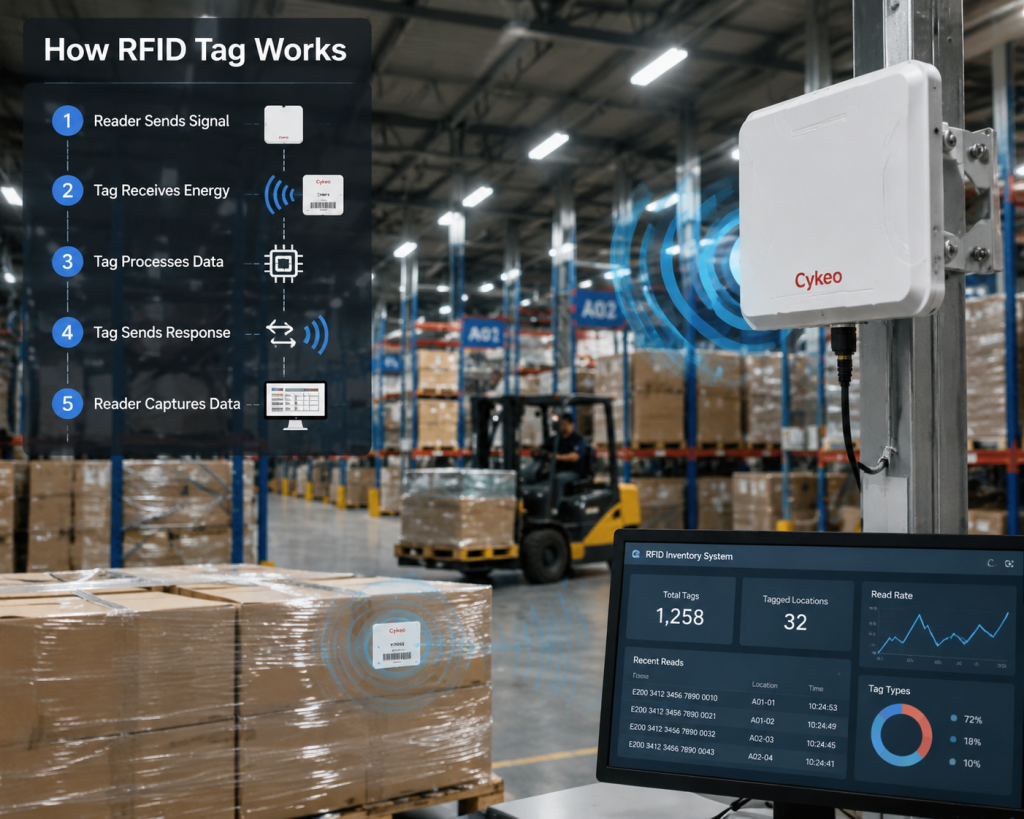
A Cykeo RFID system demonstrates how RFID readers communicate with tagged items, capture identification data, and enable real-time inventory visibility in smart logistics operations.
FAQ About How RFID Tags Work
Do RFID tags need batteries?
Most passive RFID tags do not require batteries. They receive energy from the RFID reader signal and activate only during communication.
Can RFID tags be tracked everywhere?
No. RFID tags are not GPS devices. They can only be detected when they are within range of a compatible RFID reader.
Are RFID tags reusable?
Some RFID tags can be rewritten multiple times, while others are designed for permanent identification depending on the chip type and application.
Can RFID work through metal?
Standard RFID tags usually perform poorly on metal surfaces. Specialized anti-metal RFID tags are designed with additional shielding materials to improve performance.
Why Cykeo RFID Solutions Improve Real-World RFID Deployment
At Cykeo, RFID development focuses on practical engineering rather than theoretical performance numbers. Our solutions combine RFID readers, tags, software interfaces, and application experience to support demanding environments.
From industrial workshops where tools disappear between shifts to warehouses managing thousands of items daily, RFID technology works best when hardware selection matches the actual operating environment.
How does an rfid tag work? It works by transforming radio frequency energy into digital identification communication, allowing physical objects to become connected, searchable, and manageable in modern intelligent systems.