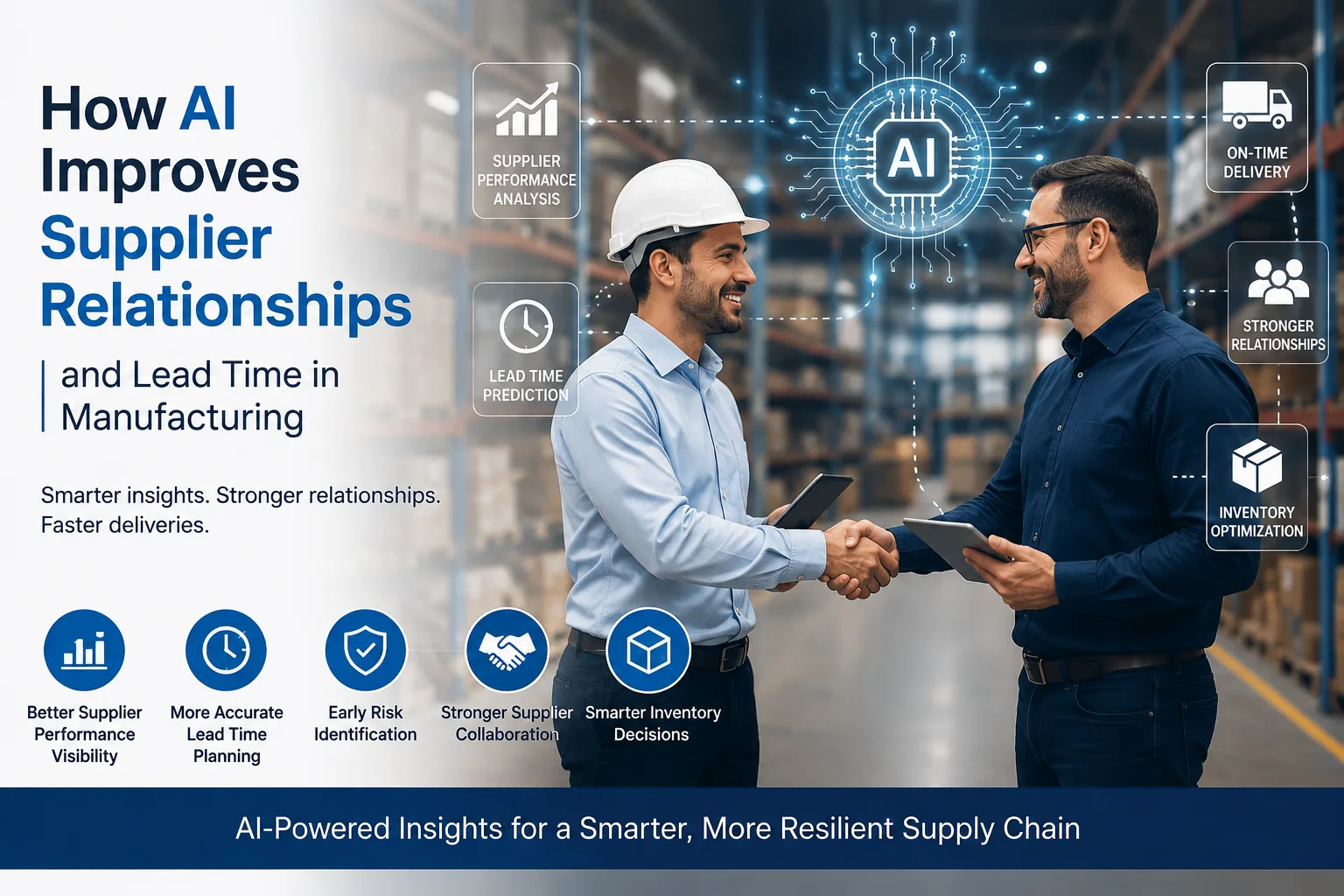
For manufacturers, supplier performance has a direct impact on production schedules, inventory levels, and customer deliveries. A supplier delay can create a shortage of critical materials, while unreliable lead-time estimates can make production planning more difficult.
AI for inventory management can help manufacturers use historical purchasing, inventory, delivery, and supplier-performance data to identify patterns and make more informed procurement decisions. AI can support supplier management, replenishment, demand forecasting, and lead-time analysis.
1. Better Visibility Into Supplier Performance
Manufacturers often evaluate suppliers using basic measures such as price and delivery dates. AI can analyze a broader range of information, including actual delivery times, promised dates, quality performance, order history, and delivery consistency.
This creates a more detailed view of supplier reliability. Instead of relying only on an average lead time, businesses can identify suppliers whose delivery performance is becoming less predictable.
With AI inventory management solutions, manufacturers can use these insights to support better purchasing and inventory decisions.
2. More Accurate Lead-Time Planning
Supplier lead times can change because of production capacity, material availability, logistics issues, or changes in demand. Using one fixed lead-time value for every planning decision can therefore create problems.
AI can analyze historical supplier performance and changing conditions to estimate lead-time risk more dynamically. It can identify patterns such as a supplier consistently taking longer during certain periods or a recent increase in delivery delays.
This information can help procurement teams adjust planning before a delay affects production.
3. Identifying Supplier Risks Earlier
AI can continuously analyze procurement and inventory information to identify potential supply risks.
For example, the system may detect that:
- A supplier's delivery performance is declining.
- A critical component has a long and increasingly variable lead time.
- Inventory is approaching a level that may not cover upcoming production.
- A single supplier is responsible for an important material.
Early identification gives procurement teams more time to contact suppliers, adjust orders, increase appropriate safety stock, or evaluate alternative sources.
4. Improving Supplier Communication
Supplier relationships depend on timely and accurate communication. Procurement teams may spend considerable time requesting delivery updates, confirming purchase orders, and following up on delayed shipments.
AI-powered workflows can help organize these activities by identifying which supplier interactions require attention and prioritizing them according to production impact.
For example, a delay involving a non-critical material may require less urgent action than a delayed component needed for an important production order. AI can help teams focus their attention where it matters most.
5. Supporting Better Inventory Decisions
Supplier reliability and inventory planning are closely connected. A highly reliable supplier may require less protective inventory than one with unpredictable delivery performance.
AI can combine supplier reliability, demand patterns, current inventory, and lead-time information to support more appropriate reorder points and safety-stock decisions.
This can help manufacturers balance two competing risks: carrying too much inventory and running out of materials when production needs them.
6. Building Stronger Supplier Relationships
AI does not replace supplier relationships. Instead, it can give procurement teams better information for managing those relationships.
With clearer performance data, manufacturers can have more productive discussions with suppliers about delivery reliability, quality issues, capacity constraints, and improvement opportunities.
The result can be a more data-driven supplier-management process rather than relying mainly on manual follow-ups or individual experience.
7. Connecting AI With Existing ERP Systems
The value of AI increases when inventory and supplier information is connected with existing ERP or procurement systems. This allows AI to work with current purchase orders, inventory movements, supplier records, and production requirements.
A data-driven inventory management approach can then help manufacturers connect demand forecasting, supplier performance, replenishment, and lead-time planning into a more coordinated process.
Conclusion
AI can improve supplier relationships and lead-time management by providing better visibility into supplier performance, identifying risks earlier, improving planning, and helping procurement teams prioritize the issues that can have the greatest operational impact.
For manufacturers, the goal is not simply to use AI for forecasting. It is to connect inventory, supplier, demand, and lead-time intelligence so procurement decisions are based on current and historical operational data. When implemented with reliable data and appropriate human oversight, AI can become a practical tool for creating more responsive and resilient supply chains.