Growth is supposed to feel good. But for a lot of businesses, the moment things start taking off is also the moment their infrastructure starts falling apart.
The website slows down. The checkout page times out. Customer support starts fielding complaints that have nothing to do with the product — and everything to do with the server struggling to keep up. Cloud hosting for growing businesses exists to solve exactly this problem before it becomes a costly crisis.
If your business is scaling and your hosting still lives on a single shared server from three years ago, this is worth your full attention.
What Makes Cloud Hosting Different From Traditional Hosting
Traditional hosting puts your website on one physical server. When that server struggles, your site struggles — there's no redundancy built into the architecture, just a single point of failure sitting between you and your customers.
Cloud hosting distributes your workload across a network of interconnected servers. Resources are generally virtualised, redundant, and managed carefully. If any one of the nodes deals with an issue, then traffic is automatically rerouted to the properly working infrastructure. This fundamentally changes the reliability profile of your online presence.
That architectural difference is what makes cloud hosting solutions the default choice for businesses that are serious about sustainable growth. You're not just buying server space. You are buying a system engineered to meet your business needs.
Elastic Scaling: Pay for What You Use in Real-Life
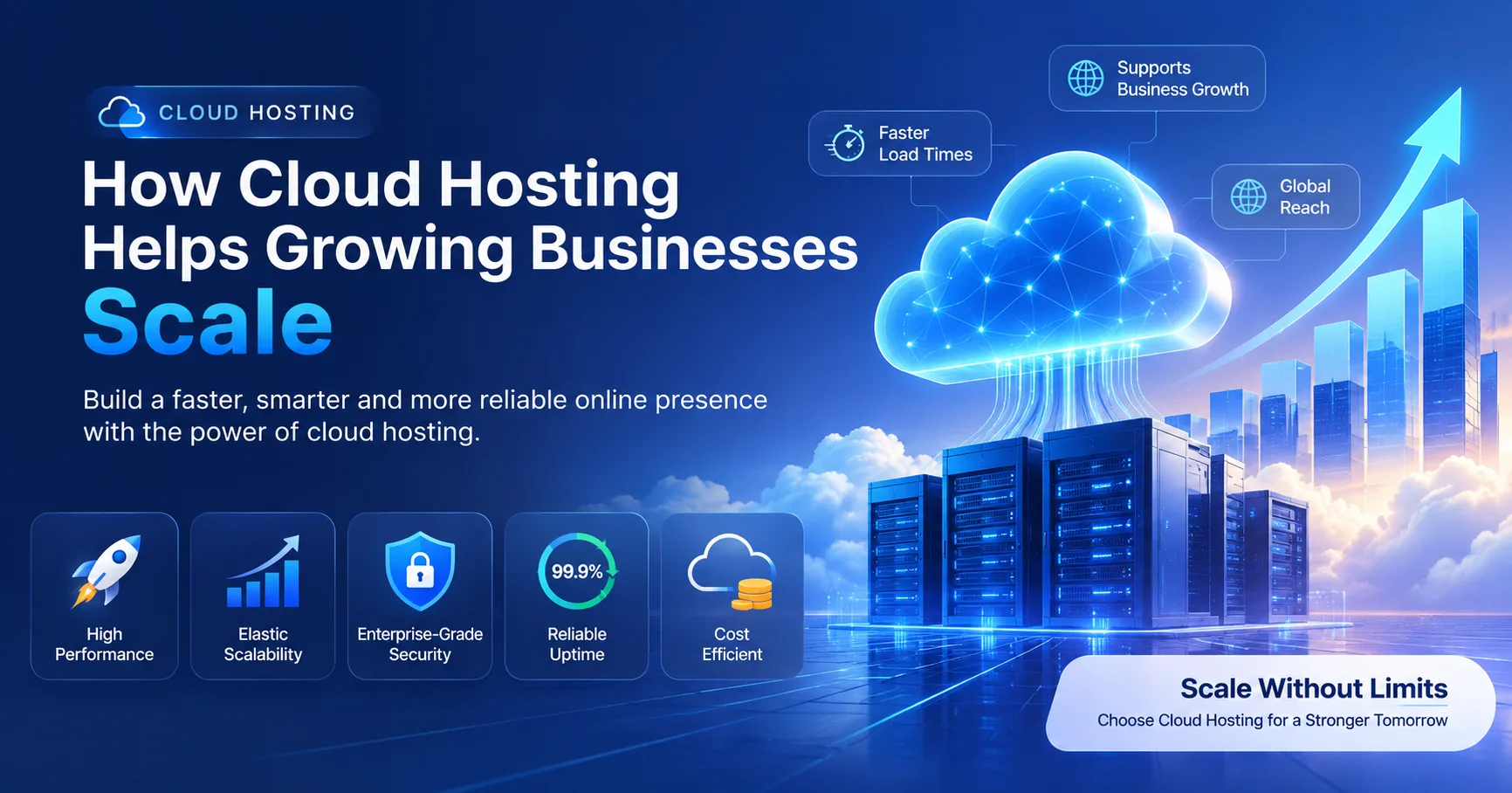
One of the most noteworthy benefits of cloud hosting for growing businesses is elastic scaling — the ability to automatically scale or contract resources as per real-time demand.
Here's the scenario most growing businesses face: traffic is unpredictable. You have busy seasons and quiet ones, campaign spikes and organic lulls. Provisioning for peak load on traditional hosting means overpaying during slow periods. Under-provisioning means your site goes down exactly when you need it most.
This is especially critical for cloud hosting for high-traffic websites — e-commerce stores during sale seasons, SaaS platforms during onboarding surges, and media sites during breaking news cycles. The businesses that handle these moments without a hiccup aren't luckier. They're better prepared at the infrastructure level.
Uptime Is a Revenue Metric
Every hour your website is down has a direct cost — lost sales, lost leads, and damaged trust that takes far longer to rebuild than the outage itself.
Reliable cloud hosting services typically deliver 99.9% uptime guarantees backed by redundant infrastructure: multiple data centres, automatic failover systems, and intelligent load balancing. Compare that to shared hosting, where one overloaded account on the same physical server can drag your performance down without any fault of your own.
For growing businesses, uptime isn't a technical metric to track in a dashboard. It's a revenue metric that shows up directly in your monthly numbers.
Performance Drives Conversions
Speed matters more than most businesses realise. Research consistently shows that a one-second delay in page load time can reduce conversions by approximately 7%. For a business generating $50,000 a month in online revenue, that single second costs roughly $3,500 monthly — from a problem that the right cloud hosting provider directly solves.
Cloud hosting solutions deliver performance through geographic server distribution, NVMe SSD storage, and optimised network routing. A quality cloud hosting provider also offers built-in CDN integration and caching layers that ensure fast delivery regardless of where your users are located — an increasingly important factor as businesses grow into international markets.
Security That Grows With Your Business
Growing businesses become more attractive targets. More clients refer to more sensitive data, and more information means higher stakes when something goes wrong.
Comprehensive cloud hosting services consist of DDoS mitigation, automated backups, SSL certificates, and firewalls that update on time to address growing threats. The main difference with quality cloud hosting is that security is added into the infrastructure layer — not sold as a premium add-on after you've already signed up.
A serious cloud hosting provider treats security as a baseline, not a feature tier.
Cost Efficiency at Every Growth Stage
One of the persistent myths about cloud hosting for growing businesses is that it's inherently more expensive than traditional options. In practice, the economics work the other way when you account for the full picture.
Shared hosting is cheap until your traffic outgrows it — and when it does, the migration is disruptive and expensive. Dedicated servers generally provide raw performance but need upfront hardware commitment and constant technical support. Cloud hosting occupies the practical middle ground: enterprise-grade infrastructure priced around actual usage rather than anticipated peak capacity.
Infinitive Host has built its cloud hosting solutions around transparent, predictable pricing designed for businesses in active growth phases. Their cloud hosting services span entry-level deployments through to high-availability production environments — without forcing you to over-engineer from day one.
Choosing the Right Cloud Hosting Provider
Not all cloud hosting is created equal. When evaluating a cloud hosting provider, these are the questions that separate genuinely scalable infrastructure from marketing copy:
- Does the platform scale automatically, or does scaling require manual intervention and a support ticket?
- What does the uptime SLA actually cover — and what compensation exists when it falls short?
- Is technical support available in real time, or are you waiting in a queue at the worst possible moment?
- Does the pricing model become more or less cost-effective as you grow?
Infinitive Host is built around these exact considerations — making it a natural fit for businesses that need cloud hosting for high-traffic websites, cost predictability, and infrastructure that performs under real growth pressure.
Conclusion
Scaling a business is hard enough without your infrastructure creating friction at every stage. The right cloud hosting for growing businesses removes that friction — delivering the uptime, performance, and scalability that growth actually requires.
Cloud hosting is not simply a technical decision. It is a strategic one. Brands that invest heavily in the right cloud hosting solutions early are engineered on a foundation that supports momentum instead of one that limits it.
If your present setup is already showing strain, the cost of staying put is higher than the cost of migration. Infinitive Host offers cloud hosting services built mainly for this stage — flexible, secure, and structured to scale alongside your business rather than hold it back.
The infrastructure decisions you make today will directly shape the growth you can sustain tomorrow.