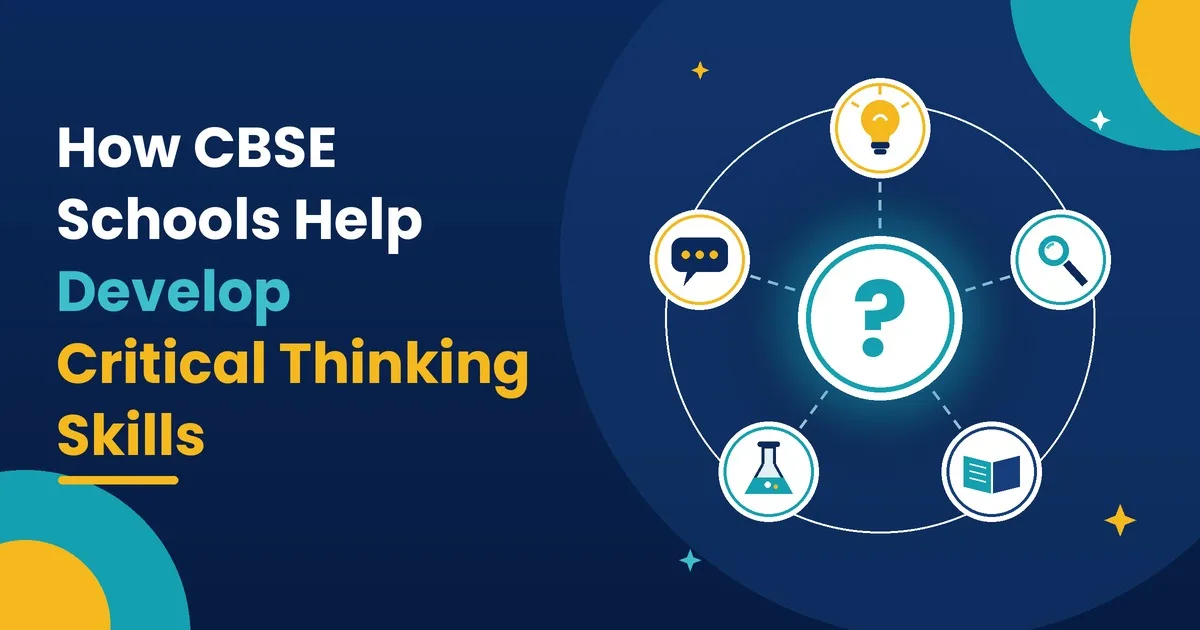
Education is not just about learning lessons, memorising answers, or scoring good marks in examinations. It is also about helping children understand the world around them, ask questions, and find solutions to everyday problems. Critical thinking is one of the most important skills students can develop during their school years. It allows them to examine information, think independently, and make sensible decisions.
The CBSE curriculum encourages students to understand concepts, apply their knowledge, and participate in different learning activities. This is one reason many parents explore CBSE schools in Bangalore when choosing a school for their children. A supportive learning environment can help students become curious learners who are confident enough to ask questions, explore ideas, and learn from their mistakes.
What Is Critical Thinking and Why Does It Matter?
Critical thinking is the ability to look at information carefully, understand different viewpoints, and arrive at a logical conclusion. Instead of accepting everything they hear or read, students learn to ask questions and consider the reasons behind an answer.
For example, when a student learns about environmental pollution, critical thinking encourages them to understand its causes, examine its effects, and think about possible solutions. This makes learning more meaningful than simply memorising facts from a textbook.
These skills are useful in every subject, from Mathematics and Science to English and Social Studies. They also help children become better problem-solvers, communicate their ideas clearly, and make thoughtful decisions as they grow older.
Encouraging Students to Ask Questions
One of the simplest ways to develop critical thinking is to encourage children to ask questions. When students understand that asking questions is a natural part of learning, they become more interested in discovering how things work.
CBSE classrooms can support this approach through discussions, classroom activities, and interactive lessons. Instead of providing answers immediately, teachers can encourage students to think about a problem and explain their reasoning.
For instance, during a Science lesson, a teacher might ask students why certain objects float while others sink. Students can share their ideas, discuss their observations, and understand the scientific principles behind the answer.
This approach helps children become active participants in their education. Parents comparing the top best CBSE schools in Bangalore can look for schools where teachers encourage curiosity and create opportunities for students to express their thoughts.
Learning Through Practical Activities
Children often understand concepts better when they can connect classroom lessons with real-life experiences. Practical learning activities allow students to explore ideas, test their understanding, and discover solutions through observation.
Science experiments, Mathematics activities, classroom projects, and environmental studies are useful examples. When students conduct an experiment, they learn to observe what happens, compare results, and understand why a particular outcome occurs.
Project-based learning can also develop critical thinking. Students working on a project about water conservation, for example, may need to identify problems, collect information, discuss possible solutions, and present their findings.
Such activities help students understand that learning is not limited to textbooks. It also involves exploring questions, making connections, and applying knowledge to real situations.
Developing Problem-Solving Skills Through Mathematics and Science
Mathematics and Science provide many opportunities for students to develop logical thinking. Instead of focusing only on finding the correct answer, students can learn to understand the steps involved in reaching a solution.
In Mathematics, teachers can encourage students to solve a problem using different methods and explain why a particular approach works. This helps them recognise patterns, analyse information, and develop confidence when facing unfamiliar questions.
Science lessons can encourage students to form hypotheses, make observations, and draw conclusions from evidence. These experiences teach children to think carefully before accepting an explanation.
Parents exploring top ranked CBSE schools in Bangalore should consider how schools balance academic knowledge with opportunities for students to practise reasoning and independent problem-solving.
Group Discussions and Teamwork
Critical thinking also develops when students listen to different opinions and learn to consider other perspectives. Group discussions and collaborative activities give children opportunities to share their ideas, support their arguments, and respond respectfully to their classmates.
For example, students discussing the importance of reducing plastic waste may suggest different ways to protect the environment. By listening to one another, they can compare ideas and identify practical solutions.
Teamwork also teaches children that a problem may have more than one possible answer. They learn to evaluate suggestions, explain their choices, and work towards a common goal.
These experiences improve communication skills and help students become more open-minded. They also prepare children to work effectively with others in higher education and future careers.
How Teachers Support Independent Thinking
Teachers have an important role in helping students develop the confidence to think independently. A classroom that welcomes different ideas allows children to express their opinions without being afraid of making mistakes.
Rather than concentrating only on the final answer, teachers can ask students to explain how they reached a conclusion. This helps identify gaps in understanding and encourages them to think more deeply about a topic.
Regular feedback, classroom debates, presentations, and open-ended questions can make lessons more engaging. Teachers can also help students distinguish between reliable information and unsupported claims, an increasingly important skill when children use digital resources.
When parents compare CBSE schools in South Bangalore, they can ask about teaching methods, classroom participation, practical activities, and opportunities for students to develop independent thinking.
Choosing the Right CBSE School in Bilekahalli
The school environment can influence how children learn and develop their abilities. Parents looking at CBSE schools in Bilekahalli should consider more than academic results alone. Teaching practices, classroom facilities, extracurricular activities, and opportunities for practical learning can all contribute to a child's educational experience.
Presidency School Bangalore South provides parents with an option to explore when considering their child's schooling needs. Families can review the school's curriculum, learning environment, facilities, and student activities to understand how these align with their expectations.
A school that encourages curiosity, participation, and consistent learning can help children develop skills that support them both inside and outside the classroom. Parents should also consider whether the school provides a supportive atmosphere where students feel comfortable asking questions and learning from their experiences.
Conclusion
Critical thinking helps children become curious, independent, and confident learners. Through practical activities, classroom discussions, problem-solving exercises, and supportive teaching methods, CBSE schools can help students develop the ability to analyse information and make informed decisions.
When choosing among the top best CBSE schools in Bangalore, parents should look for an environment that values both academic learning and the development of essential life skills. With the right guidance and regular opportunities to explore ideas, children can build strong thinking skills that support their future education and everyday lives.