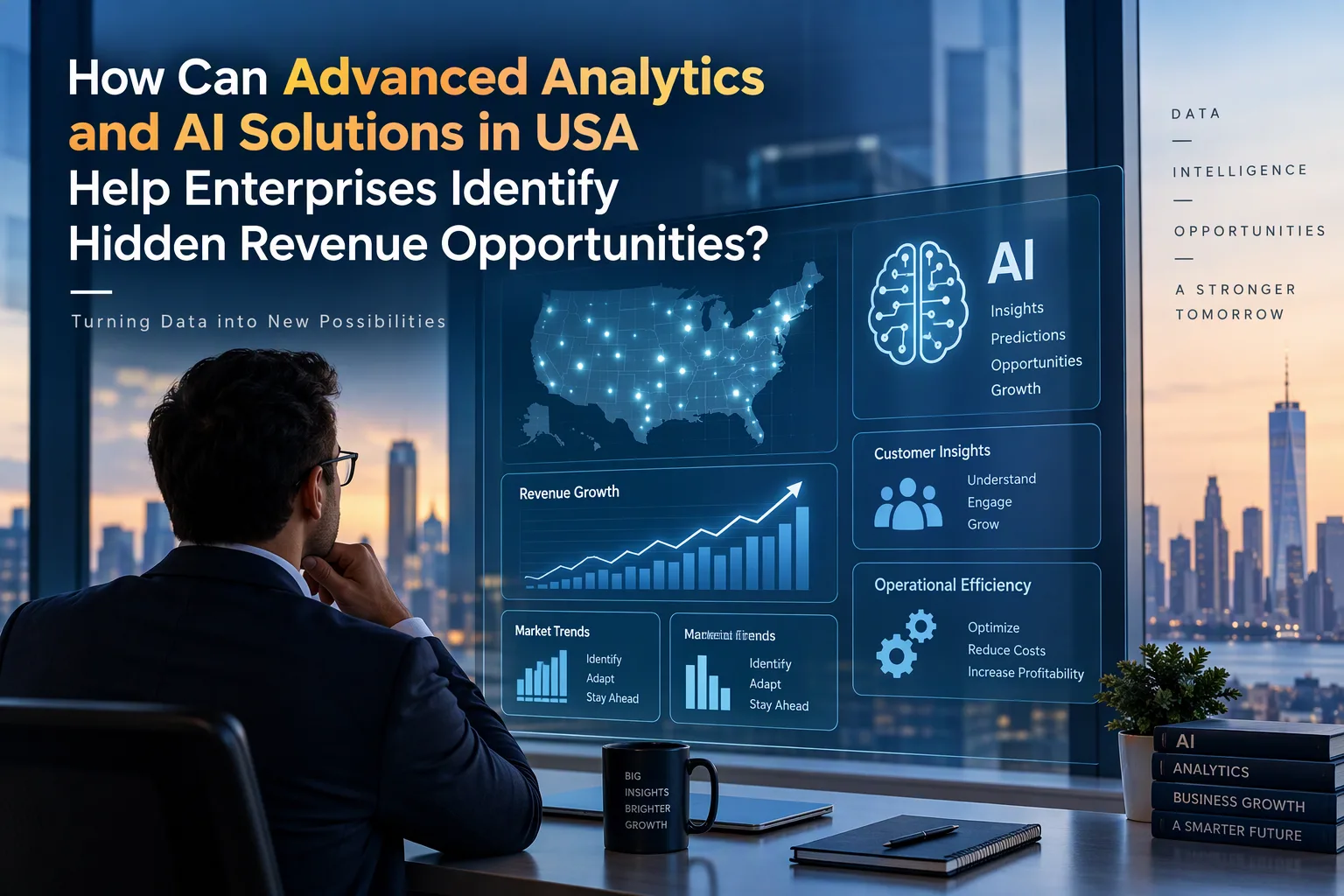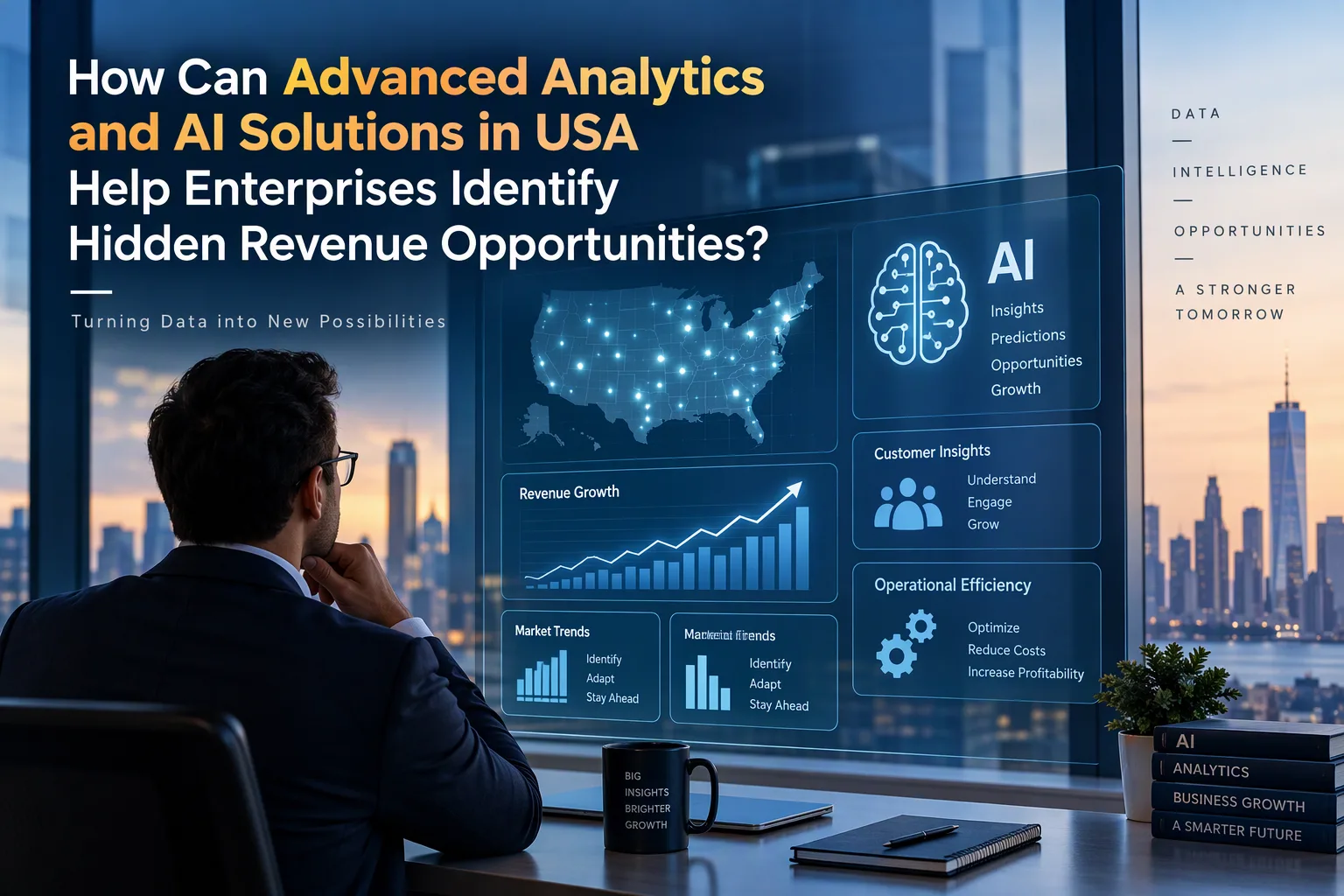
In today’s data-driven economy, organizations generate massive volumes of information from customer interactions, sales activities, supply chains, digital channels, and operational systems. However, much of this data remains underutilized. This is where Advanced Analytics and AI Solutions in USA are gaining attention, helping enterprises uncover patterns, inefficiencies, and growth opportunities that may otherwise remain hidden.
As artificial intelligence continues to evolve, businesses are moving beyond simple reporting and adopting predictive, prescriptive, and generative AI capabilities to identify new revenue streams, optimize pricing, improve customer retention, and enhance decision-making. According to industry trends, enterprises across sectors are increasingly investing in analytics platforms, machine learning models, and AI-powered intelligence systems to transform raw data into measurable business value.
Understanding Hidden Revenue Opportunities
Hidden revenue opportunities refer to untapped sources of income that organizations may not recognize through traditional reporting methods. These opportunities often exist in:
- Customer behavior patterns
- Product usage insights
- Pricing inefficiencies
- Cross-selling and upselling possibilities
- Supply chain optimization
- Operational cost reductions that improve profitability
- Emerging market trends
- Customer retention improvements
Many organizations possess the necessary data but lack the tools and analytical capabilities needed to identify actionable insights.
The Evolution of Analytics: From Reporting to AI-Driven Intelligence
Traditional business intelligence systems focused primarily on historical reporting. While useful, these systems often answered the question:
"What happened?"
Modern AI-powered analytics can answer:
- What is happening now?
- Why is it happening?
- What is likely to happen next?
- What actions should be taken?
This shift enables enterprises to proactively discover revenue opportunities before competitors do.
How Advanced Analytics Helps Identify Revenue Opportunities
1. Customer Segmentation Beyond Basic Demographics
Advanced analytics can analyze customer behaviors, purchasing habits, engagement levels, and product interactions.
Instead of grouping customers solely by age or location, AI systems can identify micro-segments such as:
- High-value repeat buyers
- Customers likely to upgrade services
- Users at risk of churn
- Customers interested in complementary products
These insights allow businesses to create targeted offerings that increase conversion rates and customer lifetime value.
Example
A software company may discover through analytics that customers using a specific feature set are significantly more likely to purchase premium support services. This insight can inform targeted recommendations and personalized marketing efforts.
2. Predictive Analytics for Revenue Forecasting
Predictive analytics uses historical and real-time data to forecast future outcomes.
Businesses can identify:
- Future demand patterns
- Seasonal fluctuations
- Emerging customer needs
- Potential sales opportunities
By recognizing opportunities early, organizations can allocate resources more effectively and avoid missing revenue-generating trends.
Recent advancements in machine learning have improved forecasting accuracy by incorporating variables such as market conditions, customer behaviors, and operational factors simultaneously.
3. Identifying Cross-Sell and Upsell Opportunities
AI systems can analyze purchasing patterns across thousands or millions of transactions.
Common discoveries include:
- Products frequently purchased together
- Customers likely to upgrade subscriptions
- Services that complement existing purchases
Recommendation engines used by major digital platforms have demonstrated how personalized suggestions can increase average order value and customer engagement.
For enterprises, similar models can be applied to B2B sales, financial services, healthcare solutions, and manufacturing environments.
4. Dynamic Pricing Optimization
Pricing remains one of the most influential factors affecting revenue.
Advanced analytics platforms can evaluate:
- Customer demand
- Competitor pricing
- Inventory levels
- Market conditions
- Purchase history
AI-driven pricing models help organizations determine the optimal price point that balances competitiveness and profitability.
In industries such as airlines, hospitality, retail, and e-commerce, dynamic pricing has become a core revenue optimization strategy.
How AI Helps Discover Revenue Opportunities Hidden in Customer Data
Real-Time Customer Journey Analysis
Modern AI systems can evaluate customer journeys across multiple touchpoints simultaneously.
This includes:
- Website visits
- Mobile applications
- Social media engagement
- Sales conversations
- Customer support interactions
By connecting these data points, organizations can identify moments where customers abandon purchases or encounter friction.
Reducing these barriers often leads directly to higher conversion rates and increased revenue.
Churn Prediction and Retention
Acquiring a new customer is often significantly more expensive than retaining an existing one.
AI models can detect warning signs such as:
- Reduced engagement
- Declining usage patterns
- Negative support experiences
- Changes in purchasing behavior
Organizations can then intervene with retention strategies before customers leave.
Even modest improvements in retention rates can have a substantial impact on long-term revenue growth.
Supply Chain and Operational Analytics as Revenue Drivers
Many companies focus exclusively on sales-related opportunities, but operational improvements can also contribute significantly to profitability.
Inventory Optimization
AI-powered analytics can identify:
- Overstock situations
- Slow-moving inventories
- Product demand patterns
- Procurement inefficiencies
Better inventory management reduces unnecessary costs and helps ensure high-demand products remain available when customers need them.
Resource Allocation
Analytics can reveal:
- Underperforming regions
- Capacity utilization gaps
- Workforce productivity trends
- Process bottlenecks
Addressing these inefficiencies increases operational effectiveness and improves overall profitability.
The Growing Role of Generative AI in Revenue Discovery
Generative AI has become one of the most important developments in enterprise technology over the last few years.
Organizations are now exploring how generative AI can:
- Analyze large volumes of unstructured data
- Summarize customer feedback
- Generate business insights
- Support strategic planning
- Enhance sales intelligence
Many enterprises are integrating generative AI capabilities into analytics platforms to help decision-makers identify opportunities faster than traditional methods.
Rather than replacing analysts, these systems often augment human expertise by reducing time spent on manual data analysis.
Industry Applications
Retail
Retailers use AI and analytics to:
- Forecast product demand
- Personalize customer recommendations
- Optimize promotions
- Improve pricing strategies
Manufacturing
Manufacturers leverage analytics for:
- Predictive maintenance
- Production optimization
- Supply chain visibility
- Quality improvement
Reduced downtime and improved efficiency can significantly impact profitability.
Financial Services
Financial institutions apply AI to:
- Customer segmentation
- Fraud detection
- Loan risk assessment
- Personalized financial products
These capabilities improve customer experiences while uncovering new revenue opportunities.
Healthcare
Healthcare organizations use advanced analytics to:
- Optimize resource allocation
- Improve patient engagement
- Predict care requirements
- Enhance operational efficiency
Technology and SaaS
Software companies increasingly use analytics to:
- Monitor product adoption
- Identify expansion opportunities
- Predict customer churn
- Improve subscription renewal rates
Key Technologies Driving Modern Analytics
Enterprises adopting Advanced Analytics and AI Services in USA typically rely on several technologies working together:
Machine Learning
Machine learning identifies patterns and generates predictions from historical data.
Natural Language Processing (NLP)
NLP enables analysis of:
- Customer reviews
- Support tickets
- Surveys
- Social media conversations
Predictive Analytics Platforms
These systems forecast future business outcomes based on historical trends and real-time information.
Cloud-Based Analytics
Cloud platforms provide scalable environments capable of processing massive datasets with greater flexibility and speed.
Real-Time Data Processing
Organizations increasingly require real-time intelligence rather than weekly or monthly reporting cycles.
Real-time analytics allows decision-makers to respond immediately to changing business conditions.
Important Limitations and Challenges
While AI and analytics provide significant opportunities, organizations should understand potential limitations.
Data Quality Issues
Poor-quality data can lead to inaccurate insights and unreliable predictions.
Common problems include:
- Missing information
- Duplicate records
- Data silos
- Inconsistent formats
Privacy and Regulatory Compliance
Enterprises must ensure responsible use of customer data while complying with privacy regulations and industry requirements.
Skills and Talent Gaps
Advanced analytics initiatives often require expertise in:
- Data science
- Machine learning
- Business intelligence
- AI governance
This remains a challenge for many organizations.
Model Bias and Explainability
AI systems may unintentionally produce biased outcomes if underlying datasets contain imbalances.
Organizations increasingly prioritize explainable AI to improve transparency and trust.
The Importance of AI and Advanced Analytics Consulting in USA
As analytics ecosystems become more complex, many enterprises seek guidance on strategy, implementation, governance, and integration.
The objective is not simply deploying AI tools but aligning analytics initiatives with measurable business outcomes.
Successful programs typically focus on:
- Clearly defined business objectives
- High-quality data foundations
- Cross-functional collaboration
- Ongoing performance monitoring
- Responsible AI practices
Organizations that treat analytics as a strategic capability rather than a standalone technology project tend to achieve more sustainable results.
Emerging Trends Shaping the Future
Several trends are influencing how enterprises identify hidden revenue opportunities:
Agentic AI Systems
Organizations are exploring AI agents capable of performing multistep analysis, generating recommendations, and assisting decision-making with minimal supervision.
Augmented Analytics
Analytics platforms increasingly automate data preparation, insight discovery, and reporting processes.
AI-Powered Decision Intelligence
Businesses are moving from descriptive reporting toward systems that recommend specific actions based on predictive outcomes.
Unified Data Platforms
Enterprises are consolidating fragmented data environments to improve visibility across departments and business functions.
Real-Time Revenue Intelligence
Organizations increasingly expect instant insight generation, enabling faster responses to market changes and customer needs.
Conclusion
Hidden revenue opportunities often exist within customer interactions, operational processes, pricing structures, and market behaviors. The challenge for many enterprises is not a lack of data but the ability to turn that data into meaningful action.
By leveraging Advanced Analytics and AI Solutions in USA, organizations can move beyond historical reporting and gain predictive, real-time, and AI-driven insights that reveal new growth possibilities. Whether through customer segmentation, dynamic pricing, churn prediction, operational optimization, or generative AI-assisted analysis, modern analytics technologies are reshaping how enterprises uncover value.
However, success depends on more than technology alone. High-quality data, responsible AI practices, skilled teams, and clear business objectives remain essential for transforming analytical insights into sustainable revenue growth. As AI capabilities continue to mature, enterprises that develop strong analytics foundations will be better positioned to identify opportunities, adapt to market shifts, and make more informed business decisions.