
Introduction
Technology has changed the way we communicate, work, learn, shop, and interact with the world around us. From smartphones and artificial intelligence to cloud computing and wearable devices, digital tools have become part of everyday life. Among these innovations, augmented reality (AR) is creating new ways to connect digital information with the physical world.
Unlike technologies that replace our surroundings with entirely virtual environments, augmented reality adds digital elements to what we already see. It can display navigation directions over a live camera view, allow customers to preview furniture in their homes, provide technicians with visual instructions, or help students explore complex subjects through interactive 3D models.
What once seemed like science fiction is now available through smartphones, tablets, smart glasses, and other connected devices. As hardware improves and software becomes more sophisticated, augmented reality is finding applications across industries and everyday activities.
But AR is not just about adding digital images to the real world. Its real value lies in making information easier to understand, helping people complete tasks, and creating more interactive experiences.
So, how is augmented reality changing the modern world, and what can we expect from this technology in the coming years? Let’s explore its growing role across different aspects of life.
1. Understanding Augmented Reality in Today’s World
Augmented reality is a technology that overlays digital content onto a person’s view of the physical environment. This content may include text, images, animations, 3D objects, instructions, or contextual information.
AR applications use cameras, sensors, location data, and software to connect digital elements with the user’s surroundings. Depending on the device and application, digital content may appear on a smartphone screen, through wearable glasses, or within a specialised display.
For example, a person shopping for furniture can use an AR application to see how a virtual sofa might look in their living room. Someone exploring an unfamiliar city may use an AR navigation feature to view directional indicators through their phone’s camera. A maintenance technician might see digital instructions positioned alongside the equipment they are repairing.
These experiences share a common principle: information appears in the context where it is useful.
It is also important to distinguish augmented reality from virtual reality (VR). VR generally immerses users in a computer-generated environment, while AR combines digital content with the real world. Mixed reality (MR) can go further by enabling digital objects to interact with or respond to the surrounding environment.
Although these technologies overlap in some applications, AR stands out for its ability to enhance real-world activities without necessarily removing users from their physical surroundings.
2. Augmented Reality Is Transforming Education
Education is one of the areas where augmented reality can make a meaningful difference. Traditional learning methods often depend on textbooks, diagrams, presentations, and verbal explanations. These approaches remain valuable, but some subjects are difficult to understand through two-dimensional materials alone.
AR provides another way to explore complicated ideas by turning abstract information into interactive visual experiences.
Imagine a student learning about the human heart. Instead of looking at a static diagram, the student could use an AR application to explore a three-dimensional model, examine its structures, and understand how different parts relate to one another.
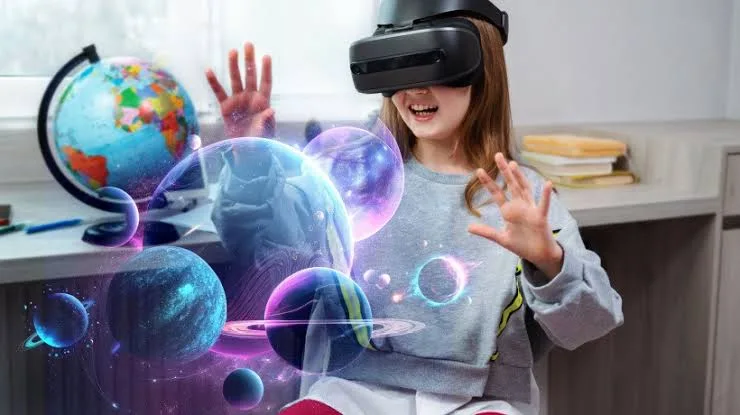
In science classes, AR can help visualise molecules, planetary systems, geological formations, and biological processes. In history lessons, students may explore digital reconstructions of historical objects or buildings while visiting museums or studying from home.
The technology can also support practical training. Students learning mechanical skills, engineering concepts, or equipment operation may benefit from visual demonstrations and guided exercises.
For teachers, AR offers opportunities to introduce interactive learning activities that encourage curiosity and participation.
However, successful educational AR requires more than impressive visuals. Content must be accurate, age-appropriate, accessible, and aligned with learning objectives. Devices and applications must also be available to students who need them.
When used alongside effective teaching methods, augmented reality can make difficult concepts more tangible and create additional opportunities for exploration.
3. Changing the Way People Shop
Shopping has become increasingly digital, but purchasing certain products online still involves uncertainty. Customers may struggle to judge the size of an item, imagine how furniture will fit into a room, or decide whether a particular colour or style suits them.
Augmented reality helps bridge this gap by allowing shoppers to preview products in their own surroundings.
Furniture retailers, for example, can offer applications that place virtual chairs, tables, and sofas inside a customer’s home. The shopper can move around the room, examine the product from different angles, and assess its approximate size and appearance.
Beauty and fashion brands use AR-based virtual try-on features to let customers experiment with makeup, eyewear, and selected accessories. Some applications can overlay products on a live camera view, giving users a better idea of how different options might look.
AR can also improve in-store shopping. Customers may use compatible applications to access product details, view demonstrations, or interact with digital displays.
For businesses, these experiences can make online product discovery more engaging and help customers make more informed decisions.
Nevertheless, virtual previews are not always perfectly accurate. Lighting, camera calibration, device capabilities, and product modelling can affect how an item appears. AR should therefore complement clear product descriptions, accurate measurements, and realistic photographs rather than replace them.
As the technology develops, retailers will continue exploring ways to make product discovery more interactive and personalised.
4. Improving Healthcare and Medical Training
Healthcare professionals work in environments where accurate information, careful planning, and effective communication are essential. Augmented reality offers several ways to support these requirements.
One application is medical education. Students can use AR to explore anatomical structures through three-dimensional visualisations, helping them understand the relationships between organs, muscles, bones, and other body systems.
AR may also support procedural training by displaying visual guidance during simulated exercises. Learners can practise specific techniques while receiving contextual information, with instructors supervising the activity.
In clinical settings, certain AR systems for healthcare can assist with visualisation and planning. Depending on the application, clinicians may be able to view relevant medical imagery or digital models alongside a patient’s physical anatomy.
Rehabilitation is another area of interest. AR-based exercises can provide visual feedback, interactive activities, and task-specific guidance for patients following appropriate clinical plans.
The technology may also help explain medical conditions and treatment options to patients. Three-dimensional visualisations can make some complex concepts easier to discuss during consultations.
However, healthcare applications require careful validation. Medical information must be accurate, patient data must be protected, and clinicians must remain responsible for clinical decisions. AR systems intended for medical use may also be subject to regulatory requirements.
The most useful applications are those that address a clearly defined clinical or educational need rather than introducing technology for its own sake.
5. Making Manufacturing and Maintenance More Efficient
Manufacturing environments involve complex machinery, detailed assembly procedures, quality checks, and equipment maintenance. Workers often need to consult technical documents or seek guidance from experienced colleagues to complete unfamiliar tasks.
Augmented reality can make relevant information available closer to where the work takes place. A great example is Realwear ARC 3.
For example, an assembly worker may follow digital instructions displayed through a compatible device while fitting components together. Visual indicators can help identify parts, highlight assembly sequences, and show where specific components belong.
During maintenance, AR can provide access to equipment diagrams, troubleshooting instructions, and service documentation. A technician may also share a live view of a machine with a remote specialist who can offer guidance without travelling to the site.
These capabilities can be especially useful when equipment is complex or when experienced specialists support multiple locations.
AR can also assist with training new employees by combining practical activities with contextual information. Instead of relying entirely on classroom instruction, workers can learn selected procedures in a supervised environment.
Still, the technology does not eliminate the need for technical expertise, safety training, or approved operating procedures. Digital guidance must be relevant to the equipment and kept up to date.
When integrated thoughtfully into existing workflows, AR can help make instructions more accessible and support more consistent task execution.
6. Enhancing Navigation and Travel Experiences
Finding a destination in an unfamiliar location can be challenging, particularly when street signs are unclear or conventional maps are difficult to interpret.
Augmented reality offers an alternative by placing directional information over a live camera view. Rather than repeatedly checking a map and looking back at the street, users may see arrows, labels, or other visual indicators that help them understand where to go.
Depending on the application and device, AR navigation can support pedestrian directions, indoor wayfinding, and the identification of nearby points of interest.
Tourism is another promising area. Visitors exploring historical landmarks can use AR experiences to view reconstructions of buildings, discover information about cultural sites, or learn how a location has changed over time.
Museums can use digital overlays to explain exhibits, illustrate historical events, or show how artefacts were originally used.
For travel businesses, AR can create more engaging experiences before and during a visit. Hotels and attractions may also use interactive visual content to help visitors understand facilities and plan activities.
However, navigation accuracy depends on factors such as GPS availability, lighting, camera performance, and the surrounding environment. Indoor navigation can be particularly challenging without appropriate infrastructure. A great product for this is Moziware CIMO.
AR is therefore best viewed as an additional navigation and discovery tool, rather than a complete replacement for conventional maps or reliable signage.
7. Bringing Augmented Reality into Everyday Life
AR is increasingly accessible through devices people already own. Smartphones and tablets have helped introduce the technology to a wider audience without requiring specialised equipment.
Social media filters are among the most familiar examples. Users can apply digital effects to their faces, change backgrounds, or add animated elements to photographs and videos.
Although these experiences are often designed for entertainment, they demonstrate how digital content can respond to a person’s movements and surroundings.
AR can also support practical everyday activities. Homeowners may preview paint colours, explore interior design options, or estimate how certain objects could fit within a room. Some applications help identify objects, display contextual information, or visualise repair instructions.
In fitness and recreation, AR experiences can combine physical surroundings with interactive challenges, games, or guided activities.
The growth of wearable technology may make certain experiences more convenient. Smart glasses, for instance, can potentially display selected notifications, directions, or contextual information without requiring users to hold a smartphone.
However, convenience must be balanced with privacy, distraction, and comfort. Applications should be designed to support real activities rather than constantly compete for the user’s attention.
The future of everyday AR will likely depend on whether it can solve practical problems simply and reliably.
8. The Role of Augmented Reality in Architecture and Real Estate
Architecture and construction require professionals to interpret designs, assess spaces, and coordinate work across multiple teams. Two-dimensional drawings and digital plans remain important, but they do not always make it easy for every stakeholder to visualise the final result.
AR can help connect digital building models with physical environments.
Architects and designers may use AR to view proposed layouts within an existing space. This can help clients understand how a renovation, extension, or new feature might look before construction begins.
On construction sites, AR can support the comparison of digital design information with visible building elements. Depending on the system, workers may view reference models, identify selected components, or review installation details.
Real estate professionals can also use AR to help potential buyers explore furnishing arrangements and interior design options. Rather than imagining an empty room’s possibilities, customers may interact with virtual furniture and decorative elements.
These applications can improve communication between designers, contractors, clients, and other stakeholders.
However, digital models must be accurate, appropriately aligned, and updated as designs change. AR visualisation alone does not replace engineering verification, building inspections, or professional approval.
Its greatest value lies in helping people understand design information in relation to the physical space.
9. How AR Is Changing Marketing and Customer Engagement
Brands are constantly looking for ways to capture attention and make their products more memorable. Augmented reality provides opportunities to turn conventional marketing materials into interactive experiences.
A printed advertisement, product package, or event display could trigger digital content when viewed through a compatible application. Customers might explore a three-dimensional product model, watch an animation, or interact with branded content.
Product demonstrations are another possibility. Instead of relying solely on photographs or videos, businesses can allow potential customers to explore selected products from different angles or preview them in their own environment.
AR can also support experiential campaigns at exhibitions, retail locations, and promotional events. These experiences may encourage participation and give customers a more active role in discovering a brand.
For digital marketers, the technology creates additional ways to communicate product features and explain complex offerings.
However, an AR campaign still needs a clear purpose. Businesses should consider whether the experience helps customers understand a product, compare options, or complete a purchase.
Campaign performance should be evaluated using relevant measures, such as engagement, qualified leads, product interactions, conversions, and customer feedback.
An experience that attracts attention but does not provide useful information may have limited commercial value.
10. Challenges That Could Affect AR Adoption
Despite its growing range of applications, augmented reality faces several challenges that businesses and consumers need to consider.
Hardware limitations: Not every device supports the same AR capabilities. Screen quality, processing power, battery life, sensors, and wearable comfort can influence the experience.
Development costs: Creating accurate 3D models, interactive experiences, and specialised applications may require considerable time and technical resources.
Privacy concerns: AR applications can use cameras, location information, and other sensor data. Developers must handle this information responsibly and explain how it is collected and used.
User experience: Poorly designed overlays, inaccurate object placement, or excessive notifications can make AR frustrating rather than useful.
Accessibility: Some applications may not accommodate users with different visual, physical, or cognitive needs. Accessible design should be considered from the beginning.
Technical accuracy: AR experiences rely on digital content that must be relevant to the real environment. Incorrect measurements, outdated instructions, or misaligned visual elements can create confusion.
Adoption and training: Organisations may need to train employees, update workflows, and establish procedures for maintaining devices and software.
Addressing these issues is essential if AR is to move beyond novelty and become a dependable part of everyday activities.
11. What Does the Future of Augmented Reality Look Like?
The future of augmented reality will be influenced by advances in artificial intelligence, wearable devices, computer vision, connectivity, and spatial computing.
AI could make AR experiences more responsive by helping applications recognise objects, interpret voice commands, retrieve relevant information, and adapt content to a user’s needs.
For example, an AR application might recognise a household appliance and display relevant instructions from an approved product manual. In a learning environment, it could provide additional explanations about a digital model. In a retail setting, it might help customers compare product features.
Wearable devices could also make selected AR experiences less dependent on smartphones. As smart glasses improve in comfort, display quality, and battery performance, they may become more practical for specific professional and everyday tasks.
Spatial computing could further connect digital objects with physical environments, allowing users to interact with virtual information in more natural ways.
However, widespread adoption is not guaranteed. Cost, privacy, comfort, technical limitations, and the availability of genuinely useful applications will influence how quickly the technology develops.
It is also unlikely that every activity will benefit from AR. Some tasks are better served by conventional screens, printed instructions, or direct human interaction.
The most successful AR applications will be those that offer a clear advantage over existing methods and fit naturally into the user’s environment.
Conclusion
Augmented reality is becoming an increasingly practical part of the modern digital landscape. By combining digital information with the physical world, it offers new ways to learn, shop, navigate, work, and interact with products and services.
Its applications extend across education, healthcare, manufacturing, travel, architecture, marketing, and everyday life. In each of these areas, AR can help people visualise information, understand complex concepts, and access relevant guidance in context.
Nevertheless, the technology is not a solution to every problem. Its effectiveness depends on useful applications, reliable information, appropriate hardware, thoughtful design, and responsible data practices.
As AI, wearable devices, and spatial computing continue to develop, augmented reality may become more integrated into everyday experiences. Rather than replacing the real world, its greatest potential lies in helping people understand and interact with that world more effectively.
For individuals and businesses alike, the important question is no longer simply what augmented reality can display. It is how the technology can make a real task easier, clearer, safer, or more engaging.