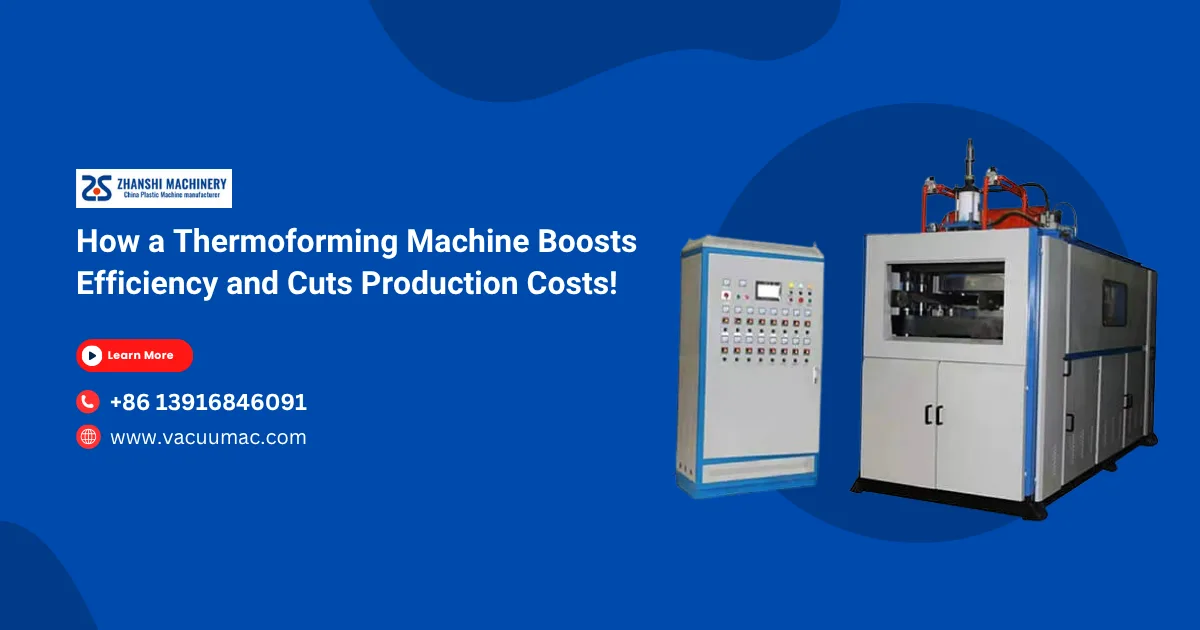
In today’s highly competitive manufacturing landscape, maximizing efficiency while minimizing production costs has become essential for companies striving to maintain profitability and market share. A key factor that can drive such improvements is the adoption of advanced manufacturing technologies — among which the thermoforming machine plays a pivotal role. As a leader in manufacturing innovation, Shanghai Zhanshi Mechanical Equipment Co., Ltd. is proud to offer state-of-the-art thermoforming machines that help businesses optimize production processes, reduce waste, and enhance product quality.
Understanding the Thermoforming Machine and Its Process
It is important to understand what a thermoforming machine is and how it operates.
Thermoforming is a manufacturing process where a plastic sheet is heated until soft and then formed over a mold to create a product. The machine precisely controls temperature, pressure, vacuum, and mechanical movement to shape the sheet, which cools and solidifies, retaining the mold shape.
Common thermoforming machine types include:
- Vacuum Forming Machines: Use vacuum pressure to pull hot plastic against molds, ideal for simpler shapes.
- Pressure Forming Machines: Employ additional air pressure to form more detailed and intricate products.
- Mechanical Forming Machines: Use plugs or mechanical forces to assist in shaping.
This versatile method is widely used for producing packaging, insulation panels, automotive parts, medical trays, and consumer goods.
How a Thermoforming Machine Boosts Manufacturing Efficiency
1. Faster Production Cycles Compared to Other Methods
One of the most notable efficiency benefits of a thermoforming machine is its short cycle time. Unlike injection molding, which requires the melting of raw resin and filling of complex molds, thermoforming heats pre-manufactured plastic sheets to a soft state, which significantly reduces heating time. Additionally, tooling for thermoforming is usually less complex and quicker to produce.
Consequently, manufacturers can achieve rapid output that supports high-volume demands without compromising quality. Short cycle times also enable faster switches between product types, improving time-to-market agility.
2. Reduced Tooling and Setup Time
Thermoforming machines utilize molds that are typically made of aluminum or other economical materials, which are less expensive and quicker to fabricate than steel molds used in injection molding. This decreases initial tooling costs and allows for faster project initiation.
Setup times are also minimized because the process requires fewer adjustments after mold installation. Operators can swiftly start production, reducing downtime and increasing machine utilization.
Also Read: Thermoforming Machine Trends in 2026: What’s New and What’s Next?
3. Lower Material Waste and Optimized Material Use
Since thermoforming starts with plastic sheets of precise thickness and size, manufacturers can reduce raw material waste. Excess margins around the formed parts can often be recycled or reused, enabling sustainable and cost-effective resource management.
In comparison, processes like injection molding produce runners and sprues that often cannot be recycled easily, leading to higher material losses and costs.
4. Flexibility in Product Design and Rapid Prototyping
Thermoforming machines allow for easy modifications in mold design and product specifications without extensive retooling. This flexibility is essential for businesses needing to frequently update products or customize batches for various markets.
Rapid prototyping using thermoforming shortens the development cycle and minimizes costs associated with product iterations, enabling more responsive manufacturing operations.
5. Simplified Maintenance and Reduced Operating Expenses
Shanghai Zhanshi’s thermoforming machines are engineered for durability and ease of maintenance, with streamlined components and automated systems that reduce manual intervention.
Lower machine wear and tear, combined with fewer faults and breakdowns, decrease maintenance labor and parts costs. Efficient use of electricity and automation further reduce operating expenses, enhancing the overall return on investment.
How Using a Thermoforming Machine Cuts Production Costs
Initial Investment vs Long-Term Savings
Though acquiring advanced thermoforming machines entails upfront investment, the long-term operational savings often outweigh initial expenses. Reduced tooling costs, minimized waste, and faster production cycles collectively lower per-unit costs.
Moreover, the robustness and reliability of Shanghai Zhanshi’s machines mean fewer stoppages and maintenance events, translating into lower indirect costs.
Decreased Labor Costs Due to Automation
The automation of thermoforming processes—such as automatic sheet feeding, forming, trimming, and stacking—reduces dependency on manual labor. This not only cuts labor costs but also improves workplace safety by minimizing operator exposure to repetitive or risky tasks.
Energy Efficiency
Thermoforming machines heat plastic sheets only when required and for short durations, unlike other processes that melt bulk plastic. This targeted heating approach consumes less energy, resulting in cost savings on utilities.
Reduced Waste Disposal Fees
By generating less scrap and having high recyclability rates for waste material, thermoforming helps companies avoid substantial disposal fees associated with industrial waste, further improving cost efficiency.
Improved Product Quality Reduces Rework and Returns
The precision and consistency of thermoforming machines lower the rate of defective products. Fewer rejects mean less money lost to rework, material wastage, and customer returns — protecting both profits and brand reputation.
Shanghai Zhanshi Mechanical Equipment Co., Ltd.: Delivering Excellence in Thermoforming Technology
As a world-class manufacturer, Shanghai Zhanshi Mechanical Equipment Co., Ltd. specializes in developing thermoforming machines equipped with advanced control systems, high-precision molds, and robust construction.
Advantages of partnering with Shanghai Zhanshi include:
- Customizable Solutions: Tailoring machines to specific product dimensions, volumes, and materials.
- Innovative Technology: Integrating PLC control, energy-efficient heating elements, and automated operations.
- Global Support: Providing comprehensive after-sales service and technical training.
- Quality Assurance: Meeting international manufacturing standards to ensure product reliability.
Our commitment is to equip manufacturers with machinery that maximizes efficiency, reduces costs, and fosters sustainable production growth.
Investing in a thermoforming machine represents a strategic decision that drives manufacturing efficiencies and cuts production costs without compromising on quality. The ability to produce parts quickly, with minimal waste and lower labor demands, makes thermoforming an attractive option across industries.
Also Read: How Thermoforming Machine Manufacturers Are Innovating Sustainable Packaging: Shanghai Zhanshi
Frequently Asked Questions (FAQs)
Q1: What kinds of products can be made using a thermoforming machine?
A: Thermoforming machines can produce a vast range of plastic items, including food packaging trays, blister packs, vehicle parts, medical components, signage, protective helmets, and more.
Q2: How does thermoforming compare with injection molding?
A: Thermoforming generally has lower tooling costs and faster prototyping. It is ideal for larger, thinner parts but may not be suitable for highly intricate designs best served by injection molding.
Q3: Can thermoforming machines handle different plastic materials?
A: Yes, modern thermoforming machines can form a variety of thermoplastics, including ABS, PET, PVC, polystyrene, polycarbonate, and more, depending on the machine specifications.
Q4: What is the average lifespan of a thermoforming machine?
A: With proper maintenance, Shanghai Zhanshi thermoforming machines can operate efficiently for 10 to 15 years or more.
Q5: How much training is required to operate a thermoforming machine?
A: Shanghai Zhanshi provides extensive training sessions. Operators typically gain proficiency within days, depending on their previous experience.
Q6: Does thermoforming produce a lot of waste material?
A: No, thermoforming produces significantly less waste. Scrap material from sheets is often reusable or recyclable, minimizing environmental impact and costs.
Q7: How customizable are Shanghai Zhanshi thermoforming machines?
A: Very customizable. We work with clients to tailor machines for sheet size, thickness, cycle time, automation level, and more.
Q8: Are these machines energy efficient?
A: Yes, Shanghai Zhanshi thermoforming machines incorporate energy-saving features such as sectional heating and automated standby modes.
Q9: Can thermoforming machines be integrated into automated production lines?
A: Absolutely, our machines are designed for integration with robotic arms, conveyors, and trimming units to create seamless automated workflows.
Q10: What after-sales support does Shanghai Zhanshi provide?
A: We offer installation assistance, training, regular maintenance, spare parts availability, and 24/7 technical support.