Specialized Trailers for Non-Standard Loads
When it comes to heavy truck transport companies, Al Faris Group brings unmatched fleet depth and engineering expertise to every project. Standard trucking fleets simply aren't designed to handle cargo that spans multiple lanes or exceeds 100 tonnes in a single piece. Moving this kind of load requires more than a bigger truck — it requires a fleet purpose-built around the physics of oversized weight distribution.
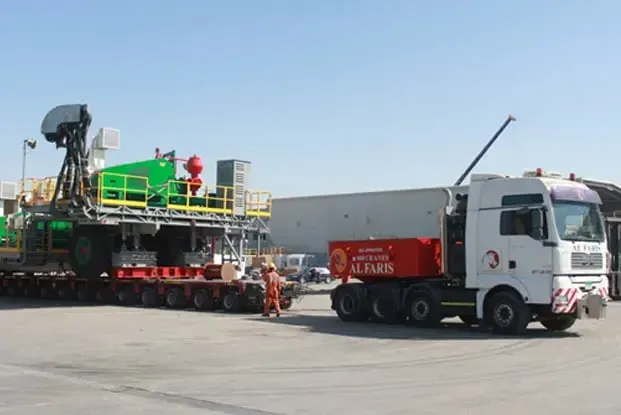
Al Faris Group operates a fleet of conventional hydraulic trailers and self-propelled modular transporters (SPMTs), each configured specifically for oversized and overweight industrial cargo. This ranges from power transformers weighing several hundred tonnes to large process vessels destined for refineries and petrochemical plants. Rather than relying on a one-size-fits-all trailer setup, axle configurations are selected project by project, matched to each load's actual weight distribution. This project-specific approach is what separates a specialised heavy transport operator from a general logistics fleet, and it's the foundation on which every other part of the job depends.
Matching Trailer Configuration to Cargo Type
Not every heavy load needs the same trailer setup, and treating them as if they do is one of the most common causes of transport failure in the industry. A relatively compact but extremely heavy component, such as a transformer, concentrates its weight over a small footprint. This kind of load typically needs fewer axle lines, but each line has to carry a much higher point load. A long, comparatively lighter vessel presents the opposite challenge: the weight is lower overall, but it's spread across a much greater length, and the structure itself has to be protected from bending stress during transit.
Al Faris' engineers work through this kind of load-specific analysis for every job, selecting trailer configuration, axle count, axle spacing, and trailer width accordingly. Nothing is defaulted to a standard setup. This engineering-first approach means the trailer is built around the cargo's actual stress profile, not the other way around, which is critical for protecting both the cargo and the road infrastructure it travels over.
Route Planning That Prevents Delays
The biggest risk in heavy truck transport isn't the drive itself — it's the planning that happens before a single wheel turns. Al Faris' teams conduct detailed route surveys well ahead of any transport date, identifying tight turns, load-bearing limits on bridges, overhead clearances, and any road modifications that will be needed along the route. Catching these issues early prevents the far more expensive scenario: a stalled convoy mid-route, blocking traffic and racking up costs while a fix is worked out on the fly.
This survey work typically takes place weeks ahead of the actual transport date. That lead time isn't a buffer for its own sake — it's what allows enough runway to secure the necessary permits, arrange escorts, or put temporary infrastructure changes in place before the cargo ever leaves the yard.
Managing Weight and Dimension Compliance
Heavy truck transport in the UAE operates under specific weight and dimension thresholds, and crossing any of these thresholds triggers different permit and escort requirements. Al Faris' transport planning accounts for these classifications from the very start of a project, ensuring cargo is correctly categorised and that the appropriate level of escort and permitting is arranged well in advance.
This upfront classification work matters because the alternative — discovering a compliance gap after a convoy is already underway — creates delays that are far costlier and harder to resolve than a planning oversight caught on paper.
Supporting Time-Critical Deliveries
Industrial projects often run on fixed installation windows: a plant shutdown, a scheduled crane lift, a narrow maintenance slot. None of these can absorb a delayed heavy truck transport without triggering cascading costs across the wider project schedule.
Al Faris builds contingency directly into its route planning and trailer allocation specifically to protect these time-critical deliveries. The transport date is treated as a fixed constraint that the entire plan has to work around, rather than a target the operation simply aims for. It's this discipline — engineering the fleet to the cargo, planning the route in advance, managing compliance proactively, and protecting fixed delivery windows — that defines what specialised heavy transport actually looks like in practice.