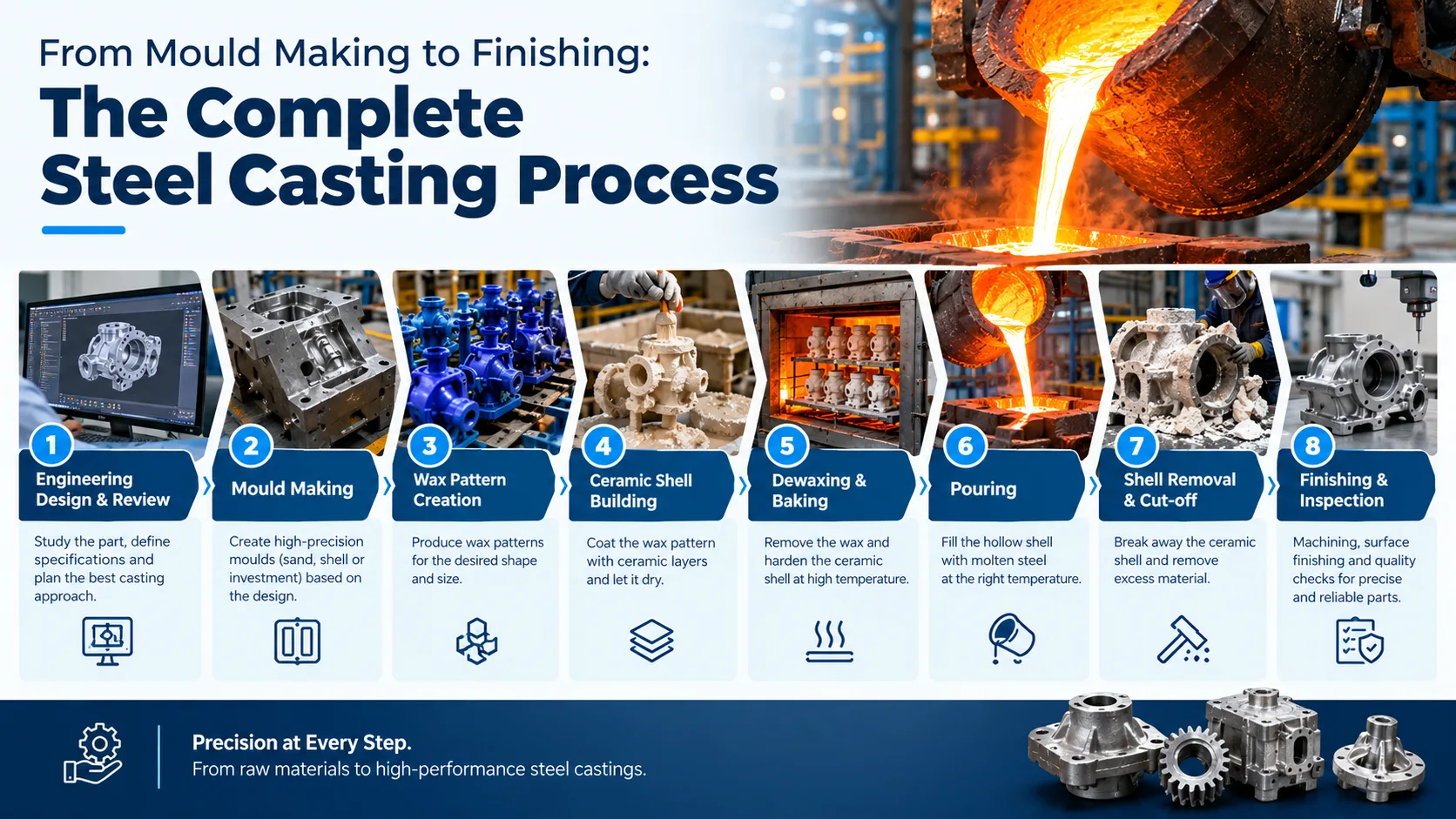
Steel casting is a widely used manufacturing process for producing strong, durable, and complex metal components for industrial applications. It involves preparing a mould, pouring molten steel into it, allowing the metal to solidify and finishing the component according to the required specifications.
Each stage of the steel casting process plays an important role in determining the quality, strength, dimensional accuracy and surface finish of the final product.
In this article, we will explain the complete steel casting process, from mould making to final inspection and explore how each step contributes to producing reliable industrial components.
What Is the Steel Casting Process?
Steel casting is a manufacturing method in which molten steel is poured into a mould cavity and allowed to cool and solidify into the desired shape.
This process is suitable for producing components with different shapes, sizes, and design requirements. Depending on the application, manufacturers may use different casting methods, such as sand casting or investment casting.
Steel castings are commonly used in heavy machinery, construction equipment, pumps, valves, mining equipment, and general engineering industries.
1. Engineering Design and Pattern Making
The first stage of steel casting is reviewing the component design and preparing the pattern.
Engineers study the component drawing, dimensions, material grade, wall thickness, and intended application. They also consider factors such as shrinkage during cooling and the machining allowance required for finishing.
A pattern is then created to represent the shape of the component. Depending on the production requirements, patterns may be made from wood, plastic, metal, or other suitable materials.
Why this step matters: Accurate pattern design helps produce castings that meet the required dimensions and reduces the risk of manufacturing defects.
2. Mould Making
Mould making is one of the most important stages in steel casting. The mould provides the cavity into which molten steel is poured.
In sand casting, prepared sand is shaped around the pattern to create the mould cavity. The pattern is removed, leaving the required shape inside the mould.
The mould also includes suitable passages for pouring molten steel and feeding the casting as the metal solidifies.
For investment casting, a ceramic shell is created around a wax pattern, and the wax is removed before pouring the metal.
Why this step matters: A properly designed and prepared mould helps the molten steel fill the cavity and supports the production of a casting with the required shape.
3. Steel Melting and Material Preparation
After mould preparation, the required steel is melted in a suitable furnace.
The steel grade is selected according to the component's intended use and required mechanical properties. Common material options include carbon steel, alloy steel, and stainless steel.
During melting, manufacturers control the chemical composition and temperature according to the applicable specifications.
Why this step matters: Correct material selection and process control help achieve the required strength, toughness, corrosion resistance, and other material properties.
4. Pouring Molten Steel into the Mould
Once the molten steel reaches the required pouring condition, it is transferred carefully into the prepared mould.
The pouring operation must be controlled to allow the mould cavity to fill properly. Suitable pouring practices also help reduce problems associated with turbulence, gas entrapment, and incomplete filling.
The pouring temperature and speed depend on the steel grade, component design, and casting method.
Why this step matters: Proper pouring helps reduce casting defects and supports consistent component quality.
5. Cooling and Solidification
After pouring, the molten steel begins to cool and solidify inside the mould.
During solidification, the metal changes from a liquid to a solid state and develops its internal structure. Cooling conditions can influence the final properties and quality of the casting.
Manufacturers must also consider shrinkage during solidification and ensure that the casting design and feeding system support proper metal supply where needed.
Why this step matters: Controlled solidification helps minimise defects and supports the production of sound steel castings.
6. Mould Removal and Casting Cleaning
Once the steel has cooled sufficiently, the casting is removed from the mould.
In sand casting, this operation is commonly called shakeout. The moulding material is removed, and the casting is separated from the remaining mould structure.
Excess metal, such as gates and risers, is then removed. The surface may be cleaned using suitable methods to remove sand, scale, and other unwanted material.
Why this step matters: Cleaning prepares the casting for inspection and subsequent finishing operations.
7. Heat Treatment
Depending on the material grade and application, steel castings may undergo heat treatment.
Common heat treatment processes include normalising, annealing, quenching, and tempering. The appropriate method depends on the required mechanical properties and applicable material specifications.
Heat treatment can help improve properties such as hardness, toughness, strength, and microstructural uniformity when the correct process is selected.
Not every steel casting requires the same heat treatment.
Why this step matters: Appropriate heat treatment helps the component meet its specified material and performance requirements.
8. Machining and Surface Finishing
After cleaning and any required heat treatment, the casting may undergo machining and finishing.
Machining operations such as milling, turning, drilling, and grinding are used to achieve specified dimensions, tolerances, and surface finishes.
The amount of machining required depends on the original casting accuracy and the final component design.
Additional surface preparation may also be carried out where required by the application.
Why this step matters: Finishing helps ensure that the casting fits correctly into the final assembly and meets the required dimensional specifications.
9. Quality Inspection and Testing
Quality inspection is an essential part of steel casting manufacturing.
The finished component is checked against the relevant drawings, material requirements, and quality specifications.
Depending on the application, inspection and testing may include:
- Visual inspection to identify surface defects.
- Dimensional measurement to verify size and tolerances.
- Chemical analysis to confirm material composition.
- Mechanical testing to evaluate specified material properties.
- Non-destructive testing, such as ultrasonic or radiographic testing, when required.
The inspection plan depends on the component's intended application and customer requirements.
Why this step matters: Proper inspection helps identify defects, verify compliance, and confirm that the component meets the specified requirements.
10. Final Finishing and Delivery
After the required inspections are completed, the casting is prepared for delivery.
This may include final cleaning, marking, corrosion protection, documentation, and packaging, depending on the order requirements.
Components are then prepared for shipment or further assembly.
Why this step matters: Proper final preparation helps protect the component during transportation and ensures that the required documentation accompanies the product.
Benefits of a Well-Controlled Steel Casting Process
A properly planned and controlled steel casting process offers several advantages:
Design Flexibility
Casting can produce complex shapes and components with different dimensions to suit engineering requirements.
Material Selection
Different steel grades can be selected to meet specific strength, toughness, wear resistance, and corrosion resistance requirements.
Manufacturing of Large Components
Suitable casting methods can produce large and heavy components for industrial machinery and equipment.
Reduced Machining in Suitable Designs
Near-net-shape casting can reduce the amount of additional machining required, depending on the component geometry and dimensional tolerances.
Application Versatility
Steel castings are used in many industries, including construction, mining, transportation, power generation, and general engineering.
Common Defects in Steel Casting and Their Prevention
Steel casting defects can affect the quality and performance of a component. Common examples include:
- Porosity: Small cavities that may result from gas or solidification-related problems.
- Shrinkage defects: Cavities or discontinuities caused by insufficient feeding during solidification.
- Incomplete filling: Occurs when molten steel does not completely fill the mould cavity.
- Cracks: May develop due to thermal stresses or other process-related factors.
- Surface defects: May result from mould conditions, metal flow, or handling.
Appropriate mould design, material preparation, pouring control, solidification management, and inspection help reduce the risk of these defects.
How to Choose the Right Steel Casting Manufacturer
Selecting the right manufacturer is important for achieving the required component quality and production consistency.
Before choosing a supplier, consider these factors:
- Manufacturing capabilities: Confirm that the manufacturer can produce the required component size and shape.
- Material expertise: Check whether the required steel grades are supported.
- Quality control: Ask about inspection procedures and testing capabilities.
- Machining and finishing: Determine whether the manufacturer can meet the required dimensional tolerances and surface finish.
- Technical support: Look for the ability to review engineering drawings and clarify manufacturing requirements.
- Delivery requirements: Confirm production capacity, lead times, and documentation needs.
Providing accurate drawings, material specifications, operating conditions, and inspection requirements helps the manufacturer evaluate the project effectively.
Conclusion
The steel casting process involves several important stages, beginning with engineering design and mould making and continuing through melting, pouring, solidification, cleaning, heat treatment, machining, and final inspection.
Each stage contributes to the quality and performance of the finished component. Careful process planning, suitable material selection, and appropriate quality checks help manufacturers produce steel castings that meet industrial requirements.
If you are exploring steel casting solutions for industrial or engineering components, visit Adithya Tech force - steel casting page to learn more about its steel casting capabilities.
Frequently Asked Questions
1. What are the main steps in steel casting?
The main steps include engineering design, pattern making, mould preparation, steel melting, pouring, solidification, mould removal, cleaning, optional heat treatment, machining, and quality inspection.
2. Why is mould making important in steel casting?
Mould making creates the cavity that determines the shape of the final component. Proper mould design also supports metal flow and helps reduce casting defects.
3. Is heat treatment necessary for every steel casting?
No. Heat treatment depends on the steel grade, component design, required mechanical properties, and applicable specifications.
4. Why is machining required after casting?
Machining may be needed to achieve accurate dimensions, specified tolerances, smooth surfaces, and features required for assembly.
5. How is steel casting quality checked?
Quality checks may include visual inspection, dimensional measurement, chemical analysis, mechanical testing, and non-destructive testing, depending on the component requirements.
6. Which industries use steel castings?
Steel castings are used in heavy machinery, mining equipment, construction equipment, pumps, valves, power generation, and general engineering applications.