
Here is how most SEO teams use Google Search Console: they log in, check total clicks, look at which pages dropped, and export a CSV of queries that someone else will eventually analyze in a spreadsheet. That spreadsheet then sits in a shared folder until the next quarterly review.
This is not a workflow problem. It is a tooling problem. GSC data is rich enough to drive a content strategy completely on its own, but turning thousands of raw query rows into publishable content topics requires a layer of analysis that manual spreadsheet work does not scale to.
The Problem With Raw Query Data
A site with reasonable organic traffic might have 3,000 unique queries in its GSC data at any given time. No content team can meaningfully analyze 3,000 individual rows. So they sample, they look at the top 50 by clicks, and they build their content strategy on that sliver while the other 2,950 queries sit unexamined.
Inside those 2,950 queries are clusters of related search terms pointing at real user intent. There are informational queries that could anchor educational content. There are commercial-intent queries that reveal what your buyers are evaluating before they purchase. There are queries where your pages rank in positions 11 through 20, close enough to page one to improve with relatively modest content work, but too far down to appear in any standard "top queries" report.
Manual analysis at scale is not feasible. What you need is a system that groups related queries automatically, classifies their intent, surfaces the patterns that matter, and converts those patterns into actionable content briefs.
What the Pipeline Actually Looks Like
When GSC data is processed properly, the workflow looks like this:
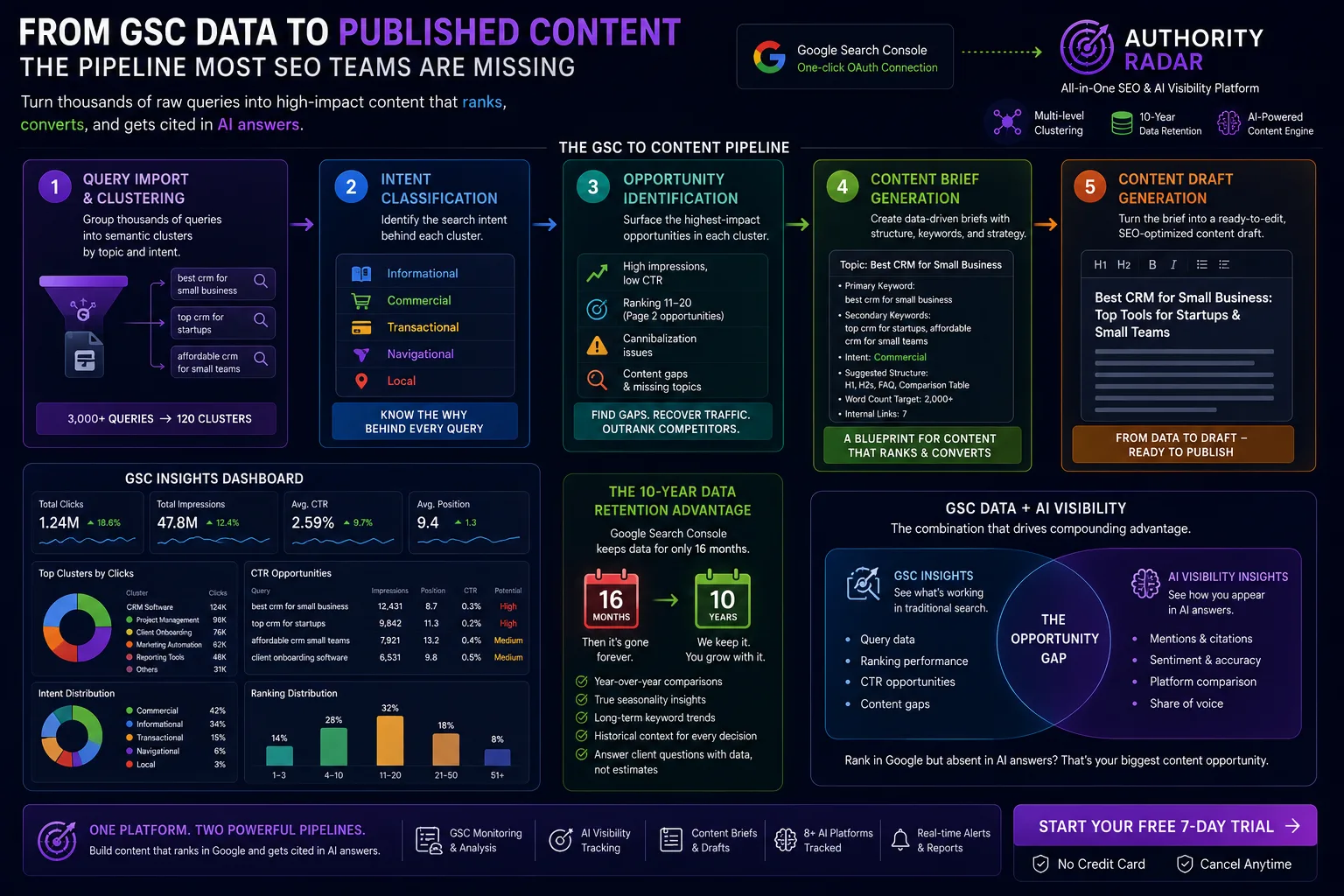
Step 1: Query import and clustering. All queries are imported and grouped into semantic clusters, where related queries regardless of exact phrasing are recognized as pointing at the same underlying topic. "Best CRM for small business," "top CRM for startups," and "affordable CRM for small teams" are three different queries but one content cluster. Treating them as separate topics wastes resources and misses the combined signal they represent.
Step 2: Intent classification. Each cluster is classified by search intent: informational, commercial, transactional, navigational, or local. This determines the content format, the target page type, and the success metric. A cluster of transactional queries needs a conversion-optimized landing page, not a long-form educational guide. Getting this wrong produces content that ranks but does not convert.
Step 3: Opportunity identification. Within each cluster, specific opportunities are flagged: high-impression, low-CTR queries where a title rewrite could recover hidden traffic; pages with cannibalization issues where two of your own pages are splitting ranking signals; and queries where you are ranking page two with content that could realistically reach page one with focused improvement.
Step 4: Content brief generation. The cluster, its intent classification, and the specific opportunity data combine into a structured content brief: topic focus, primary and secondary keywords, suggested structure, word count target, and internal linking recommendations.
Step 5: Content draft. The brief converts into a ready-to-edit content draft built from real query data, not keyword research guesswork.
This pipeline is exactly what Authority Radar's GSC Monitoring is built to run. The connection to Google Search Console is a one-click OAuth, the clustering uses a multi-level algorithm rather than basic AI grouping, and the output goes all the way from raw queries to a publishable draft without leaving the platform.
The 10-Year Data Retention Advantage
There is a structural limitation most teams encounter eventually: Google Search Console only retains query-level data for 16 months. Once that window passes, the historical data is gone permanently. You cannot look back at how search demand for your category evolved over three years. You cannot compare this season to the same season two years ago. You are permanently working with a short-term view of a long-term trend.
Authority Radar warehouses your GSC data for up to 10 years. This means the analysis you do today has historical context behind it. It means year-over-year comparisons are possible. It means when a client asks why organic traffic has shifted over the past three years, you have the query-level data to answer with specifics rather than estimates.
Why This Connects to AI Visibility
The GSC-to-content pipeline and AI visibility tracking are not separate problems. They are two sides of the same content strategy question.
Your GSC data tells you which queries are driving traditional organic traffic and where the content gaps are. Your AI visibility tracking tells you which queries are being answered by AI systems and whether your content is being cited in those answers. The overlap, queries where you rank well in Google but are absent from AI answers, is where the most valuable content investment opportunities sit.
A team that only does GSC analysis is optimizing for a channel that is losing click share to AI summaries. A team that only does AI visibility tracking lacks the foundational SEO data that determines whether their content even enters the AI retrieval pool in the first place. Both together, in a single platform connected to the same dataset, is what Authority Radar is built to provide.
If your content pipeline currently starts with keyword research instead of your own query data, and if your strategy does not account for how content performs in AI answers alongside traditional rankings, there is a version of this that closes both gaps simultaneously. Start your free 7-day trial and run both pipelines on your actual site data.