Open any Odoo instance on a Monday morning, and you'll find the same ritual playing out. A sales manager filters a report by date range. An operations lead cross-references three screens to figure out why inventory looks off. A finance person exports something to a spreadsheet because the dashboard just won't bend to the one question they actually have. None of this is broken, exactly. It just takes time, and places the onus of getting to the answer on the one who has the least of that. And that's precisely the kind of problem that an AI dashboard for Odoo is designed to solve – without adding another chart or table to the interface, but by allowing people to ask for what they want in natural language.
But conversational analytics will soon emerge as the next big upgrade to Odoo – without making any change to existing charts and other tools on the Odoo dashboard.
Why Static Dashboards Are Losing Their Grip
Dashboards were built for a world where the questions were predictable. Revenue this month. Top products this quarter. Open tickets by team. Odoo's native reporting handles that world well.
The problem is that real business questions rarely arrive pre-filtered. A CEO doesn't wake up wanting “the sales dashboard.” She wakes up with questions about why a particular area is doing poorly, or why the costs are creeping up from some supplier, or how a price adjustment is affecting margin. These questions span modules, require filters that aren’t pre-built into the system, and frequently demand an additional question the minute the initial response comes through.
A fixed dashboard can't keep up with that kind of curiosity. This was designed to answer the question that had been predicted, not the one actually formed at nine in the morning.
What Changes When You Talk to Your Data
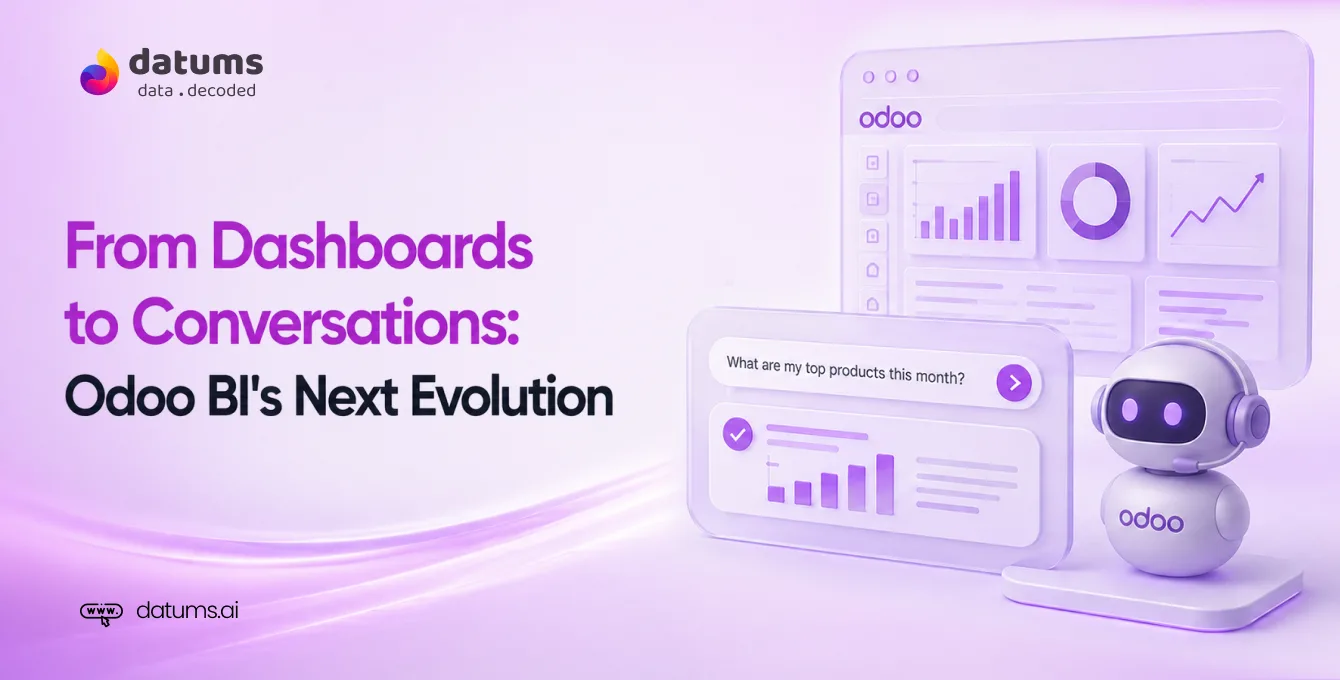
Conversational analytics flips the workflow. Instead of hunting for the right filter or the right report, you type or say what you want to know, and the system does the translating. This is where an Odoo AI dashboard app earns its keep; it sits between the raw ERP data and the person asking the question, and it does the heavy lifting of turning a plain sentence into a real query.
A few things tend to change almost immediately once teams adopt this approach:
• Questions get asked more often, because asking no longer means opening five screens first.
• Follow-up questions happen in the same breath, instead of getting dropped because reformulating the report felt like too much work.
• People outside the “reporting-savvy” crowd warehouse leads, junior sales reps, department heads without a BI background start pulling their own answers instead of waiting on someone else.
• Insights arrive framed as decisions, not just numbers on a screen, because the system can explain what's driving a trend, not only display it.
None of this requires learning a query language or memorizing where a metric lives inside Odoo's module structure. The conversation carries that weight instead.
How Conversational BI Actually Works Inside Odoo
It helps to break this down into pieces, because “talk to your data” can sound abstract until you see what's actually happening underneath.
Natural Language In, Real Query Out
The first task of the system then would be to find out in which modules the answer lies – Sales, CRM, Inventory, Manufacturing, Purchase, Finance, or POS – and convert the natural language query into the one that will allow the database to process it. Now it happens the moment someone finishes typing.
Context That Sticks
A good conversational layer remembers what was just asked. If someone follows up with “now break that down by region,” the system already knows what “that” refers to. Static dashboards don't offer this kind of continuity — every new question usually means starting from a blank filter panel again.
One Interface Across Every Module
This is arguably where the biggest shift shows up. An Odoo KPI dashboard AI layer doesn't care that inventory data and finance data technically live in different corners of the ERP. From the user's side, it's one conversation, and the system handles the cross-module stitching quietly in the background.
Visuals That Build Themselves
The output isn't limited to a wall of text. Ask for a trend, and you get a chart. Ask for a comparison, and you get something built to compare. This is what makes it function as a genuine Odoo data visualization app rather than just a chatbot bolted onto a database; the visuals are generated on demand, shaped around the specific question, not pulled from a pre-set library of report templates.
What This Looks Like on an Ordinary Day
Picture the kinds of questions that actually come up in a typical week, and how differently they get handled once conversational BI is in place:
- A regional manager wants to know which lead sources are converting best this cycle, without waiting on the CRM team to build a filtered view.
- A warehouse supervisor asks which products are sitting close to out-of-stock, and gets the list immediately instead of running a report and exporting it.
- A finance lead wants to understand which vendors have the most purchase orders still open, without cross-referencing two separate screens.
A plant manager asks which work centers are running hottest this week, and follows up by asking why, right in the same thread.
Each of these used to mean navigating to a specific report, applying filters, and often asking someone else to build the view in the first place. With a conversational layer, the question and the answer happen back to back, in the language the person actually thinks in.
A Morning With datumsAI
Consider a CEO checking in before a leadership meeting. Instead of opening four separate Odoo reports, she asks a single question about which store locations are underperforming this financial year. The answer comes back with the numbers behind it and a short explanation of what's driving the gap. She follows up, asking what would happen to profitability if she adjusted pricing on a specific product line. That answer arrives too, in the same conversation, without her touching a filter or waiting on a report request.
This is the practical promise behind platforms like datumsAI, built specifically to extend Odoo with conversational intelligence rather than replace its operational core. The ERP still runs the business. The conversational layer just makes the business legible on demand, to whoever needs to see it, in whatever moment they need to see it.
It's worth noting that this kind of layer works precisely because it respects the ERP underneath it — read-only access, live data, no duplicated reporting infrastructure to maintain. The intelligence sits on top; Odoo stays the single source of truth.
The Bigger Shift Behind the Trend
What's really happening here isn't just a new feature category. It's a change in who gets to ask questions of the data at all. Dashboards, for all their value, quietly gatekept insight behind whoever knew how to build the report. Conversation removes that gate. A junior team member can ask the same caliber of question as a data analyst, because the system does the translating either way.
That's the real shift BI is going through right now, and Odoo users sit right at the center of it, not because the ERP is changing, but because the way people are allowed to interact with what it already knows finally is.
Static dashboards will stick around for the questions everyone already knows to ask. But the interesting decisions rarely start there; they start with a question nobody built a report for yet. That's the space conversational analytics is stepping into, and it's why more Odoo teams are treating an AI dashboard as less of an add-on and more of a new default. The teams that get comfortable asking their data direct questions, on the spot, in their own words, are the ones who'll spend less time compiling information and more time acting on it. The dashboard isn't disappearing. It's just learning to talk back.