Life on the water is great, but keeping batteries charged can be a challenge, especially when you're spending several days away from shore power. Navigation equipment, cabin lights, communication devices, refrigerators, and other onboard electronics all need electricity.
That's one reason more boat owners are exploring Flexible Solar Panels for Boats. Unlike conventional rigid modules, flexible solar panels can be designed for certain curved surfaces and areas where a traditional framed panel may be difficult to accommodate.
But choosing a marine solar panel isn't simply about finding one that bends. Saltwater exposure, changing weather, limited installation space, shading, and electrical compatibility all deserve attention.
Whether you own a sailboat, fishing boat, yacht, or recreational vessel, here's what you should understand before adding solar power to your boat.

1. Why Choose Flexible Solar Panels for Boats?
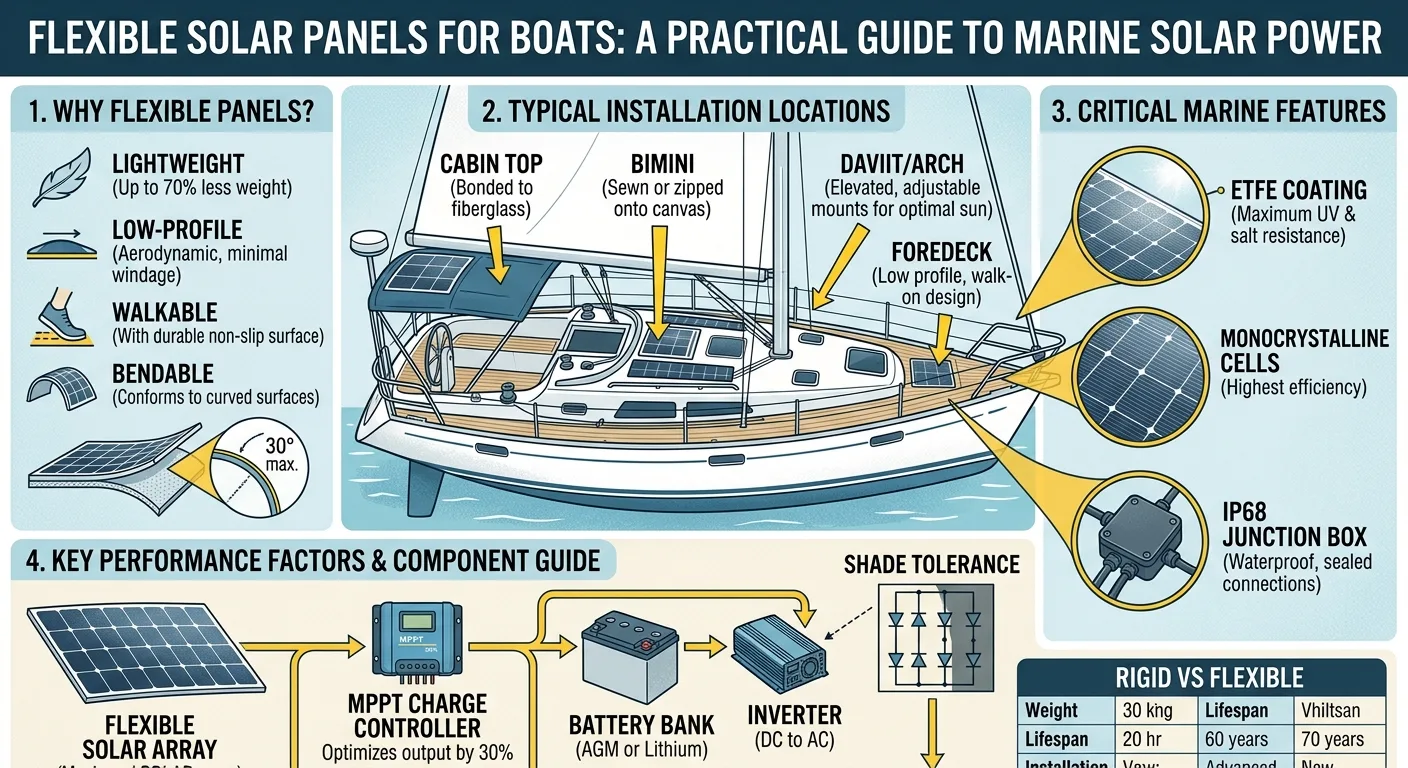
Space is often limited on a boat. Between navigation equipment, antennas, hatches, railings, and other deck fittings, finding a suitable location for solar panels isn't always easy.
Flexible solar modules offer several practical advantages.
Adaptability to curved surfaces
Some boat surfaces are not completely flat. Flexible panels can accommodate certain curved installation areas, depending on their construction and permitted bending radius.
Low-profile installation
Without a conventional rigid frame, flexible modules can provide a lower-profile installation where additional panel height would be inconvenient.
Useful for weight-conscious projects
Weight matters on smaller vessels and sailboats. A lightweight solar solution may help reduce the additional load compared with some traditional framed modules.
More installation possibilities
Depending on the product design, flexible panels may be suitable for selected cabin roofs, curved deck areas, and other marine surfaces.
However, flexible doesn't mean foldable or suitable for unlimited bending. Always check the manufacturer's mechanical specifications before installation.
2. Where Can You Install Solar Panels on a Boat?
Choosing the right location is just as important as choosing the panel itself.
Here are several areas worth considering:
- Cabin roof: Often provides a relatively open surface for mounting solar modules.
- Bimini top: Can offer useful sunlight exposure, provided the panel and supporting structure are suitable for the installation conditions.
- Deck areas: Some flat or gently curved sections may accommodate flexible modules.
- Yacht surfaces: Larger vessels may have additional installation space around selected roof and deck structures.
Before deciding, check for shading from masts, antennas, railings, sails, and other equipment.
Even partial shading can affect solar output, depending on the module design and electrical configuration. A location that receives uninterrupted sunlight for several hours is generally preferable to one that stays shaded for much of the day.
3. How to Choose the Right Marine Solar Panel
Not every flexible solar panel is designed for the same environment. A module intended for an RV roof may not automatically be suitable for a marine installation.
When comparing products, pay attention to these details.
Marine environmental resistance
Salt spray, moisture, UV exposure, and temperature changes can place additional demands on marine solar equipment. Look for documented environmental testing and corrosion-resistance information rather than relying on general marketing descriptions.
Panel dimensions and flexibility
Measure the available installation area before selecting a product. Check the minimum bending radius and confirm that the panel can accommodate the intended surface without excessive mechanical stress.
Power output
Consider your daily electricity consumption. Navigation equipment, lighting, pumps, and refrigeration can have very different energy requirements.
A larger panel isn't automatically the best solution if the available installation area is limited or the vessel frequently experiences shading.
Electrical compatibility
Check the panel's operating voltage, current, open-circuit voltage, and short-circuit current. These values need to be compatible with the charge controller and battery system.
For marine projects, Bright Solar's H Series is a product range worth considering. The appropriate configuration should be selected according to the vessel, installation surface, and electrical requirements.
4. How to Install Flexible Solar Panels on a Boat
Marine installation requires more attention than simply placing a panel on a surface.
A practical installation process generally includes the following steps:
- Measure the installation area. Check the available dimensions and identify obstacles that may cause shading.
- Inspect the surface. Make sure the substrate is suitable, clean, dry, and structurally sound.
- Confirm the mounting method. Select an appropriate attachment method based on the panel manufacturer's instructions and the vessel's surface material.
- Position the panel. Avoid unnecessary bending, twisting, or pressure on the module.
- Plan the cable route. Protect wiring from water ingress, abrasion, movement, and mechanical damage.
- Complete electrical connections. Use compatible marine-suitable components and follow applicable electrical safety requirements.
Adhesive installation may be appropriate for certain products and surfaces, but not every adhesive works with every marine substrate. Surface preparation, temperature, humidity, and long-term exposure all affect bonding performance.
For demanding installations, professional assessment is worthwhile.
5. Common Marine Solar Installation Problems
A few mistakes can affect the performance and service life of a boat solar system.
Ignoring saltwater exposure: Marine environments are demanding. Check corrosion resistance for the panel materials, connectors, mounting hardware, and electrical components.
Installing under frequent shade: Masts, sails, and antennas can create moving shadows. Consider their position throughout the day.
Bending the panel too much: Flexible modules still have mechanical limits. Exceeding the specified bending radius can damage the internal structure.
Poor cable protection: Loose wiring and exposed connections can become problems in wet, high-movement environments.
Choosing products based only on wattage: Dimensions, operating voltage, environmental resistance, and installation requirements are equally important.
6. How to Maintain Marine Solar Panels
Marine solar panels need regular inspection, particularly on vessels that spend long periods in saltwater environments.
Rinse away accumulated salt and dirt using fresh water and a soft cloth. Avoid abrasive cleaning tools or chemicals that may damage the panel surface.
Check cable connections, mounting points, and surrounding materials periodically. Look for signs of corrosion, loose attachments, damaged insulation, or changes in the panel surface.
If the boat is stored outdoors, consider how prolonged UV exposure and changing weather conditions may affect the complete installation.
Regular checks can help identify small problems before they become more difficult to address.
Final Thoughts
Flexible Solar Panels for Boats can be a useful option for marine solar projects where installation space, surface shape, and additional weight are important considerations. However, the right solution depends on more than flexibility alone.
Before choosing a product, evaluate the available mounting area, daily power requirements, saltwater exposure, shading conditions, and electrical compatibility.
At Bright Solar, we understand that marine solar projects often involve installation challenges that standard rooftop applications don't have. Whether you're equipping a sailboat, upgrading a yacht, or developing a customized marine energy system, choosing the right panel for the actual application is where a successful project begins.