In today’s digital-first business landscape, organizations generate massive volumes of real-time data from applications, IoT devices, sensors, mobile platforms, websites, and customer interactions. Traditional data processing systems often fail to handle the speed and complexity of modern data environments. This is where Event Stream Processing (ESP) platforms play a critical role.
ESP platforms enable organizations to process, analyze, and respond to continuous streams of data instantly. By analyzing “data in motion” instead of relying on traditional “save-and-process” models, ESP solutions empower businesses to make faster decisions, improve operational efficiency, and gain competitive advantages in real time.
Click here for more information : https://qksgroup.com/market-research/market-forecast-event-stream-processing-esp-2026-2030-worldwide-5649
What is Event Stream Processing (ESP)?
Event Stream Processing (ESP) is a technology framework designed to capture, process, analyze, and react to real-time event streams generated from multiple data sources. These events may originate from IoT sensors, enterprise applications, transaction systems, connected devices, websites, or user interactions.
Unlike conventional computing systems that depend on synchronous request-response communication models, ESP platforms operate using a reactive and continuous processing approach. Instead of storing incoming data first and processing it later, ESP systems analyze and process events immediately as they arrive.
How Event Stream Processing Works
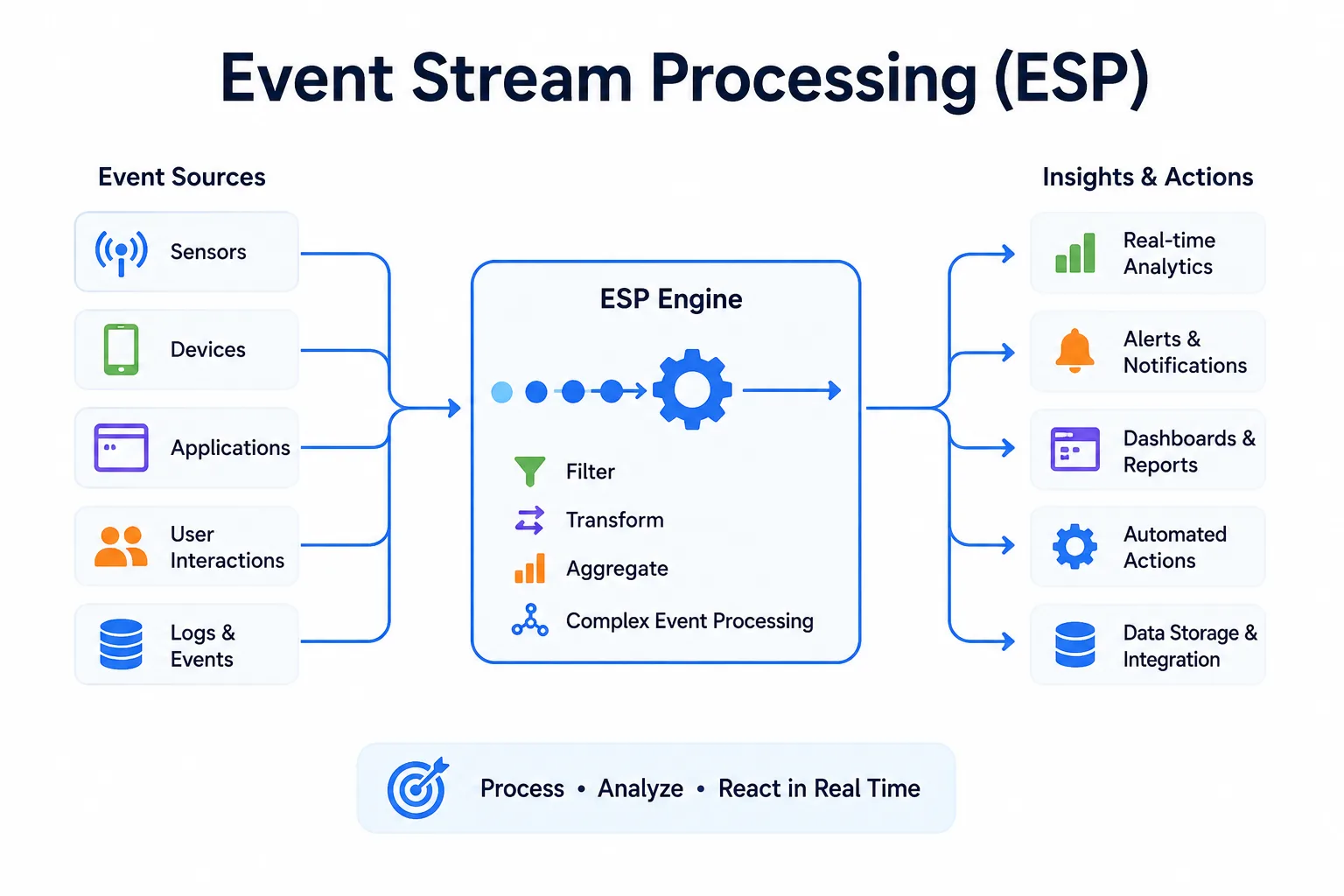
ESP platforms continuously ingest high-velocity data streams from diverse sources. Once the data enters the system, the platform performs several operations, including:
- Real-time data ingestion
- Event filtering and routing
- Data transformation and enrichment
- Aggregation and correlation
The processed information is then delivered to dashboards, applications, analytics systems, or automated workflows for immediate action.
Key Features of ESP Platforms
Real-Time Data Processing
ESP platforms process incoming events instantly, enabling organizations to react to business-critical situations without delays.
Complex Event Processing (CEP)
CEP capabilities help identify meaningful event patterns across multiple data streams. This enables businesses to detect fraud, predict failures, and automate responses.
High Scalability
Modern ESP solutions are designed to handle millions of events per second, making them suitable for large-scale enterprise environments.
Low Latency Analytics
ESP systems provide near-instantaneous analytics with minimal latency, ensuring faster decision-making.
Benefits of Event Stream Processing Platforms
Faster Decision-Making
Real-time event analysis allows organizations to make informed decisions instantly based on live operational data.
Click here for market share report : https://qksgroup.com/market-research/market-share-event-stream-processing-esp-2025-worldwide-6527
Enhanced Customer Experience
Businesses can monitor customer behavior in real time and personalize interactions dynamically.
Improved Operational Efficiency
ESP platforms automate event detection and response processes, reducing manual intervention and improving workflow efficiency.
Fraud Detection and Risk Management
Financial institutions and e-commerce companies use ESP to identify suspicious transactions and security threats immediately.
Applications of ESP Across Industries
Banking and Financial Services
ESP platforms are widely used for fraud detection, algorithmic trading, risk analysis, and compliance monitoring.
Healthcare
Healthcare providers use ESP solutions for patient monitoring, emergency response systems, and real-time medical analytics.
Retail and E-Commerce
Retail businesses utilize event stream processing to optimize customer engagement, inventory tracking, and personalized recommendations.
Telecommunications
Telecom operators rely on ESP for network monitoring, service optimization, and real-time customer analytics.
Event Stream Processing vs Traditional Data Processing
Traditional systems follow a batch-oriented “save-and-process” approach where incoming data is stored before analysis. While suitable for historical reporting, these systems are inefficient for time-sensitive applications.
ESP platforms, on the other hand, use a continuous “process-first” architecture. They analyze streaming data instantly, making them ideal for applications requiring immediate insights and rapid response times.
Future Trends in Event Stream Processing
The adoption of ESP platforms is accelerating due to the growing demand for real-time analytics and intelligent automation. Emerging trends shaping the ESP market include:
- Integration with Artificial Intelligence (AI) and Machine Learning (ML)
- Expansion of edge computing and IoT ecosystems
- Cloud-native event streaming architectures
- Real-time cybersecurity threat detection
As businesses continue generating massive amounts of streaming data, ESP technologies will become increasingly essential for digital transformation initiatives.
Conclusion
Event Stream Processing platforms have become indispensable for organizations seeking real-time visibility, faster decision-making, and intelligent automation. By continuously processing and analyzing live data streams, ESP solutions help enterprises improve operational efficiency, strengthen customer experiences, and respond instantly to dynamic business conditions.