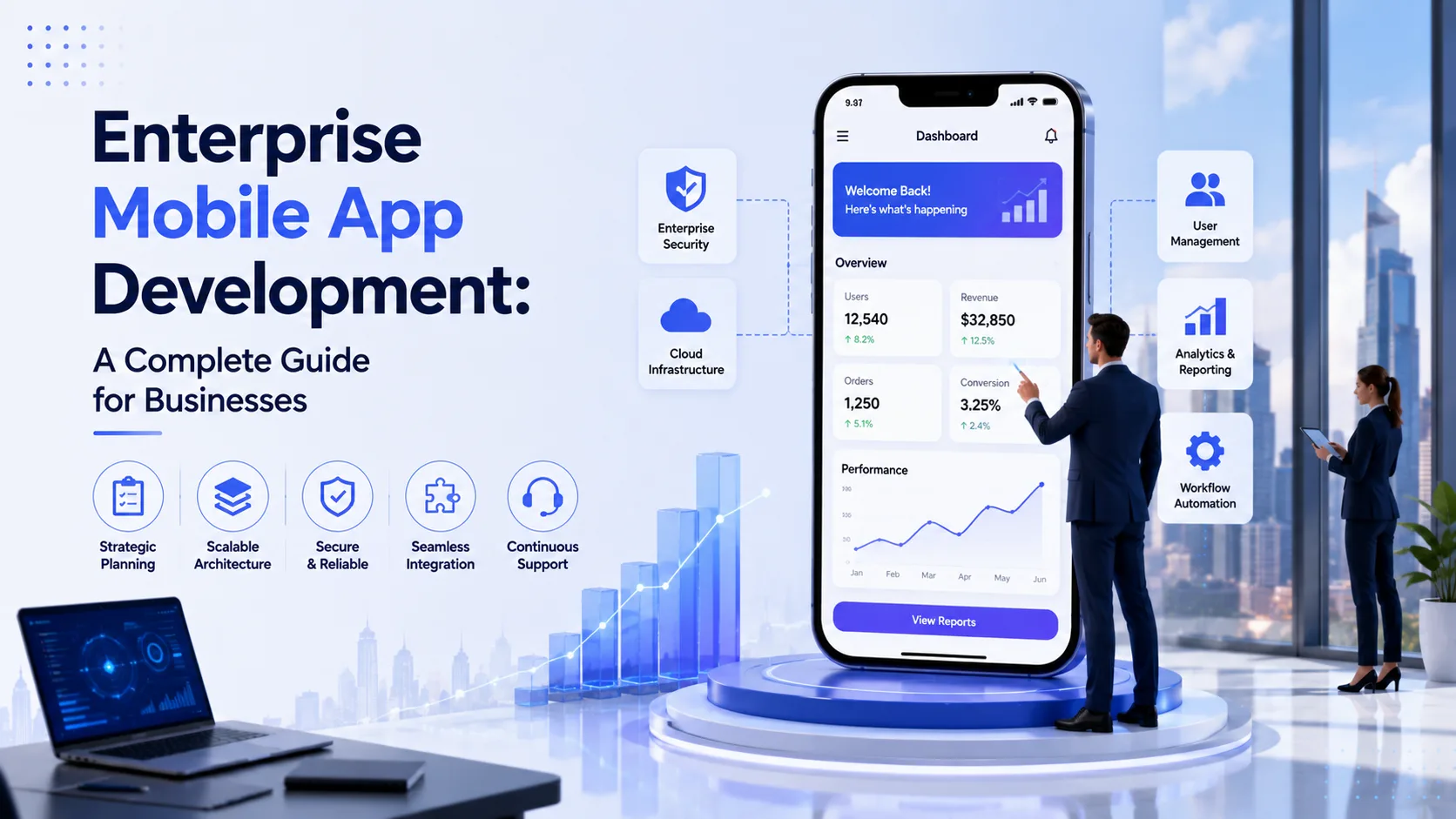
Mobile applications are no longer just customer engagement tools. For modern enterprises, they have become a powerful way to improve internal operations, automate workflows, enhance employee productivity, and deliver better customer experiences.
From banking and healthcare to retail, logistics, and manufacturing, businesses are investing in enterprise mobile app development to stay competitive in a digital-first market.
But building an enterprise mobile app is very different from creating a regular consumer application. Enterprise apps must handle complex workflows, integrate with existing systems, protect sensitive data, and support thousands of users without performance issues.
So, how can businesses build a successful enterprise mobile application?
This complete guide covers everything you need to know about enterprise mobile app development, including its benefits, types, features, development process, costs, and how to choose the right development partner.
What Is Enterprise Mobile App Development?
Enterprise mobile app development refers to the process of designing and building mobile applications specifically for organizations to improve business operations, communication, productivity, and customer engagement.
Unlike standard mobile apps, enterprise applications are designed to address complex business requirements such as:
- Employee collaboration
- Data management
- Workflow automation
- Customer relationship management
- Enterprise system integration
- Security and compliance
These apps can be developed for:
- Android devices
- iOS devices
- Cross-platform environments
Enterprise mobile apps can be used internally by employees or externally by customers and business partners.
Why Do Businesses Need Enterprise Mobile Apps?
1. Improve Employee Productivity
Enterprise apps provide employees with instant access to business tools, documents, dashboards, and communication platforms from anywhere.
Examples include:
- Sales tracking apps
- Employee management apps
- Field service apps
- Inventory management apps
Employees can complete tasks faster without depending on desktop systems.
2. Better Customer Experience
Businesses can use mobile applications to provide personalized experiences through:
- Faster communication
- Personalized recommendations
- Self-service features
- Loyalty programs
- Real-time notifications
A well-designed enterprise app can strengthen customer relationships and improve retention.
3. Streamline Business Operations
Enterprise mobile apps help automate repetitive tasks and reduce manual processes.
Businesses can automate:
- Approvals
- Reporting
- Inventory tracking
- Employee attendance
- Order processing
- Customer support
This improves efficiency and reduces operational costs.
4. Real-Time Data Access
Enterprise apps allow employees and decision-makers to access important business information anytime.
Examples:
- Sales reports
- Analytics dashboards
- Customer data
- Inventory status
- Performance metrics
Real-time access helps businesses make faster decisions.
5. Enhanced Security
Enterprise apps are built with advanced security measures to protect sensitive business information.
Security features include:
- User authentication
- Role-based access control
- Data encryption
- Secure APIs
- Multi-factor authentication
- Device management
Types of Enterprise Mobile Applications
1. Employee Productivity Apps
These apps help employees manage daily tasks and improve collaboration.
Examples:
- HR management apps
- Communication platforms
- Task management tools
- Employee portals
2. Customer-Facing Enterprise Apps
These applications help businesses improve customer interactions.
Examples:
- Banking apps
- Retail apps
- Healthcare apps
- Travel apps
3. Enterprise Resource Planning (ERP) Apps
ERP mobile applications allow businesses to manage core operations remotely.
Features include:
- Finance management
- Inventory control
- Supply chain tracking
- Reporting
4. Customer Relationship Management (CRM) Apps
CRM mobile apps help businesses manage customer interactions and sales processes.
Features:
- Lead tracking
- Customer profiles
- Sales analytics
- Communication management
5. Field Service Apps
These apps are designed for businesses with employees working remotely.
Used in industries like:
- Construction
- Logistics
- Healthcare
- Maintenance services
Features:
- Job scheduling
- GPS tracking
- Work reports
- Customer updates
Key Features of Enterprise Mobile Apps
A successful enterprise mobile app should include features that improve usability, security, and business efficiency.
User Authentication
Secure login systems help protect company data.
Common methods:
- Password authentication
- Biometrics
- Single Sign-On (SSO)
- Multi-factor authentication
Role-Based Access Control
Different users should have different permissions based on their roles.
Example:
- Admin access
- Manager access
- Employee access
- Customer access
Push Notifications
Real-time notifications help users stay updated about:
- Tasks
- Orders
- Approvals
- Alerts
- Updates
Cloud Integration
Cloud connectivity allows businesses to store, access, and manage data efficiently.
Popular cloud platforms:
- AWS
- Microsoft Azure
- Google Cloud
Analytics Dashboard
Enterprise apps should provide insights through:
- Reports
- User analytics
- Performance tracking
- Business metrics
Offline Functionality
Many enterprise apps need to work even with limited connectivity, especially field service applications.
API Integration
Enterprise apps often need integration with existing systems such as:
- ERP
- CRM
- Payment systems
- Databases
- Third-party applications
Enterprise Mobile App Development Process
Step 1: Define Business Goals
The first step is understanding:
- Business challenges
- Target users
- Required features
- Expected outcomes
A clear strategy helps avoid unnecessary development costs.
Step 2: Choose the Right Platform
Businesses need to decide between:
Native Apps
Separate apps built specifically for Android or iOS.
Advantages:
- Better performance
- Advanced device access
- Improved user experience
Cross-Platform Apps
Built using frameworks like:
- Flutter
- React Native
Advantages:
- Faster development
- Lower costs
- Single codebase
Step 3: Design UI/UX
Enterprise apps should focus on:
- Simple navigation
- User-friendly workflows
- Accessibility
- Business-specific requirements
A good design improves adoption among employees and customers.
Step 4: Development
Developers build:
- Frontend interfaces
- Backend systems
- APIs
- Database architecture
- Security features
Agile development is commonly used for enterprise projects.
Step 5: Testing
Enterprise apps require extensive testing, including:
- Functional testing
- Security testing
- Performance testing
- Device testing
- User acceptance testing
Step 6: Deployment
The app is launched through:
- App Store
- Google Play Store
- Enterprise app distribution systems
Step 7: Maintenance and Updates
Post-launch support includes:
- Bug fixes
- Security updates
- Feature improvements
- Performance optimization
Technologies Used for Enterprise Mobile App Development
Frontend Technologies
- Swift (iOS)
- Kotlin (Android)
- Flutter
- React Native
Backend Technologies
- Node.js
- Java
- Python
- .NET
- PHP
Database Technologies
- MySQL
- PostgreSQL
- MongoDB
Cloud Technologies
- AWS
- Azure
- Google Cloud
Emerging Technologies
- Artificial Intelligence
- Machine Learning
- IoT
- Blockchain
- Augmented Reality
How Much Does Enterprise Mobile App Development Cost?
The cost depends on several factors:
- App complexity
- Number of features
- Platform selection
- UI/UX requirements
- Backend infrastructure
- Integrations
- Security requirements
Approximate cost ranges:
App TypeEstimated CostBasic Enterprise App$20,000 - $50,000Medium Complexity App$50,000 - $150,000Advanced Enterprise Solution$150,000+Complex enterprise applications with AI, analytics, and multiple integrations require higher investment.
Challenges in Enterprise Mobile App Development
Data Security
Protecting sensitive company and customer information is a major challenge.
Integration Complexity
Connecting mobile apps with existing enterprise systems requires careful planning.
User Adoption
Employees may resist new technology without proper training and onboarding.
Scalability
Apps must handle increasing users and data as businesses grow.
Maintenance
Continuous updates are required to keep applications secure and efficient.
How to Choose an Enterprise Mobile App Development Company?
Before selecting a development partner, consider:
Experience
Check experience building enterprise-level applications.
Technical Expertise
Ensure they understand your required technologies.
Industry Knowledge
Domain expertise helps create better solutions.
Security Practices
Verify their approach to data protection.
Portfolio
Review previous enterprise projects and case studies.
Support Services
Choose a company that provides long-term maintenance.
Why Choose FATbit Technologies for Enterprise Mobile App Development?
FATbit Technologies helps businesses build scalable enterprise mobile applications tailored to their unique requirements.
The company provides expertise in:
- Custom mobile app development
- Enterprise software solutions
- Marketplace applications
- SaaS platforms
- AI-powered applications
- Business automation solutions
With experience across industries like healthcare, eCommerce, education, logistics, and retail, FATbit helps businesses transform ideas into reliable digital solutions.
Final Thoughts
Enterprise mobile app development is no longer optional for businesses aiming to improve efficiency, customer experience, and digital transformation.
A well-built enterprise application can help organizations automate processes, improve collaboration, access real-time data, and create stronger customer relationships.
By choosing the right technology strategy and experienced development partner, businesses can build secure, scalable, and future-ready mobile applications that support long-term growth.