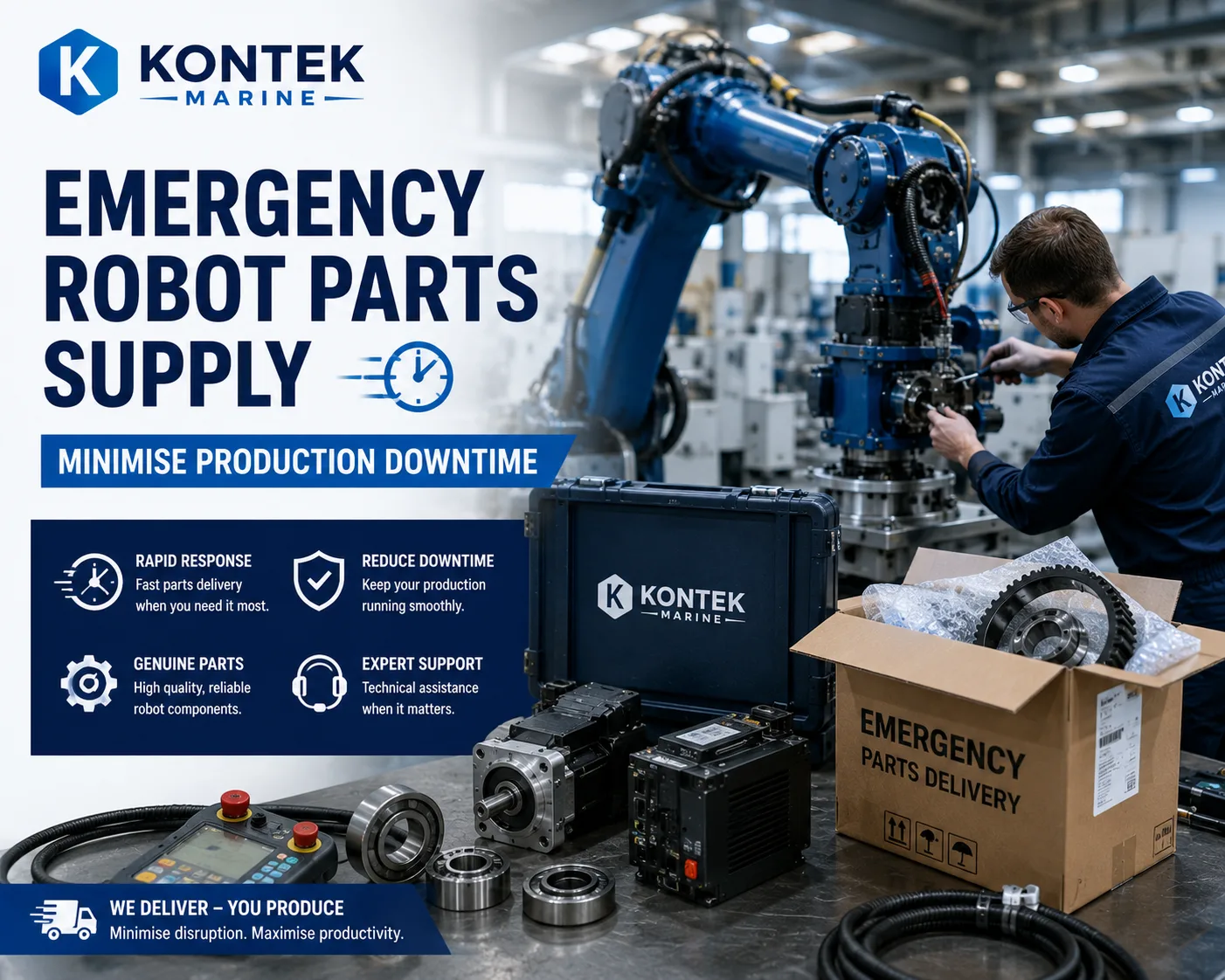
Emergency Robot Parts Supply Minimise Production Downtime
A Robot Cell Failure Has No Convenient Timing
Robotic production cells do not fail during scheduled downtime. They fail mid-shift, during peak production windows, or at the start of a critical run, whenever the failure is least convenient for the plant. The response time from failure to parts identification, sourcing, and delivery is what determines how many hours or days of production are lost.
Robotics Automation Solutions emergency support exists precisely for this moment. A genuine emergency parts mobilisation capability is what manufacturers need when the preventive maintenance window has already passed, and a production cell is down now, not next week.
What Happens When a Robotic Cell Fails Without a Parts Plan
The failure sequence in a robotic cell without pre-arranged emergency parts access typically follows a predictable and expensive pattern. The maintenance team identifies the failed component. A request is submitted to standard procurement channels. Lead times are confirmed as often 3 to 10 working days for a non-stocked OEM part. Production waits, and the cost accumulates with every hour.
For automotive, electronics, and pharmaceutical manufacturers running automated cells that are critical to daily output targets, a 3- to 10-day wait is not acceptable. The commercial consequences of missed deliveries, contractual penalties, and cascading supply chain disruption exceed the cost of the part itself by orders of magnitude. In many cases, the part costs a few thousand dollars, while the associated production loss and penalty exposure run into a much larger figure by the time the line is back up.
This is exactly the gap that emergency parts access is designed to close. It is the missing element in Robotics Automation Solutions that otherwise deliver strong day-to-day performance but leave plants exposed the moment an unexpected failure occurs, and the standard procurement clock starts running.
The International Federation of Robotics publishes data on manufacturing robot downtime costs and operational continuity in automated production at ifr.org, a useful reference point for quantifying the business case for emergency parts readiness.
How Kontek Marine's Emergency Parts Mobilisation Works
When a robotic cell fails unexpectedly, Kontek Marine's team acts quickly to identify, source, and deliver the required components with minimal delay. The process begins with the robot brand, model, and failed component description, from which the technical team confirms the correct part before sourcing begins. No substitutions are made without confirmation.
Sourcing is conducted through Kontek Marine's worldwide supplier network, the same network that supports end-of-life and hard-to-find parts procurement. For FANUC, ABB, KUKA, Yaskawa, and Kawasaki systems, parts access across servo drives, controller boards, encoders, and cable harnesses is available through verified supply channels. Because the network is already established and not built from scratch after a failure, dispatch can begin as soon as the part is confirmed rather than waiting on a fresh supplier search.
This emergency response capability sits inside a broader Robotics Automation Solutions framework that also includes parts procurement, technical support, and preventive maintenance under one service relationship, so a failing cell is never dependent on a one-off transaction with an unfamiliar supplier.
For facilities specifically running FANUC systems, it's worth taking the time to explore Kontek Marine's FANUC robot parts supply ahead of any failure, so the sourcing relationship is already established. More broadly, plants can explore Kontek Marine's complete industrial services to understand how emergency response fits alongside routine parts and maintenance support.
Parts Categories Covered for Emergency Supply
- Servo drives — urgent replacement drives for FANUC, ABB, KUKA, and Yaskawa robot axis control systems, with compatibility confirmed before dispatch
- Robot controller boards — CPU cards, I/O modules, power supply units, and communication interfaces for emergency controller restoration
- Encoders — replacement encoder assemblies for axis position feedback systems, critical for immediate robot recommissioning
- Teach pendants — emergency replacement teach pendants for operational systems where the pendant failure prevents robot operation
Cable harnesses — robot cable assemblies sourced urgently for cable failure situations in high-cycle production environments
Each of these categories is handled through the same urgency-based process, keeping emergency parts access consistent regardless of which component has failed in the Robotics Automation Solutions supporting the cell.
ABB's technical support resources for urgent robot system failures are available through ABB Robotics at useful for teams cross-checking fault diagnostics before calling for parts. Automotive plants, in particular, can explore Kontek Marine's automotive robotics support for emergency coverage tailored to high-cycle welding and assembly cells.
What to Have Ready When Calling for Emergency Robot Parts
- Robot brand and model confirm which part family applies and narrow the identification process immediately
- Part description or failed component name: servo drive, encoder, controller card, teach pendant, cable assembly
- Part number, if available, accelerates sourcing but is not required
- Production criticality helps Kontek Marine prioritise dispatch routing and freight method
- Delivery location determines the fastest logistics route from the India-based facility or from the nearest network distributor
Conclusion
Emergency robot cell failures do not become manageable because of the quality of the robot they become manageable because of the quality of the parts supplier behind the maintenance team. That is the practical value a properly resourced Robotics Automation Solutions partner adds the moment a cell goes down. To get ahead of the next unexpected failure, contact Kontek Marine for emergency robot parts support.
FAQ
Q1: How quickly does Kontek Marine respond to emergency robot parts requests?
The team acts immediately on emergency requests; identification is confirmed, and sourcing begins without delay. Delivery timeframe depends on the part and the manufacturing location, but urgency-based procurement is standard.
Q2: Does Kontek Marine verify part compatibility before emergency dispatch?
Yes, no substitutions are made without confirmation. The technical team confirms the correct part against the robot brand, model, and component description before sourcing and dispatch.
Q3: Which robot brands are covered for emergency parts supply?
FANUC, ABB, KUKA, Yaskawa, and Kawasaki are the primary brands, covering servo drives, controller boards, encoders, teach pendants, and cable harnesses.
Q4: Can Kontek Marine supply emergency parts for a robot with no available part number?
Yes. The technical team identifies the correct part from a component description and robot system details. A full part number is helpful but not required to start the sourcing process.
Q5: What information speeds up an emergency parts request?
Robot brand, model, and a clear description of the failed component are the minimum. Adding a part number, delivery location, and production criticality level allows the team to prioritise the most effective sourcing and delivery route.