Three dimensional scanning has become an increasingly important technology across modern engineering, education, manufacturing, design, and digital fabrication. By converting physical objects into digital information, 3D scanning can help organizations and individuals connect real world components with digital workflows.
EINSTAR 3D scanning equipment is designed to support a broad range of applications, including engineering projects, educational activities, 3D printing, personal manufacturing, and aftermarket development. The ability to capture physical geometry digitally can provide a useful foundation for design, documentation, prototyping, and manufacturing activities.
Understanding 3D Scanning Equipment
3D scanning equipment combines scanning hardware and supporting software to capture information about the shape and geometry of physical objects. Instead of relying entirely on manual measurements, users can create digital representations that can become part of a broader workflow.
The exact scanning process depends on the equipment, object, environment, and intended application. Different projects can require different approaches, which makes flexibility an important consideration when selecting scanning equipment.
EINSTAR solutions can be relevant to users who need to work with physical objects and incorporate their geometry into digital processes.
Supporting Engineering Workflows
Engineering is one of the major areas where 3D scanning can provide practical value. Engineers often need to work with existing components, prototypes, mechanical parts, and other physical objects.
When original digital design files are unavailable, scanning can provide a way to capture the geometry of an existing object. The resulting information can then serve as a digital reference for subsequent engineering activities.
This can support design development, customization, documentation, and other technical workflows.
Capturing Existing Components
Many engineering projects begin with existing physical components rather than newly manufactured objects.
A 3D scanner can help capture the geometry of these components and bring the information into a digital environment. This can make it easier to reference physical parts during later stages of design and development.
The approach can be particularly useful for aftermarket work and projects involving older components for which original digital models may not be readily available.
Supporting Product Development
Product development often involves multiple stages of design, prototyping, evaluation, and refinement.
3D scanning can contribute to this process by allowing physical prototypes or reference objects to be converted into digital information.
Designers and engineers can use captured geometry as a starting point for additional modeling and development. This can create a connection between physical prototypes and digital design workflows.
Supporting Aftermarket Applications
Aftermarket development frequently requires working with existing products and components. Replacement parts, customized components, and modified designs may need to match the geometry of an existing object.
3D scanning equipment can provide digital information about physical components, helping users incorporate existing geometry into new development workflows.
This can be useful for automotive components, mechanical parts, product customization, and other aftermarket applications.
3D Scanning in Manufacturing
Manufacturing increasingly relies on digital information. Product designs, prototypes, measurements, and production references can all become part of connected digital workflows.
3D scanning can help bridge the gap between physical objects and digital manufacturing by creating digital representations of existing components. EINSTAR 3d scanning equipment supports workflows related to engineering, manufacturing, education, and 3D printing applications.
These representations can support design development, prototyping, manufacturing preparation, and other production-related activities.
Supporting 3D Printing
3D printing is one of the most accessible manufacturing applications for 3D scanning.
An existing physical object can be scanned and converted into digital information. After suitable processing and design adjustments, the resulting model can become part of a 3D printing workflow.
This can be useful for personal manufacturing, prototyping, customization, and product development.
The combination of scanning and 3D printing allows users to move between physical references and digitally manufactured objects.
Personal Manufacturing Applications
Personal manufacturing allows individuals to create and customize physical products using digital tools.
3D scanning can expand these possibilities by allowing users to capture existing objects and use them as references for new designs.
A creator may scan an object, process the digital information, make modifications, and prepare the resulting design for 3D printing or another manufacturing method.
This workflow can support experimentation and customization without requiring every design to be created entirely from the beginning.
Educational Applications
Education is another important field for 3D scanning technology.
Students can use scanners to learn how physical objects are transformed into digital models. This provides practical exposure to concepts involving digital design, engineering, manufacturing, and 3D printing.
Educational projects can involve scanning everyday objects, prototypes, models, or technical components and then exploring the resulting digital information.
Introducing Digital Manufacturing Concepts
Traditional classroom instruction can explain digital manufacturing concepts theoretically, but hands on scanning can provide an additional practical dimension.
Students can observe how a physical object becomes digital information and how that information can be used in later stages of a manufacturing workflow.
This can help connect concepts such as three dimensional modeling, scanning, digital fabrication, and physical production.
Supporting STEM Learning
Three dimensional scanning can be incorporated into science, technology, engineering, and mathematics learning activities.
Students can explore object geometry, digital models, engineering concepts, and manufacturing processes through practical projects.
This can encourage experimentation and help learners understand how digital technologies are used in real world applications.
Handheld and Portable Scanning Solutions
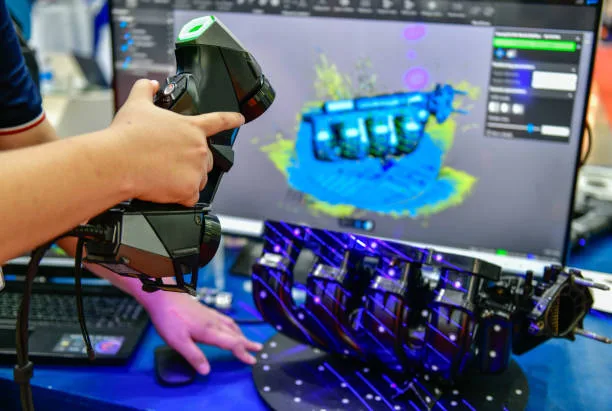
Different projects require different scanning environments. Handheld and portable scanning equipment can provide flexibility when users need to move around an object or work outside a fixed scanning station.
This can be particularly useful for larger components, objects located in workshops, or projects where transportation is inconvenient.
Portable scanning can therefore complement desktop scanning by providing another approach for different working conditions.
Desktop Scanning Solutions
Desktop scanning provides a more controlled environment for suitable objects.
Smaller components, prototypes, models, and other objects can be positioned within a dedicated scanning workspace. This can be convenient for projects where mobility is not the primary requirement.
A desktop workflow can also provide a practical setup for repeated scanning activities in educational, engineering, or design environments.
Capturing Complex Geometry
Physical objects can contain curved surfaces, irregular shapes, recessed areas, and other geometric features that may be difficult to reproduce manually.
3D scanning equipment can help capture these characteristics digitally. The resulting information can then provide a useful reference for subsequent design and engineering work.
This can be especially valuable when working with existing components that need to be incorporated into modern digital workflows.
Creating Digital References
One of the key benefits of 3D scanning is the ability to create digital references from physical objects.
A digital reference can support many different activities. Engineers can use it for product development, designers can use it as a modeling reference, manufacturers can use it during development, and educators can use it for learning projects.
The same fundamental scanning technology can therefore support different workflows depending on the user's objectives.
Supporting Prototyping and Iteration
Modern product development often involves repeated iterations. A prototype can be created, evaluated, modified, and produced again.
3D scanning can support this cycle by converting physical prototypes into digital references.
The captured information can be reviewed and incorporated into further design work, creating a continuous relationship between physical and digital development.
Combining Scanning With Digital Modeling
Scanning does not necessarily replace conventional digital modeling. Instead, the two technologies can work together.
A scanner can capture physical geometry, while modeling software can be used to refine, modify, or develop the digital representation.
This combination provides flexibility for projects where the starting point is an existing physical object but the final objective involves a new or modified design.
Supporting Engineering Documentation
Documentation can be important for engineering and manufacturing projects. Digital representations of physical components can provide useful references for future work.
Scanning can help create such references, particularly when physical objects need to be incorporated into a digital documentation system.
This can contribute to more connected workflows between physical components and digital information.
Improving Workflow Flexibility
Different industries and projects have different requirements. Some users may need to scan small components in a controlled environment, while others may need to capture larger objects in a workshop or manufacturing facility.
A range of scanning equipment can provide flexibility by allowing users to select an approach that matches their working conditions.
This can make it easier to integrate 3D scanning into existing engineering, educational, and manufacturing processes.
Considerations When Choosing Scanning Equipment
Selecting appropriate 3D scanning equipment requires consideration of the intended application.
Object size is an important factor. Users should determine whether their projects involve small components, medium sized objects, or larger physical structures.
The working environment should also be considered. Desktop systems can be suitable for controlled spaces, while portable or handheld solutions can provide additional mobility.
The desired digital output is another important consideration. Projects involving 3D printing may have different requirements from engineering documentation or educational activities.
Developing an Efficient Scanning Workflow
An effective scanning workflow begins with a clear objective.
Users should identify the object they want to capture, determine what information is required, and consider how the digital data will eventually be used.
The physical object can then be prepared for scanning. After data capture, the information can be reviewed and processed before being incorporated into design, engineering, education, or manufacturing activities.
Planning each stage can help create a more organized and efficient workflow.
The Role of Software
Scanning hardware is only one component of a complete 3D scanning workflow. Software plays an important role in processing captured information and preparing digital models.
Depending on the application, scanned information may need to be reviewed, aligned, processed, or prepared for another digital environment.
The combination of appropriate hardware and software can help users move efficiently from physical capture to digital application.
Applications Across Multiple Industries
The broad range of potential applications demonstrates the versatility of 3D scanning technology.
Engineering teams can use scanning for existing components and product development. Manufacturers can incorporate scanned information into digital workflows. Educators can use scanning to teach digital manufacturing concepts. Creators can combine scanning with personal manufacturing and 3D printing.
This broad applicability makes 3D scanning relevant to organizations with very different objectives.
The Future of Digital Manufacturing
As manufacturing continues to become more digital, technologies that connect physical objects with digital information are likely to remain important.
3D scanning provides one of these connections by allowing real world geometry to enter digital workflows.
Combined with digital modeling, 3D printing, and other manufacturing technologies, scanning can contribute to increasingly connected approaches to product development and production.
Conclusion
EINSTAR 3D scanning equipment provides opportunities to incorporate physical object digitization into engineering, education, manufacturing, 3D printing, personal manufacturing, and aftermarket workflows.
The technology can help capture existing components, create digital references, support product development, document physical objects, and provide starting points for further digital design.
For engineering teams, scanning can support work with existing components and prototypes. For manufacturers, it can contribute to digital production workflows. For educators, it can provide hands on opportunities to explore digital manufacturing. For individual creators, it can open new possibilities for personal manufacturing and 3D printing.
By connecting physical objects with digital information, 3D scanning can help organizations and individuals develop more flexible approaches to design, engineering, education, and manufacturing. As digital workflows continue to evolve, versatile scanning equipment can remain an important part of the modern manufacturing and design landscape.