
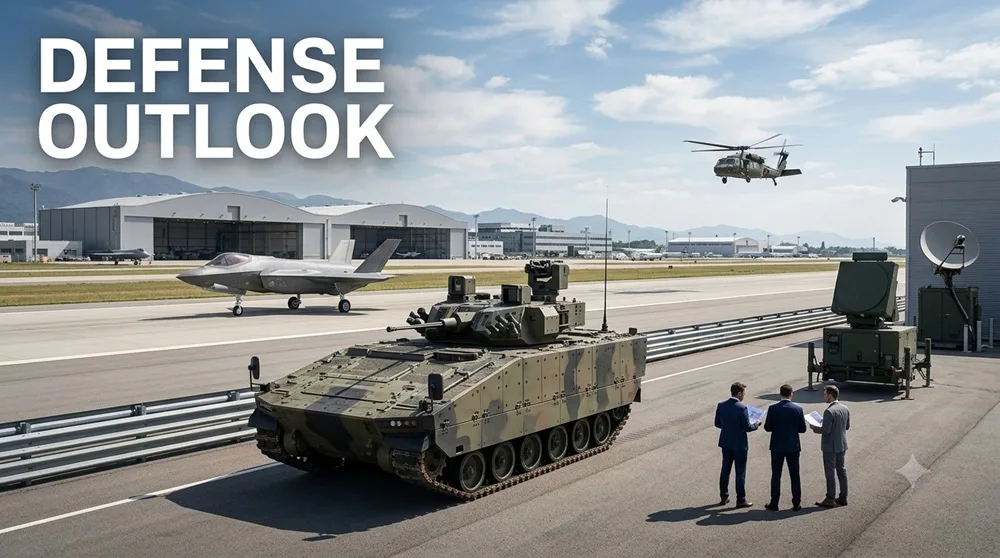
The global defense outlook is being shaped by geopolitical tensions, rising military expenditure, technological modernization, and the growing adoption of autonomous and cyber capabilities. BIS Research estimates that the cumulative defense budget of the top 30 countries will reach $29,031.67 billion during 2023–2033, with a 5.37% CAGR. The defense industry is increasingly focused on multi-domain capabilities spanning air, land, sea, space, and cyberspace.
What are the Key Drivers Shaping the Defense Outlook?
- Rising defense procurement: Increasing investments in fighter aircraft, multi-mission helicopters, naval platforms, missile systems, and other advanced military assets are supporting defense modernization.
- Growing adoption of autonomous systems: Autonomous platforms are gaining importance across military applications as armed forces seek improved operational efficiency, situational awareness, and reduced personnel exposure.
- Geopolitical tensions: Regional conflicts, territorial disputes, and evolving security threats are encouraging governments to strengthen military readiness and accelerate procurement programs.
- Government-led modernization programs: Long-term defense contracts and investments in next-generation capabilities are supporting the development and deployment of advanced systems across multiple military domains.
Get An Updated Sample for Defense Outlook - Focus on Key Enabling Technologies, Geo-Political Risks, and Country Analysis and Forecast, 2023-2033
How is the Defense Industry Impacting Global Security?
The defense industry influences global security by accelerating technological innovation and strengthening military capabilities across air, land, sea, and space domains. Advanced systems improve surveillance, deterrence, mobility, and battlefield effectiveness while also influencing international alliances and procurement relationships. At the same time, the spread of sophisticated technologies can create new security challenges and dependencies, making responsible acquisition and strategic cooperation increasingly important.
What are the Key Trends Influencing the Defense Industry?
- Expansion of hypersonic capabilities: Hypersonic missiles and next-generation missile defense systems are becoming important areas of strategic investment.
- Growth of military space capabilities: Space-based intelligence, surveillance, and reconnaissance, commercial small satellites, and dedicated space forces are becoming increasingly important to defense planning.
- Digitalization of warfare: Cyber warfare, the Internet of Military Things, artificial intelligence, robotics, and connected battlefield technologies are transforming military operations.
- Increasing defense industry indigenization: Countries are strengthening domestic manufacturing capabilities and local supply chains to reduce import dependency and improve strategic autonomy.
Which Countries are Shaping the Global Defense Outlook?
The global defense outlook covers 30 major defense-spending countries, including the U.S., China, Russia, India, Germany, Australia, the U.K., Saudi Arabia, France, South Korea, Japan, Italy, Canada, Ukraine, the U.A.E., Turkey, Israel, Poland, Brazil, Taiwan, the Netherlands, Spain, Singapore, Algeria, Indonesia, Oman, Kuwait, Colombia, Pakistan, and Norway. Their defense priorities vary according to geopolitical risks, modernization requirements, domestic industrial capabilities, and emerging military technologies.
What are the Major Challenges and Opportunities?
The defense industry faces challenges associated with long procurement cycles, high import dependency, and substantial manufacturing costs, particularly for complex air and space systems. Integrating emerging technologies into existing military infrastructure can also require significant investment and specialized expertise.
At the same time, substantial opportunities are emerging from the digital battlefield, Internet of Military Things, autonomous systems, and aging military fleets. Fleet replacement and modernization programs can generate demand for advanced platforms, while connected defense architectures can create opportunities for technology providers across sensing, communications, cybersecurity, and command-and-control applications.
Who are the Key Players in the Defense Industry?
- Lockheed Martin Corporation
- Raytheon Technologies Corporation
- The Boeing Company
- Northrop Grumman Corporation
- BAE Systems
- Airbus S.A.S
- Thales Group
- Embraer SA
- Leonardo S.p.A.
- Textron Systems Aviation
- Dassault Aviation
- General Dynamics
- Saab AB
- Tactical Missiles Corporation
- MBDA Missile System
Get More Insights for Defense Industry
Conclusion
The global defense outlook is expected to remain shaped by geopolitical uncertainty, modernization programs, and rapid technological advancement. Rising defense budgets are creating opportunities across aerospace, missile systems, autonomous platforms, cybersecurity, and space capabilities. As countries strengthen military readiness and domestic defense ecosystems, industry participants with advanced technologies, scalable solutions, and integrated capabilities are well positioned for sustained growth.