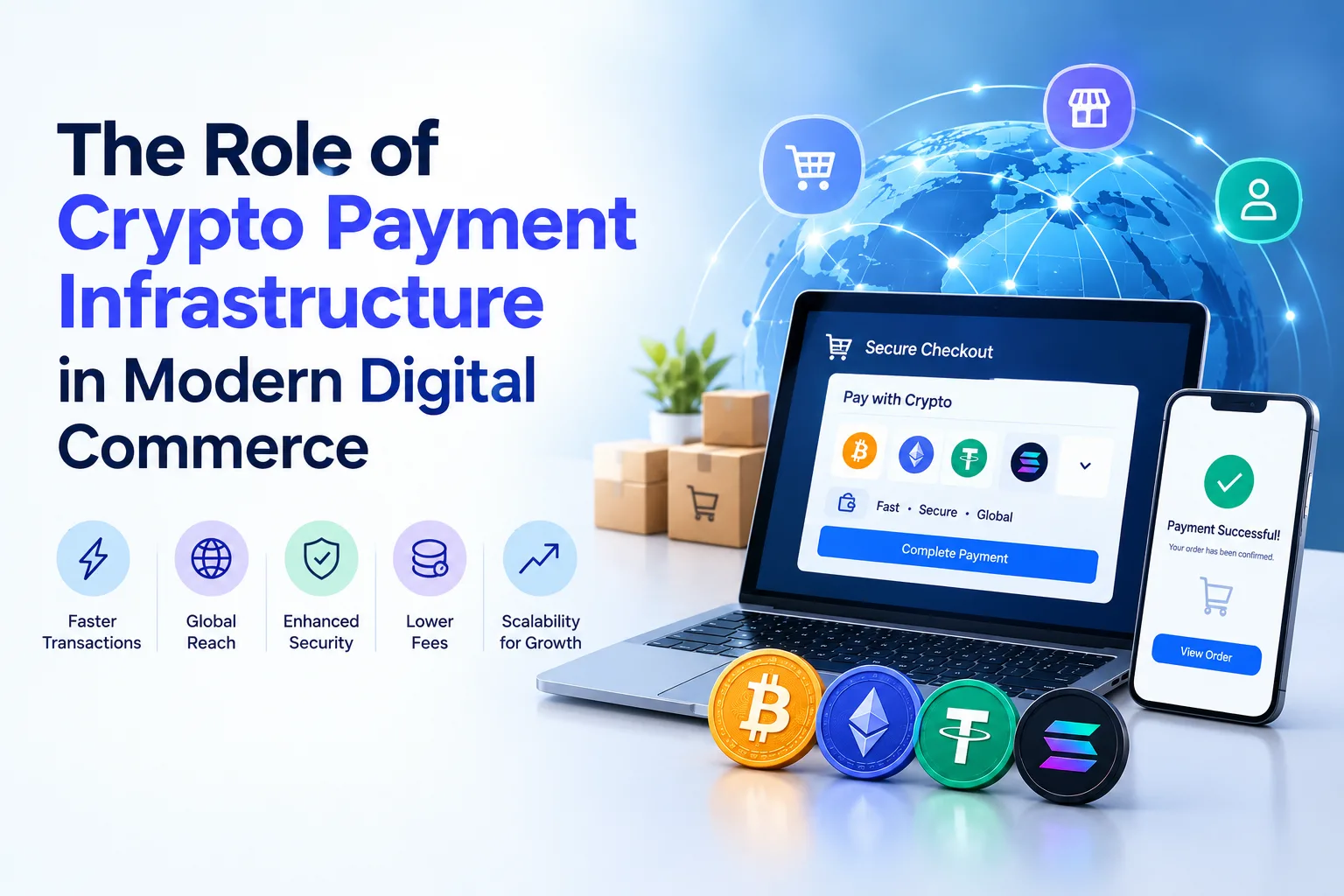

Cryptocurrency Development in 2026: What Businesses Need to Know Before Building
Cryptocurrency development has moved well beyond creating a token and deploying a smart contract. In 2026, businesses entering the blockchain sector face a more mature market shaped by institutional adoption, stablecoins, tokenized assets, Layer 2 networks, stronger security expectations, and increasingly detailed regulatory requirements. The technical decision is no longer simply whether to use blockchain. Businesses must determine why blockchain is necessary, which network architecture fits the use case, how digital assets will be governed, and how the product will operate within applicable regulations.
Why Businesses Are Investing in Cryptocurrency Development in 2026
The cryptocurrency industry has increasingly moved toward practical business applications. Companies are exploring blockchain for payments, asset tokenization, decentralized finance, digital ownership, loyalty systems, gaming, settlement, and financial infrastructure.
A 2026 Coinbase and EY-Parthenon survey of 351 institutional investors found that nearly three-quarters planned to increase digital-asset allocations. The survey also reported strong institutional interest in stablecoins and tokenized assets. This suggests that blockchain is becoming increasingly connected to financial infrastructure rather than being viewed solely as a speculative technology.
For businesses, this creates an important distinction. Cryptocurrency development should not begin with the question, "Which blockchain should we use?" It should begin with, "What business problem are we trying to solve?"
Define the Business Case Before Choosing a Blockchain
Blockchain can provide value when a business needs shared ownership, programmable transactions, transparent settlement, digital scarcity, or decentralized coordination.
For a financial platform, blockchain may provide programmable settlement and digital asset ownership. For a gaming company, it can support transferable digital assets. A global payment business may use stablecoins for cross-border value transfers. A real-world asset platform can use tokens to represent economic rights associated with financial instruments or physical assets.
Blockchain is not suitable for every application, so businesses should first define clear goals such as reducing costs, improving auditability, enabling digital ownership, or supporting programmable transactions. An experienced Cryptocurrency Development Company like Blockchain App Factory can help select the right blockchain architecture and provide support for token development, smart contracts, wallets, and decentralized applications while considering security, scalability, integration, and long-term project needs.
How to Choose the Right Blockchain Architecture
Blockchain selection has become more complex because businesses can choose from Layer 1 networks, Layer 2 networks, application-specific chains, and other specialized infrastructure.
Ethereum remains a major development ecosystem, while Layer 2 networks have become increasingly important for applications requiring higher transaction volumes and lower costs. Ethereum's Dencun upgrade introduced EIP-4844, which added data blobs intended to reduce the cost of posting rollup data.
For businesses, this means the architecture decision should consider more than transaction fees. A suitable blockchain should align with the application's technical and commercial requirements.
Important factors include:
- Transaction throughput and expected demand
- Smart-contract development ecosystem
- Wallet and exchange compatibility
- Network security and decentralization
- Transaction finality
- Developer tooling
- Liquidity and ecosystem maturity
- Cross-chain requirements
- Long-term infrastructure costs
A network that appears inexpensive during initial development may create problems later if it has limited infrastructure, liquidity, developer support, or ecosystem adoption.
Why Stablecoins Matter for Cryptocurrency Development
Stablecoins have become one of the most important areas for businesses developing blockchain-based financial products.
Stablecoins can provide businesses with programmable digital payment infrastructure without exposing every transaction to the volatility associated with assets such as Bitcoin or Ether.
Potential applications include cross-border payments, merchant settlement, remittances, treasury management, payroll, digital marketplaces, and financial applications.
Chainalysis reported significant stablecoin transaction activity during 2024 and 2025, with USDT and USDC accounting for a substantial share of stablecoin usage.
However, businesses should distinguish between using stablecoins and issuing a stablecoin.
Integrating an established stablecoin can involve wallet infrastructure, transaction monitoring, payment processing, settlement logic, and compliance controls. Issuing a stablecoin introduces additional responsibilities involving reserves, redemption, custody, disclosures, governance, and regulatory requirements.
The smart contract is only one component of a stablecoin business.
Tokenization: Turning Real-World Assets Into Digital Assets
Tokenization is another important direction in cryptocurrency development.
A token can represent ownership, access rights, claims, financial interests, or other economic relationships. This has created opportunities for businesses working with real estate, funds, bonds, commodities, intellectual property, and other assets.
The development of tokenized financial products also demonstrates why tokenization requires more than blockchain programming. A token representing a real-world asset must connect the blockchain record with legal ownership, custody, investor rights, valuation, reporting, and settlement.
For example, if a token represents an interest in an asset, developers need to determine how ownership is established, who can hold the token, how transfers are restricted, and what happens if the underlying asset changes.
The fundamental challenge is therefore not simply creating the token. It is ensuring that the digital representation accurately reflects legally and economically meaningful rights.
Smart Contract Security Should Start at the Development Stage
Smart-contract security should be considered from the beginning rather than immediately before launch.
A vulnerability in a contract controlling valuable assets can have serious financial consequences. Development teams need to assess access controls, upgrade mechanisms, administrative privileges, oracle dependencies, transaction validation, reentrancy risks, and emergency procedures.
Independent audits are valuable, but an audit alone does not guarantee security. A stronger approach combines secure development practices with automated testing, code reviews, audit processes, controlled deployment, monitoring, and incident-response planning.
Security also extends beyond smart contracts. Wallets, private-key management, APIs, bridges, authentication systems, databases, and administrative interfaces can all become potential attack surfaces.
For businesses targeting institutional users, security is particularly important because large organizations often evaluate custody arrangements, signing processes, compliance controls, and operational risk before adopting blockchain infrastructure.
How Regulatory Compliance Shapes Cryptocurrency Development
Regulation can influence almost every part of a cryptocurrency product.
Depending on the business model and jurisdiction, requirements may involve securities regulations, money transmission, consumer protection, stablecoin rules, taxation, sanctions screening, know-your-customer procedures, custody, licensing, and data protection.
A cryptocurrency exchange, token issuer, decentralized protocol, payment platform, and tokenized securities marketplace can face very different regulatory obligations.
This makes legal and compliance planning an architectural issue rather than an administrative task.
For example, if a platform requires customer identification, transaction monitoring, geographic restrictions, or investor eligibility checks, these requirements can influence onboarding, wallet architecture, transaction flows, data storage, and administrative permissions.
Businesses operating internationally should also avoid assuming that compliance in one jurisdiction automatically provides authorization elsewhere.
User Experience and Blockchain Interoperability
A technically advanced blockchain application can still struggle if users find it difficult to use.
Many users do not want to understand gas fees, network switching, blockchain confirmations, private keys, or transaction signing. Businesses therefore need to decide which blockchain complexity should remain visible and which should be simplified.
Smart wallets, account abstraction, embedded wallets, sponsored transactions, fiat on-ramps, and simplified network selection can reduce friction.
Interoperability is equally important. Applications may need to interact with several blockchains, wallets, stablecoins, exchanges, or external financial systems.
Cross-chain infrastructure can expand functionality, but it also introduces additional security assumptions. Businesses should therefore evaluate whether multi-chain support is genuinely necessary before adding it to the architecture.
Understanding the Real Cost of Cryptocurrency Development
The cost of cryptocurrency development extends well beyond writing smart contracts and launching a website.
A serious project may require blockchain developers, smart-contract engineers, backend developers, frontend developers, DevOps specialists, security professionals, UI/UX designers, auditors, legal advisors, and compliance specialists.
There are also continuing costs associated with infrastructure, security monitoring, audits, blockchain nodes, third-party APIs, custody systems, compliance tools, maintenance, and incident response.
This is particularly important for financial applications. Development does not end when the first version is launched. Blockchain networks change, regulations evolve, vulnerabilities emerge, and product requirements develop alongside user adoption.
Businesses should therefore budget for both initial development and long-term maintenance.
What Businesses Should Prepare Before Starting Development
Before beginning cryptocurrency development, businesses should establish a clear product and technical specification.
This should cover the business model, target users, jurisdictions, digital asset structure, blockchain architecture, custody model, revenue model, security requirements, compliance strategy, and expected transaction volume.
A practical development process generally starts with feasibility analysis and architecture planning. This can then move into token design, prototype development, smart-contract development, security testing, integration, auditing, and controlled deployment.
Tokenomics should also be examined carefully when a project includes a native token. Supply, allocation, vesting, utility, governance, liquidity, incentives, and treasury management should have a genuine connection to the project's economic model.
A token should serve a defined purpose rather than exist simply because blockchain technology makes token creation easy.
Key Technology Trends Shaping Cryptocurrency Development in 2026
Several developments are influencing how businesses approach blockchain products.
Layer 2 networks are making high-volume applications more practical. Stablecoins are becoming increasingly relevant to payment infrastructure. Tokenization is expanding into financial markets. Smart-wallet technologies are reducing user friction. Meanwhile, institutional participation is placing greater emphasis on compliance, custody, security, and governance.
These trends suggest that cryptocurrency development is becoming increasingly integrated with existing financial and enterprise systems.
The strongest projects will not necessarily be those with the most complicated blockchain architecture. They will be those that use blockchain where it provides a clear advantage while keeping unnecessary technical complexity away from users.
The Future of Cryptocurrency Development for Businesses
Cryptocurrency development in 2026 is increasingly about building practical digital infrastructure rather than simply launching tokens.
Businesses are using blockchain to investigate faster settlement, programmable payments, tokenized assets, decentralized applications, and new financial models. At the same time, higher institutional participation is raising expectations around security, compliance, governance, and operational reliability.
For businesses considering cryptocurrency development, the most important decision is not which blockchain is currently popular. It is whether the proposed architecture can support the project's business model, regulatory requirements, security standards, user experience, and long-term operating needs.
A successful cryptocurrency project should therefore be designed as a business system first and a blockchain application second. When technology, economics, security, compliance, and user requirements are considered together from the beginning, blockchain becomes a practical component of the product rather than an expensive feature added after the fact.
Conclusion
Cryptocurrency development in 2026 requires more than selecting a blockchain and building a token. Businesses need to evaluate the use case, architecture, security, compliance, tokenomics, user experience, and long-term operating costs before development begins. With stablecoins, Layer 2 networks, and asset tokenization creating new opportunities, the focus is shifting toward practical blockchain applications with clear business value. Companies that approach development with careful planning and a strong understanding of technical and regulatory requirements can build cryptocurrency products that are secure, usable, and sustainable over the long term.