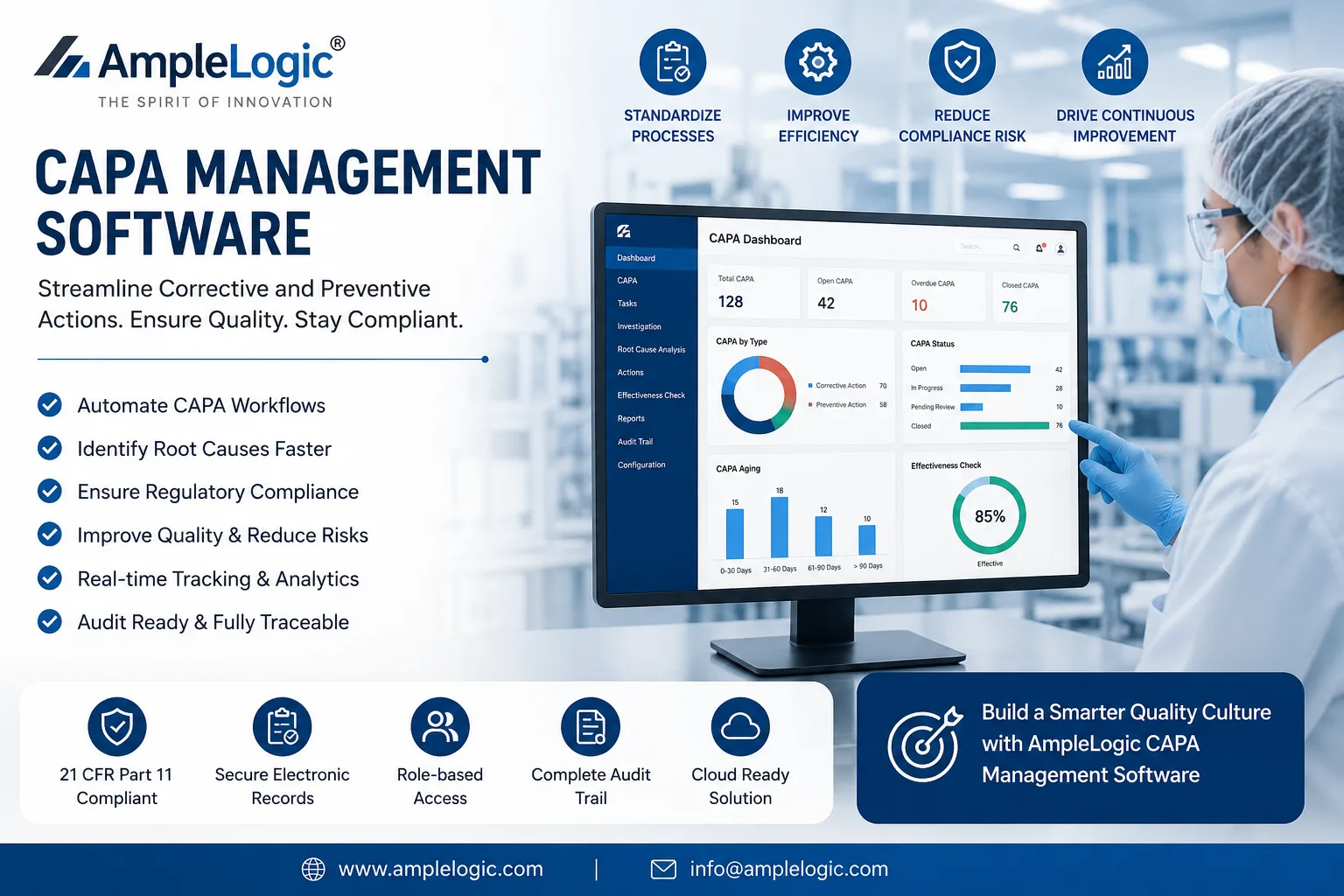
In regulated industries, maintaining product quality and ensuring compliance is a continuous challenge rather than a one-time effort. Organisations today are increasingly turning to CAPA management software to strengthen their quality frameworks, reduce operational risks, and ensure systematic handling of deviations and non-conformances.
As discussed by AmpleLogic, CAPA management software enables life sciences organisations to digitally manage corrective and preventive actions with improved traceability, structured workflows, and regulatory alignment throughout the quality lifecycle (amplelogic.com).
What CAPA Management Software Really Does
At its core, CAPA management software is designed to ensure that quality issues are not only resolved but also prevented from recurring. It provides a structured digital environment where organisations can capture quality events, investigate root causes, define corrective actions, and verify effectiveness.
Unlike traditional manual approaches, which rely heavily on spreadsheets and isolated documentation, CAPA software centralises all activities into a single system, ensuring transparency and consistency across departments.
AmpleLogic emphasises that CAPA is a foundational component of a modern Quality Management System (QMS), helping organisations maintain regulatory compliance and operational control (amplelogic.com).
The Role of CAPA in Modern Quality Systems
CAPA is not just a compliance requirement—it is a critical mechanism for continuous improvement. It ensures that organizations move beyond reactive problem-solving and adopt a proactive quality mindset.
Key roles of CAPA include:
- Identifying systemic quality issues
- Preventing recurrence of deviations
- Supporting regulatory inspections and audits
- Improving manufacturing and operational consistency
- Driving data-based decision-making
In highly regulated environments such as pharmaceuticals and medical devices, CAPA is essential for maintaining product integrity and patient safety.
How CAPA Management Software Streamlines Operations
Modern CAPA platforms introduce automation and intelligence into quality management workflows. These systems help organizations reduce manual effort while increasing accuracy and compliance.
1. Digital CAPA Initiation
Quality events such as deviations, complaints, and audit findings automatically trigger CAPA records within the system.
2. Structured Root Cause Analysis
The software provides tools to systematically analyze issues using standardized methodologies, ensuring consistency in investigations.
3. Automated Workflow Execution
Tasks are assigned, monitored, and escalated automatically to ensure accountability and timely completion.
4. Comprehensive Documentation
Every step is recorded in a secure audit trail, ensuring full traceability for regulatory inspections.
5. Effectiveness Validation
The system ensures that implemented corrective and preventive actions are evaluated for effectiveness before closure.
CAPA Lifecycle in a Digital Environment
A well-implemented CAPA system follows a structured lifecycle:
- Detection of Quality Issue
- CAPA Creation and Categorization
- Investigation and Root Cause Analysis
- Action Planning and Approval
- Implementation of Corrective & Preventive Actions
- Effectiveness Review
- Formal Closure with Documentation
This structured approach ensures that no step is overlooked and that all actions remain fully traceable and auditable.
Key Benefits of CAPA Management Software
The adoption of CAPA management software provides both operational and strategic advantages:
Improved Regulatory Compliance
Supports adherence to global standards such as FDA regulations, GMP guidelines, and ISO requirements.
Increased Operational Efficiency
Automation reduces delays and eliminates manual tracking inefficiencies.
Enhanced Visibility and Control
Real-time dashboards provide insights into ongoing quality issues and trends.
Reduced Risk Exposure
Systematic corrective actions minimize the likelihood of recurring deviations.
Stronger Continuous Improvement Culture
Organizations can identify patterns and implement long-term improvements based on data.
According to AmpleLogic, integrated CAPA systems help organizations create a unified quality ecosystem where all processes are interconnected and efficiently managed (amplelogic.com).
CAPA Within a Connected Quality Ecosystem
In modern enterprises, CAPA does not operate in isolation. It is tightly integrated with other quality processes such as:
- Deviation Management
- Change Control
- Audit Management
- Complaint Handling
- Document Management
This integration ensures seamless communication between processes, reduces duplication of effort, and improves overall quality governance.
CAPA management software has become a critical enabler for organizations aiming to achieve high standards of quality, compliance, and operational excellence. It transforms traditional manual processes into structured, automated, and highly traceable workflows.
As highlighted by AmpleLogic, modern CAPA systems provide end-to-end lifecycle management, regulatory compliance support, and integration with broader QMS frameworks—making them essential for regulated industries seeking sustainable quality improvement (amplelogic.com).
Ultimately, CAPA management software is not just a compliance tool—it is a strategic asset for building resilient, efficient, and continuously improving quality systems.