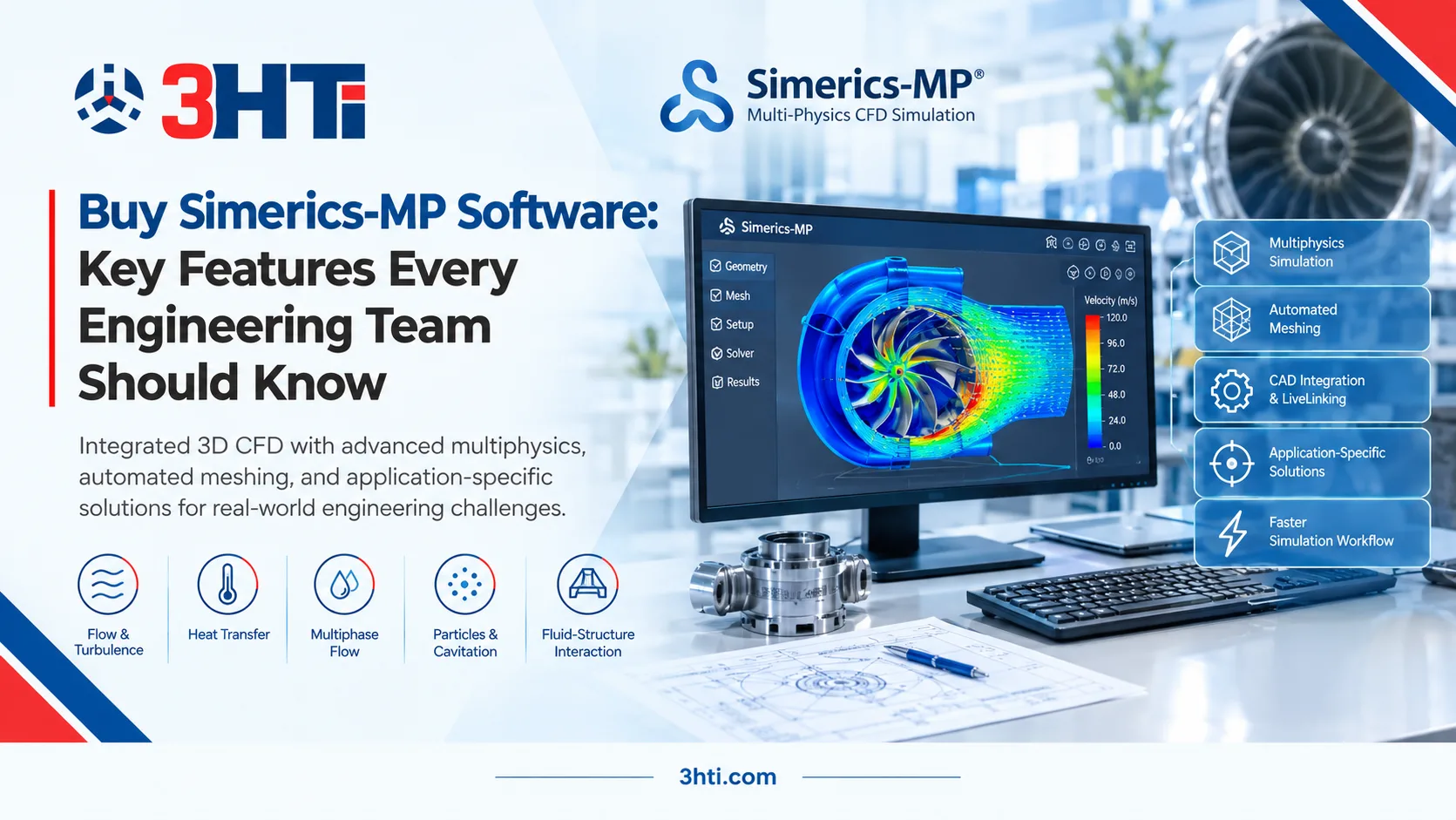
If you plan to buy Simerics-MP software, the key question is not simply which CFD package to purchase. Engineering teams should evaluate how the software handles CAD geometry, meshing, multiphysics, transient analysis, complex geometries, and the specific physical phenomena they need to model.
Simerics-MP is a 3D computational fluid dynamics (CFD) environment designed for multi-purpose applications involving single-phase and multiphase flow, turbulence, cavitation, heat and mass transfer, particles, and fluid-structure interaction. Its built-in meshing workflow is designed to work directly from CAD surfaces, reducing the need for conventional CAD cleanup.
For enterprise engineering organizations, the most important evaluation criteria are therefore physics coverage, geometry handling, simulation speed, workflow automation, application fit, and the level of engineering support required.
Key Takeaways
- Simerics-MP combines preprocessing, meshing, simulation, and post-processing within an integrated CFD environment.
- Its physics capabilities include flow, turbulence, conjugate heat transfer, multiphase flow, cavitation, aeration, particles, and fluid-structure interaction.
- The built-in mesher can generate meshes directly from CAD surfaces and is designed to reduce or eliminate conventional CAD-cleanup work.
- Simerics-MP+ extends the core platform with application-specific capabilities, including vehicle, marine, turbomachinery, positive-displacement, valve, and integrated fluid-system applications.
- Simerics-MP should be evaluated against the team's actual physics and workflow requirements rather than against generic CFD feature lists.
- Click2Cast should not be treated as a Simerics-MP module; current references identify Click2Cast with casting-simulation products outside the Simerics-MP platform.
What Should You Know Before You Buy Simerics-MP Software?
When engineering teams buy Simerics-MP software, they are investing in more than a CFD solver. The platform is intended to support a complete simulation workflow, from CAD geometry and mesh generation through physics definition, solving, and post-processing.
That makes workflow efficiency an important consideration alongside numerical capabilities.
A useful evaluation framework is:
CAD geometry → Mesh → Physics → Solver → Results → Engineering decision
If a CFD platform performs well across that chain, it can become part of the engineering development process rather than remaining an isolated analysis tool.
Integrated 3D CFD Capabilities
The core Simerics-MP platform provides 3D CFD capabilities for a broad range of fluid and thermal applications. Its published physics include flow, turbulence, conjugate heat transfer, multiphase flow, cavitation/aeration, particles, and fluid-structure interaction.
This breadth matters for products where multiple physical phenomena interact.
For example, an engineering team analyzing a pump may need to investigate flow performance and pressure behavior while also considering cavitation. A thermal-management application may require fluid flow and conjugate heat transfer rather than a flow-only model.
The practical evaluation question is therefore not simply “Does it support CFD?”, but “Does its physics cover the failure modes and performance variables that matter to our product?”
CAD-to-Simulation Workflow
One of the notable features of Simerics-MP is its approach to geometry preparation.
Its built-in general-purpose mesher generates a body-fitted binary-tree mesh directly from CAD surfaces. Simerics states that the workflow does not require conventional CAD cleaning and can automatically generate separated fluid and solid domains for conjugate heat-transfer applications.
For organizations with frequent design iterations, this can be significant.
The value is not simply fewer preprocessing steps. Reducing geometry-preparation effort can make CFD more practical earlier in the product-development cycle, when engineering teams may need to evaluate multiple design variants.
Multiphase Flow, Cavitation, and Complex Physics
Many engineering products involve physics that are difficult to represent with simplified single-phase models.
Simerics-MP includes multiphase capabilities using a Volume of Fluid (VOF) approach for applications involving phase interfaces, heat transfer, surface tension, and liquid-solid contact angle. Its published capabilities also include cavitation and aeration modeling.
These capabilities can be relevant to:
- Pumps and hydraulic machinery
- Compressors
- Valves
- Thermal-management systems
- Marine applications
- Fluid-processing equipment
- Integrated fluid systems
For a prospective buyer, this is an important differentiator because the required physics should determine the software configuration—not the other way around.
Simerics-MP vs Simerics-MP+
Another important purchasing decision is understanding the difference between the core platform and its vertical extensions.
Simerics-MP+ includes the capabilities of Simerics-MP while adding features such as streamlined setup, automated mesh/remesh for selected components, and customized data reduction. Its application-specific offerings include Vehicle, Marine, Turbo, Positive Displacement, Valves, and Systems.
This distinction is particularly relevant to enterprise teams.
A general CFD workflow may be sufficient for broad multiphysics analysis, while a team working extensively with pumps, valves, turbomachinery, vehicles, or integrated fluid systems may benefit from a specialized Simerics-MP+ configuration.
Simulation Speed Is More Than Solver Runtime
When organizations compare CFD software, they often focus on solver performance. However, total simulation time also includes geometry preparation, meshing, setup, convergence, post-processing, and result interpretation.
Simerics publishes fast model-creation and simulation workflows, including application-specific examples such as less than an hour from CAD to simulation for some Simerics-MP+ applications. These are vendor-reported capabilities and should be validated against the organization's own geometry, physics, hardware, and modeling requirements.
That last qualification is important: benchmark claims should not be generalized across every model or hardware configuration.
Where Does Click2Cast Fit?
The secondary keyword Click2Cast requires particular care.
Click2Cast is associated with casting simulation rather than being a core Simerics-MP CFD capability. Current industry references identify Click2Cast as the former name of a casting-simulation product now associated with Altair Inspire Cast.
Therefore, an engineering organization researching Simerics-MP should not assume that purchasing Simerics-MP provides Click2Cast functionality.
If casting simulation is part of the engineering requirement, it should be evaluated as a separate software capability and procurement consideration.
When Should You Consider CFD Simulation Services?
Buying software is only one part of establishing an effective simulation workflow.
Teams with limited CFD resources, unusual multiphysics problems, or a need to validate a methodology may also consider CFD simulation services alongside software acquisition. 3HTi describes its simulation services as including CFD, FEA, generative design and topology optimization, tolerance analysis, and other engineering analysis services.
This creates three practical deployment models:
- Software only — appropriate when the organization already has sufficient CFD expertise.
- Software plus training/support — useful when engineers need to establish an internal simulation capability.
- Software plus contracted simulation services — useful when specialized analysis capacity is required alongside internal engineering resources.
For organizations evaluating implementation, 3HTi's simulation services provide a relevant complement to software procurement.
A Practical Simerics-MP Buying Checklist
Before you buy Simerics-MP software, engineering and IT stakeholders should document:
- Required physics and multiphysics interactions
- CAD systems and geometry formats
- Typical model size and geometric complexity
- Steady-state versus transient requirements
- Need for multiphase, cavitation, or moving components
- Local workstation versus HPC requirements
- Required post-processing and reporting workflows
- Training and technical-support expectations
- Integration with existing engineering processes
- Whether a general Simerics-MP configuration or specialized Simerics-MP+ application is appropriate
A technical evaluation using representative production geometry is generally more informative than selecting software from a feature checklist alone.
3HTi's Simerics-MP+ software information can be used as a starting point when assessing the available application-specific capabilities.
Conclusion
To buy Simerics-MP software effectively, engineering leaders should evaluate the complete simulation workflow rather than focusing on solver features alone. CAD handling, automated meshing, multiphysics coverage, cavitation and multiphase capabilities, simulation performance, and application-specific extensions can all affect the software's practical value.
For organizations with specialized requirements, the decision should also distinguish between Simerics-MP, Simerics-MP+, and separate technologies such as casting simulation tools. A representative technical evaluation can then determine whether the platform aligns with the team's products, physics, CAD environment, computational infrastructure, and engineering processes.
FAQs
What is Simerics-MP software used for?
Simerics-MP is a 3D CFD simulation environment used for virtual testing of fluid and thermal systems. Its published capabilities cover flow, turbulence, heat transfer, multiphase flow, cavitation, particles, and fluid-structure interaction across a range of engineering applications.
Is Simerics-MP suitable for complex geometries?
Yes. Simerics-MP includes an automated meshing workflow designed to generate meshes directly from CAD surfaces. Simerics states that its mesher can handle complex geometry and detailed features while reducing the need for conventional CAD cleanup.
What is the difference between Simerics-MP and Simerics-MP+?
Simerics-MP provides the core multipurpose CFD capabilities. Simerics-MP+ builds on that foundation with streamlined setup, automated mesh/remesh capabilities for selected components, customized data reduction, and vertical applications such as vehicle, marine, turbomachinery, valves, positive-displacement machinery, and integrated systems.
Does Simerics-MP support multiphase flow?
Yes. Simerics-MP includes multiphase-flow capabilities and a VOF-based approach for applications involving phase interfaces, heat transfer, surface tension, and liquid-solid contact angle.
Is Click2Cast part of Simerics-MP?
No. Click2Cast is associated with casting simulation and should not be presented as a Simerics-MP feature. Current references identify Click2Cast as the former name of Altair Inspire Cast.