
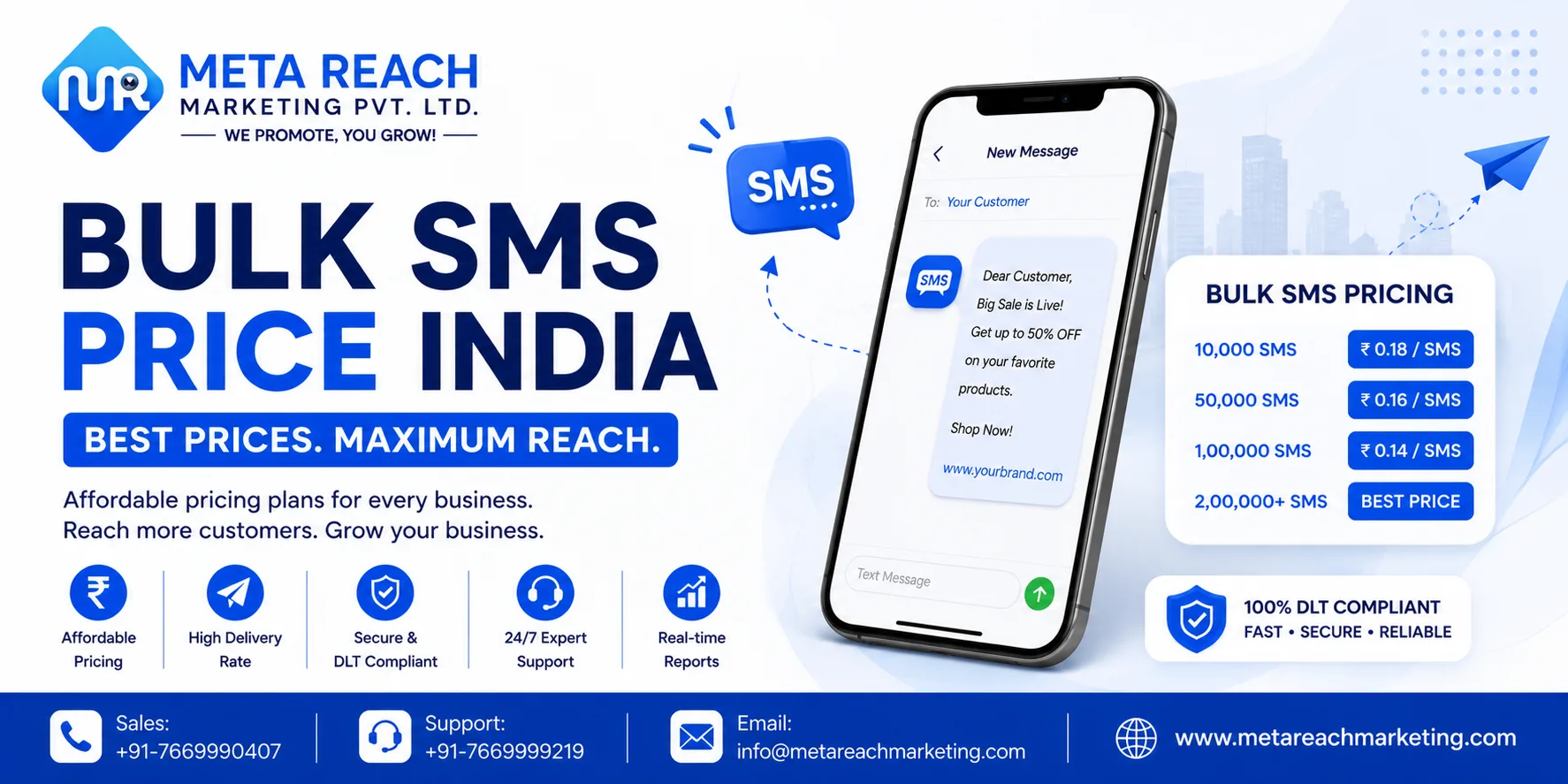
The lowest per-message rate on a bulk SMS quote is rarely the whole story, and businesses that sign up based on that single number alone are frequently surprised by what actually shows up on their first invoice. None of this typically involves outright dishonesty; it is usually a matter of a headline rate excluding several real costs that a business only discovers once they are already a customer. Knowing exactly which fees to ask about before signing anything protects a business from this exact surprise.
The DLT 'Service Fee' Layered on Top of the Mandatory Telecom Charge
Every business sending bulk SMS in India must pay a fixed, one-time DLT registration fee to the telecom operator, and this specific charge is genuinely non-negotiable regardless of which SMS provider a business chooses. What varies enormously is whether a provider charges an additional service fee on top of this mandatory cost to help a business navigate the registration paperwork. Some providers absorb this entirely as part of standard onboarding, while others quietly add a separate charge that can run into a few thousand rupees before a single message has even been sent. This is one of the first questions worth asking directly, since it directly affects the real cost of simply getting started, independent of the per-message rate a business will eventually pay.
Template Rejection and Resubmission Charges
TRAI's DLT framework requires every message template to be pre-approved before it can be used, and rejections during this process are genuinely common, particularly for first-time senders unfamiliar with what triggers a rejection. Some providers include unlimited template resubmission as part of standard support, treating a rejected template as a normal part of the onboarding process to be resolved without extra charge. Others quietly bill a per-attempt fee for each resubmission, which can add up meaningfully if a business is iterating on message wording during initial setup. This is worth clarifying explicitly before committing, since a business new to bulk SMS should reasonably expect at least one or two template rejections during its first campaign setup.
Minimum Monthly Commitments Disguised as 'Better Rates'
A lower advertised per-message rate sometimes comes attached to a minimum monthly volume commitment that gets billed in full regardless of whether a business actually sends that many messages. A business quoted an attractive rate at a specific tier should always ask directly whether that rate requires a minimum monthly spend, and what happens financially in a slower month when actual usage falls below that threshold. For a business with genuinely predictable, high monthly volume, this kind of commitment can be a reasonable trade for a better rate. For a newer or seasonal business with more variable sending patterns, a slightly higher per-message rate with no minimum commitment often works out cheaper overall once the numbers are actually run.
API Access Charged as a Premium Feature
For any business planning to integrate bulk SMS into a website, app, or CRM rather than sending manually through a dashboard, API access is essential rather than optional. Some providers include REST API access as a standard feature across all plans, while others reserve it for a higher-priced tier, effectively forcing a business that needs automation to pay for features it may not otherwise need just to unlock API integration. It is worth confirming upfront whether API access, and ideally SMPP connectivity for higher-volume enterprise integration, is included at the plan tier a business is actually evaluating, rather than assuming it comes standard everywhere.
For a transparent, no-surprises rate card covering exactly what is included at every pricing tier in India, this bulk SMS price page for India lays out current rates and inclusions clearly, without fees hidden behind a follow-up sales call.
Charges for Failed or Undelivered Messages
Perhaps the most consequential billing distinction, and one many businesses never think to ask about, is whether a provider bills for every message attempted or only for messages genuinely delivered. A contact list inevitably includes some invalid, disconnected, or unreachable numbers, and a provider that charges for every send attempt regardless of outcome is effectively billing a business for messages that were never going to arrive in the first place. A provider that only charges on confirmed delivery offers a meaningfully fairer pricing structure, and the difference can be substantial for a business with an older or less-maintained contact list where invalid numbers make up a larger share of the total.
A Short Checklist Before Signing Any SMS Contract
Before committing to any provider, it is worth getting clear, written answers to a handful of specific questions: is GST already included in the quoted rate, is there any DLT service fee beyond the mandatory telecom charge, are template resubmissions free or billed per attempt, does the quoted rate require a minimum monthly commitment, is API access included at this specific tier, and is billing based on delivered messages or attempted sends. A provider willing to answer every one of these plainly, in writing, before a contract is signed, is a considerably safer long-term choice than one that keeps pricing details vague until a business is already locked in.
Businesses across India wanting bulk SMS pricing with no hidden DLT service fees, free template support, no minimum volume lock-in, and delivery-only billing can explore what MetaReach Marketing offers with fully transparent pricing laid out before any commitment is required.
In short, the real cost of bulk SMS in India rarely comes down to the single per-message number quoted on a first call. It comes down to what that number includes, and what it quietly leaves out. Asking the right questions before signing, rather than discovering the gaps on a first invoice, is the difference between a genuinely competitive rate and a cheap-looking quote that turns out to cost considerably more than expected.