Global Biodegradable Bone Graft Polymers Market to Reach USD 6,240.0 Million by 2034, Driven by Rising Demand for Advanced Bone Regeneration Solutions
The Global Biodegradable Bone Graft Polymers Market is witnessing remarkable growth as healthcare providers increasingly adopt advanced biomaterials for orthopedic, dental, and trauma-related procedures. These biodegradable polymers provide temporary structural support while naturally degrading over time, eliminating the need for secondary surgeries and promoting effective bone regeneration. As demand for minimally invasive procedures and regenerative medicine continues to grow, the market is expected to experience steady expansion over the coming years.
The market is benefiting from continuous advancements in biomaterial science, improved surgical techniques, and the increasing prevalence of musculoskeletal disorders worldwide. Healthcare professionals are prioritizing graft materials that offer superior biocompatibility, controlled degradation, and enhanced healing performance. As a result, biodegradable bone graft polymers are becoming a preferred choice for both surgeons and patients seeking improved clinical outcomes.
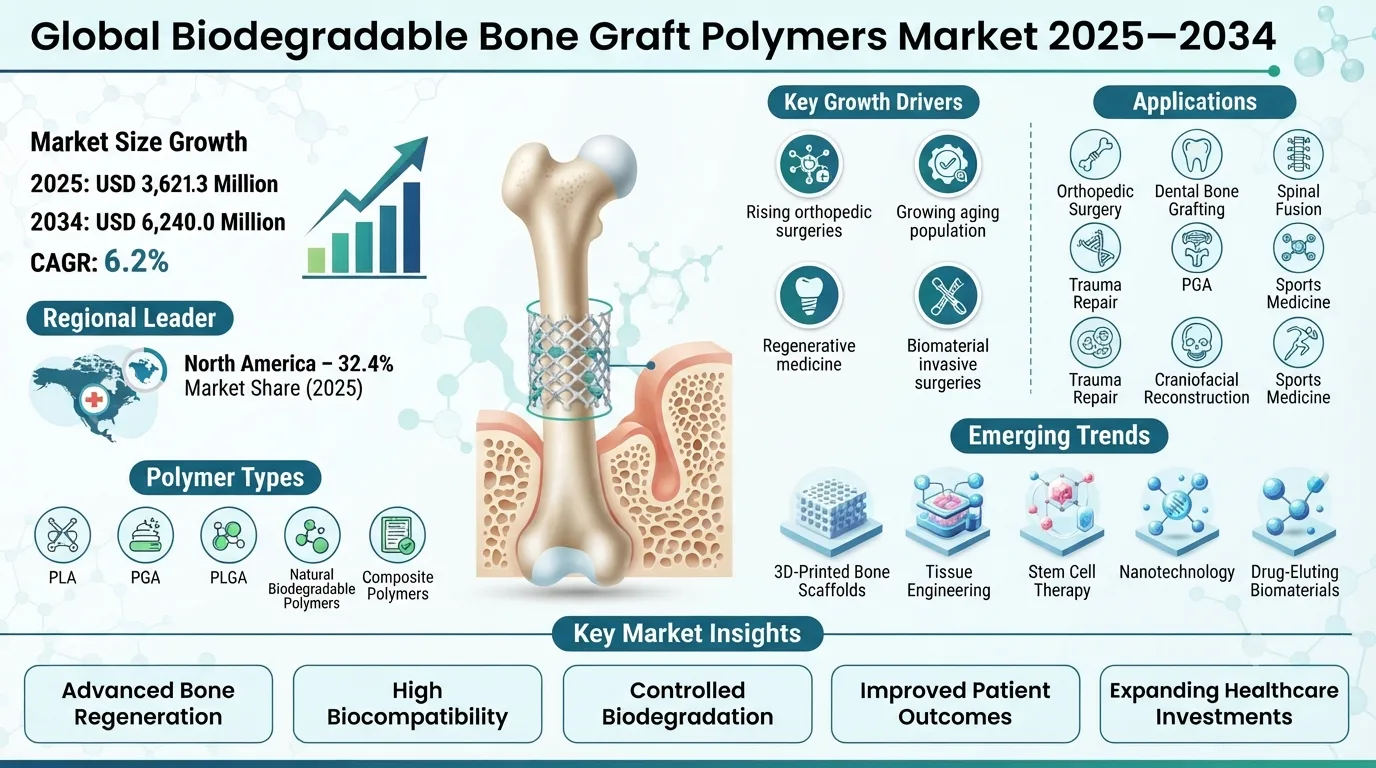
The Global Biodegradable Bone Graft Polymers Market is poised for substantial expansion, rising from USD 3,621.3 million in 2025 to approximately USD 6,240.0 million by 2034, reflecting a robust CAGR of 6.2% during the forecast period. Growing investments in healthcare innovation, rising orthopedic procedures, and increasing awareness regarding regenerative treatment options are expected to support long-term market growth.
Download a Complimentary PDF Sample Report:
https://dimensionmarketresearch.com/request-sample/biodegradable-bone-graft-polymers-market/
Understanding Biodegradable Bone Graft Polymers
Biodegradable bone graft polymers are specialized biomaterials designed to support bone regeneration while gradually breaking down inside the human body. Unlike permanent implants, these polymers naturally degrade through biological processes after fulfilling their structural function, allowing newly formed bone tissue to replace them over time.
These materials are widely used in orthopedic surgery, spinal fusion, trauma repair, maxillofacial reconstruction, sports medicine, and dental implant procedures. Their ability to reduce complications associated with permanent implants has significantly increased their clinical acceptance.
Common biodegradable polymers used in bone graft applications include:
- Polylactic Acid (PLA)
- Polyglycolic Acid (PGA)
- Polycaprolactone (PCL)
- Poly(lactic-co-glycolic acid) (PLGA)
- Natural polymer-based composites
These materials often serve as scaffolds that facilitate cell attachment, vascularization, and new bone formation.
Market Overview
The biodegradable bone graft polymers industry is becoming increasingly important within regenerative medicine. Modern healthcare systems are emphasizing faster recovery, lower surgical risks, and improved patient outcomes, all of which contribute to rising demand for biodegradable graft materials.
Manufacturers are investing heavily in research and development to improve polymer strength, degradation rates, osteoconductivity, and compatibility with advanced biological agents such as stem cells and growth factors.
The integration of tissue engineering with biodegradable polymers is expected to create significant opportunities across both developed and emerging healthcare markets.
Key Market Growth Drivers
Rising Orthopedic Procedures Worldwide
The increasing number of orthopedic surgeries is one of the strongest growth drivers for the market. Aging populations, sports injuries, osteoporosis, fractures, and degenerative bone diseases continue to increase the demand for effective bone graft materials.
Biodegradable polymers provide surgeons with materials that support healing without requiring implant removal procedures.
Growing Geriatric Population
Older adults experience higher rates of bone degeneration, fractures, and joint disorders. As global life expectancy rises, healthcare providers are performing more bone reconstruction procedures that rely on biodegradable graft materials.
The expanding elderly population creates long-term demand for advanced regenerative products.
Advancements in Biomaterials
Continuous innovation has significantly improved polymer performance.
Modern biodegradable polymers offer:
- Enhanced mechanical strength
- Better biological compatibility
- Controlled degradation rates
- Improved bone integration
- Reduced inflammatory response
These improvements have increased surgeon confidence in adopting biodegradable solutions.
Increasing Dental Implant Procedures
Dental implant surgeries often require bone augmentation before implant placement.
Biodegradable bone graft polymers are increasingly used for:
- Ridge preservation
- Sinus lift procedures
- Periodontal regeneration
- Bone defect repair
Growing cosmetic dentistry trends further support market expansion.
Expanding Regenerative Medicine
Regenerative medicine is transforming bone repair treatments.
Researchers continue developing polymer scaffolds capable of delivering:
- Stem cells
- Growth factors
- Bioactive molecules
- Drug delivery systems
This convergence between biomaterials and regenerative therapies is expected to unlock new treatment possibilities.
Emerging Market Trends
3D-Printed Bone Scaffolds
Additive manufacturing enables customized biodegradable scaffolds that match individual patient anatomy.
Benefits include:
- Personalized implants
- Faster healing
- Better structural support
- Reduced surgical complexity
3D printing is expected to become increasingly important across orthopedic reconstruction.
Composite Biomaterials
Manufacturers are combining biodegradable polymers with ceramics and bioactive materials.
Examples include:
- Hydroxyapatite composites
- Calcium phosphate composites
- Bioactive glass-polymer combinations
These hybrid materials improve both strength and osteoconductive performance.
Smart Biomaterials
Researchers are developing intelligent biodegradable polymers capable of responding to biological environments.
Future materials may:
- Release drugs gradually
- Deliver antibiotics
- Stimulate bone growth
- Control degradation automatically
These innovations represent the next generation of regenerative biomaterials.
Increased Focus on Sustainable Medical Materials
Healthcare organizations are becoming more environmentally conscious.
Biodegradable medical materials reduce long-term waste associated with permanent implants while supporting sustainable healthcare innovation.
Market Challenges
High Product Development Costs
Developing advanced biodegradable polymers requires significant investment in:
- Material research
- Clinical validation
- Manufacturing technologies
- Regulatory approvals
These factors increase product costs.
Complex Regulatory Requirements
Medical biomaterials must meet strict safety and performance standards before commercialization.
Lengthy approval timelines can delay product launches and increase development expenses.
Limited Awareness in Developing Markets
Although adoption is growing rapidly, some emerging healthcare systems continue relying on traditional graft materials due to limited awareness and budget constraints.
Educational initiatives may improve adoption rates over time.
Material Performance Limitations
Different surgical applications require varying degradation rates and mechanical properties.
Manufacturers continue working to balance:
- Strength
- Flexibility
- Degradation timing
- Biological activity
Achieving optimal performance across multiple clinical applications remains a research priority.
Market Segmentation
By Polymer Type
The market can be segmented into:
- Polylactic Acid (PLA)
- Polyglycolic Acid (PGA)
- Polycaprolactone (PCL)
- Poly(lactic-co-glycolic acid) (PLGA)
- Natural biodegradable polymers
- Composite biodegradable polymers
PLGA continues gaining popularity due to its favorable degradation characteristics and excellent biocompatibility.
By Application
Major applications include:
- Orthopedic surgery
- Dental bone grafting
- Spinal fusion
- Trauma repair
- Craniofacial reconstruction
- Sports injury treatment
Orthopedic surgery remains the largest application segment due to increasing fracture repair procedures globally.
By End User
Key end users include:
- Hospitals
- Specialty orthopedic centers
- Dental clinics
- Ambulatory surgical centers
- Research institutions
Hospitals account for a substantial market share because of higher surgical volumes and advanced infrastructure.
Competitive Landscape
The biodegradable bone graft polymers industry is characterized by continuous innovation and product development.
Leading manufacturers focus on:
- Advanced biomaterial technologies
- Strategic collaborations
- Product portfolio expansion
- Manufacturing capacity improvements
- Clinical research
- Geographic expansion
Companies are increasingly investing in regenerative medicine technologies to strengthen long-term competitiveness.
Innovation Opportunities
Several emerging technologies are expected to shape future market growth.
Tissue Engineering
Combining biodegradable polymers with tissue engineering enables the development of highly functional bone regeneration scaffolds.
Stem Cell Integration
Researchers continue exploring polymer matrices capable of supporting stem cell differentiation into bone-forming cells.
Drug-Eluting Scaffolds
Drug-loaded biodegradable polymers can simultaneously support bone growth while reducing infection risk and inflammation.
Nanotechnology
Nanostructured biodegradable polymers improve surface properties, cell attachment, and bone regeneration efficiency.
Nanotechnology is expected to play a major role in future product innovation.
Purchase the report for comprehensive details:
https://dimensionmarketresearch.com/checkout/biodegradable-bone-graft-polymers-market/
Regional Analysis
North America
North America is projected to dominate the global Biodegradable Bone Graft Polymers Market with 32.4% market share in 2025. The region benefits from highly developed healthcare infrastructure, strong presence of leading biotechnology and medical device companies, and widespread adoption of advanced orthopedic and dental grafting technologies.
High healthcare spending, continuous innovation, favorable reimbursement systems, and increasing orthopedic procedures continue supporting regional market leadership.
Europe
Europe represents another significant market driven by expanding aging populations and increasing investments in regenerative medicine.
Countries across the region continue adopting advanced bone graft technologies for orthopedic and dental surgeries while emphasizing minimally invasive treatment approaches.
Growing research collaborations also contribute to technological advancement.
Asia-Pacific
Asia-Pacific is expected to experience the fastest growth during the forecast period.
Key growth factors include:
- Expanding healthcare infrastructure
- Rising healthcare expenditure
- Increasing orthopedic surgeries
- Growing dental tourism
- Large patient population
- Improved access to advanced medical technologies
Countries such as China, India, Japan, and South Korea continue investing heavily in healthcare modernization.
Latin America
Latin America is gradually emerging as a promising market due to improving healthcare access and rising awareness regarding advanced orthopedic treatments.
Increasing private healthcare investments are expected to support future growth.
Middle East & Africa
Healthcare modernization initiatives and infrastructure development are gradually increasing demand for advanced bone regeneration technologies across the Middle East and Africa.
Although market penetration remains comparatively lower, long-term growth opportunities continue expanding.
Future Outlook
The future of the Global Biodegradable Bone Graft Polymers Market appears highly promising.
Several factors are expected to drive sustained expansion:
- Growing global aging population
- Increasing fracture incidence
- Rising sports injuries
- Expanding regenerative medicine
- Continuous biomaterial innovation
- Personalized medical implants
- Growing dental reconstruction procedures
- Advancements in 3D bioprinting
- Increased healthcare investments
As technology continues evolving, biodegradable polymers are expected to become increasingly sophisticated, providing superior healing performance while reducing complications associated with permanent implants.
Frequently Asked Questions (FAQs)
1. What are biodegradable bone graft polymers?
Biodegradable bone graft polymers are biomaterials that provide temporary structural support for bone healing while naturally degrading inside the body as new bone tissue develops.
2. What is driving the growth of the Global Biodegradable Bone Graft Polymers Market?
Major growth drivers include increasing orthopedic procedures, rising geriatric population, advancements in biomaterials, growing dental implant surgeries, and expanding regenerative medicine applications.
3. What is the projected market size by 2034?
The market is expected to grow from USD 3,621.3 million in 2025 to approximately USD 6,240.0 million by 2034, registering a CAGR of 6.2%.
4. Which region leads the market?
North America is expected to dominate the market with 32.4% market share in 2025, supported by advanced healthcare infrastructure, strong biotechnology presence, and high adoption of innovative bone graft technologies.
5. What are the primary applications of biodegradable bone graft polymers?
Major applications include orthopedic surgery, spinal fusion, dental bone grafting, trauma repair, craniofacial reconstruction, and sports medicine.
Summary of Key Insights
The Global Biodegradable Bone Graft Polymers Market is entering a strong growth phase driven by increasing orthopedic procedures, expanding regenerative medicine, and continuous advancements in biomaterial technologies. Rising demand for minimally invasive treatments and biodegradable implants that naturally integrate with the body's healing process is accelerating market adoption.
With the market projected to increase from USD 3,621.3 million in 2025 to USD 6,240.0 million by 2034 at a 6.2% CAGR, manufacturers are focusing on innovation through advanced polymer formulations, composite biomaterials, tissue engineering, nanotechnology, and personalized medical solutions. North America remains the leading regional market due to its established healthcare ecosystem, while Asia-Pacific is expected to witness the fastest future growth as healthcare investments and surgical volumes continue to rise. Overall, biodegradable bone graft polymers are poised to play a vital role in the future of orthopedic, dental, and regenerative healthcare worldwide.