Key Takeaways
- Short-Form Video Is Your Highest-Leverage Habit Posting behind-the-scenes kitchen video 3+ times a week consistently outperforms every other content format. It requires nothing more than a phone and a $30 tripod, yet delivers 2–3x higher engagement than static posts.
- Trust Converts Better Than Promotion UGC and review responses do more to drive reservations than polished branded content. When 92% of consumers trust peer recommendations over ads, your happiest diners are your best marketers.
- Remove Every Barrier Between Discovery and Booking A reservation link in your bio, a "Reserve" button on Instagram, and UTM-tracked links in every caption can meaningfully increase bookings without spending a dollar more on content or ads.
- Local Beats Large Every Time Micro-influencers and geo-targeted ads within a 1–3 mile radius consistently outperform broad campaigns. Hyperlocal reach drives real foot traffic from people who can actually walk through your door tonight.
- Likes Are Vanity, Bookings Are Reality The only metrics worth tracking are reservation clicks, offer redemptions, direct messages, and repeat guest frequency. A strategy that generates 500 likes but zero bookings is not a strategy worth repeating.
Restaurant owners consistently rank social media among their most effective marketing channels,often ahead of email, paid search, and traditional advertising. But “post more” isn’t a restaurant social media marketing strategy, and most restaurant accounts waste their limited posting time on content that doesn’t move a single reservation.
The hard part isn’t picking a platform. It’s knowing which specific restaurant social media strategies actually get diners through the door versus which ones just generate likes. We evaluated the tactics restaurant marketers are using in 2025-2026 against one filter: does it have a measurable link to visits, bookings, or retention?
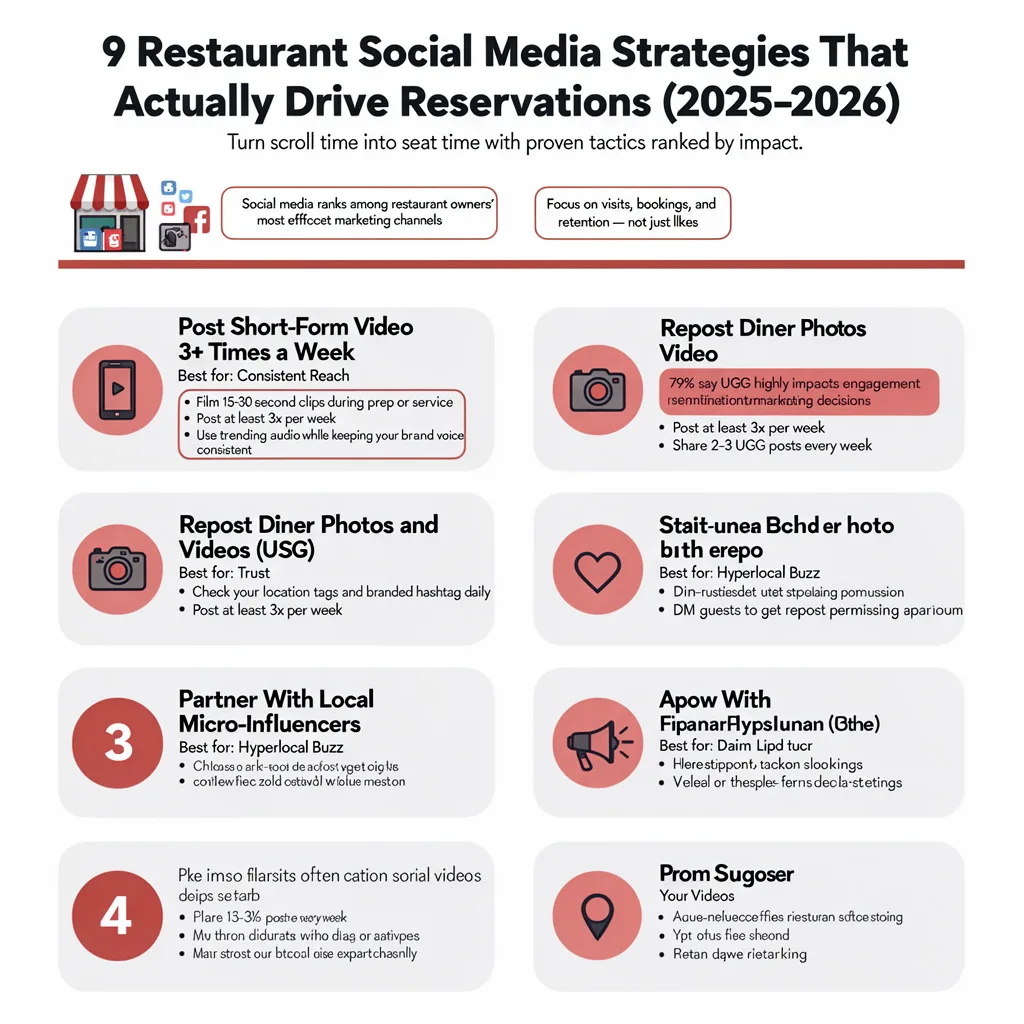
Here are the nine that passed, ranked by impact for a small team with limited time.
1. Post Short-Form Video 3+ Times a Week Best for Consistent Reach
Short-form video is the highest-leverage habit on this list. Restaurants posting behind-the-scenes kitchen footage regularly see 2–3x higher engagement than those relying only on static promotional posts.
Why it works:
Meta reports that video posts on Instagram receive significantly more engagement than static images. Short clips (under 15 seconds) are especially effective for reach and shares,particularly among younger audiences.
Best for: Any restaurant with a visually interesting menu and a phone.
Effort level: Low.
How to get started:
- Set up a simple tripod in your kitchen (under $30).
- Film 15–30 seconds during prep or service.
- Post 3x weekly (e.g., Monday prep, Wednesday lunch rush, Friday signature dish).
- Use trending audio when relevant, but keep your brand voice consistent.
2. Repost Diner Photos and Videos (UGC) Best for Trust
User-generated content (UGC) consistently outperforms branded content in influencing purchase decisions. According to Stackla, 79% of consumers say UGC highly impacts their purchasing decisions.
Why it works:
Nielsen reports that 92% of consumers trust earned media (like peer recommendations) more than paid advertising. Reposting diner content builds trust while reducing your content production workload.
Best for: Restaurants with steady foot traffic and photogenic dishes or interiors.
Effort level: Low.
How to get started:
- Check your location tag and branded hashtag daily.
- DM customers for repost permission.
- Create a branded hashtag and promote it on menus or table tents.
- Repost 2–3 pieces of UGC weekly.
3. Partner With Local Micro-Influencers Best for Hyperlocal Buzz
Micro-influencers (10K–100K followers) often outperform larger creators. Later reports that micro-influencers average significantly higher engagement rates than mega-influencers.
Why it works:
Influencer Marketing Hub reports businesses earn an average of $5.78 for every $1 spent on influencer marketing. Local creators feel authentic and drive real-world visits.
Best for: New openings, menu launches, neighborhood awareness.
Effort level: Medium.
How to get started:
- Search local food hashtags.
- Prioritize creators who already post restaurant content.
- Offer a comped meal in exchange for one Reel + Stories.
- Require location tagging and honest feedback (no scripts).
4. Run Geo-Targeted Ads Within a Few Miles Best for Immediate Foot Traffic
According to Google, 76% of people who search for something nearby on their smartphone visit a business within 24 hours.
Why it works:
Geo-targeted ads ensure your budget is spent only on people close enough to visit. This is one of the fastest ways to turn ad spend into real traffic.
Best for: Slow weekdays, weather dips, new openings.
Effort level: Low.
How to get started:
- Target a 1–3 mile radius.
- Start with $15–30/day.
- Promote a specific offer (e.g., “10% off tonight only”).
- Track redemptions to measure ROI.
5. Put a Reservation Link in Every Post Best for Conversion
OpenTable reports restaurants that make booking frictionless see significantly more reservations from social media traffic.
Why it works:
Every extra click loses potential diners. Direct booking links remove friction at the moment of intent.
Best for: Any restaurant taking reservations.
Effort level: Low.
How to get started:
- Add OpenTable, Resy, or direct booking link to bio.
- Enable Instagram’s “Reserve” button.
- Add “Link in bio to book” to captions.
- Use link stickers in Stories.
- Track booking clicks with UTM parameters.
6. Respond to Every Review Best for Long-Term Trust
BrightLocal’s 2025 survey found that 98% of consumers read online reviews for local businesses, and 89% say a business’s response affects their perception.
Why it works:
Review responses show attentiveness and accountability. Harvard Business School research found responding to reviews can improve ratings over time.
Best for: Every restaurant.
Effort level: Low (ongoing).
How to get started:
- Set a daily 10-minute review block.
- Respond to positives with specifics.
- Address negatives within 24 hours.
- Use templates for efficiency,but personalize them.
- Monitor Google, Yelp, Facebook, and TripAdvisor.
7. Show the Kitchen and the People in It , Best for Authenticity
Sprout Social reports that consumers feel more connected to brands whose leadership is visible on social media. The same applies to chefs and staff.
Why it works:
Behind-the-scenes content creates emotional connection. Competitors can copy your menu,but not your team.
Best for: Restaurants wanting to stand out from generic food posts.
Effort level: Low–Medium.
How to get started:
- Introduce one team member weekly.
- Film prep work and ingredient sourcing.
- Share the story behind a signature dish.
- Keep content raw and authentic.
8. Post Limited-Time Offers , Best for Driving This Week’s Visits
Research shows consumers are significantly more likely to act on time-limited offers versus evergreen promotions. Toast’s Restaurant Success Report notes that limited-time menu items can increase short-term sales.
Why it works:
Urgency turns passive scrolling into action.
Best for: Slow days, new dishes, seasonal items.
Effort level: Low.
How to get started:
- Identify slow service windows.
- Create a specific deadline (“This weekend only”).
- Use countdown stickers in Stories.
- Track redemptions with a code.
9. Post Consistently Best for Sustainable Growth
Hootsuite reports brands that post consistently see significantly higher engagement than those posting sporadically.
Why it works:
Consistency builds familiarity. Familiarity drives repeat visits.
Best for: Every restaurant.
Effort level: Medium.
How to get started:
- Commit to 3–4 posts per week.
- Batch-create content weekly.
- Use a simple content calendar.
- Rotate formats (BTS, dish feature, UGC).
- Schedule posts using tools like Later or Meta Business Suite.
Strategy Comparison
StrategyBest ForEffortKey BenefitShort-form videoConsistent reachLowHigher engagementRepost UGCTrustLowStrong purchase influenceMicro-influencersHyperlocal buzzMediumHigh engagement ratesGeo-targeted adsFast foot trafficLow76% visit within 24 hrsReservation linkConversionLowMore direct bookingsRespond to reviewsLong-term trustLowInfluences perceptionBehind-the-scenesAuthenticityLow–MediumStronger connectionLimited-time offersImmediate visitsLowShort-term sales liftConsistent postingSustainable growthMediumHigher engagementConclusion
Social media works for restaurants when it is built around one goal: getting people through the door. The strategies on this list are not about chasing followers or going viral. They are about building a repeatable system that turns scroll time into seat time.
You do not need a big budget or a full marketing team to make this work. You need consistency, a clear call to action, and the discipline to track what actually drives bookings rather than what just looks good on a dashboard.
Start with short-form video. Fix your booking link. Respond to every review. Then layer in the rest as your capacity grows. The restaurants winning on social media in 2025 are not the ones posting the most polished content. They are the ones showing up consistently, building trust over time, and making it effortless for hungry diners to say yes.
Pick one strategy this week. Track it. Then build from there.
Frequently Asked Questions
What’s the most effective restaurant social media strategy?
Consistency plus short-form video. Posting 3–4 times per week with video content drives both reach and retention.
Do I need a big budget?
No. Most strategies here rely on time, not money. Even paid ads can start at $15/day.
Instagram or TikTok?
TikTok is stronger for discovery. Instagram is stronger for converting followers into bookings. Most restaurants benefit from both.
How long until results?
Ads and booking links can show results within days. Organic consistency compounds over 4–8 weeks.
What metrics matter most?
Track:
- Reservation clicks
- Offer redemptions
- Direct messages
- Social referral traffic
- Repeat guest frequency
Avoid focusing only on follower count.