
Introduction
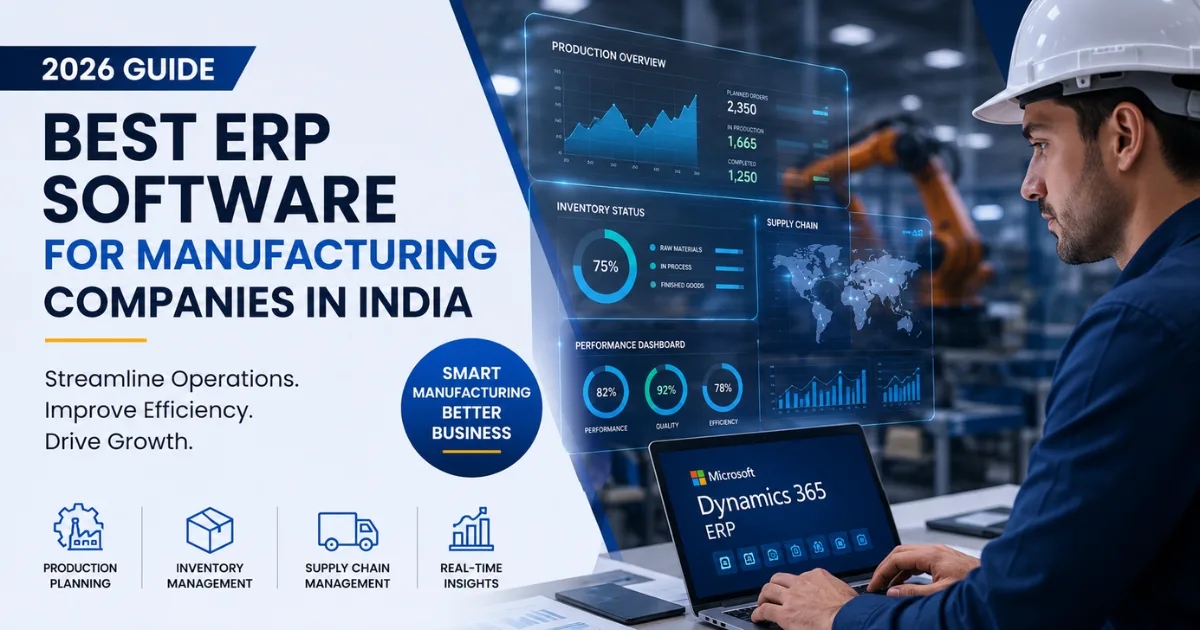
India's manufacturing sector is evolving rapidly. With initiatives like Make in India, increasing global competition, rising customer expectations, and the adoption of Industry 4.0 technologies, manufacturers are under pressure to improve efficiency while keeping costs under control.
However, many businesses still rely on spreadsheets, disconnected software, or outdated legacy systems to manage production, inventory, procurement, finance, and sales. These manual processes often lead to inventory mismatches, production delays, poor demand forecasting, and limited visibility into business performance.
This is where an Enterprise Resource Planning (ERP) system becomes a strategic investment rather than just another software purchase.
The best ERP software for a manufacturing company helps unify every department—from procurement and production to inventory, quality control, finance, sales, and customer service—on a single platform. With real-time data and automated workflows, manufacturers can make faster decisions, reduce operational costs, and improve customer satisfaction.
Whether you're looking for the best ERP for small manufacturing business or an enterprise-grade solution such as Microsoft Dynamics 365 ERP, selecting the right platform can significantly influence your company's long-term growth.
In this guide, we'll explore the leading options for manufacturing ERP software in India, compare Microsoft Dynamics solutions, discuss essential ERP features, and help you identify the right solution based on your business size and operational requirements.
What Is Manufacturing ERP?
Manufacturing ERP is a business management system specifically designed to integrate and automate core manufacturing processes. Instead of managing production, inventory, purchasing, finance, warehouse operations, and customer orders through separate applications, an ERP centralizes everything into one connected platform.
A modern ERP solution provides a single source of truth across the organization, ensuring every department works with accurate, real-time information.
Typical modules include the following:
- Production Planning
- Bill of Materials (BOM)
- Material Requirements Planning (MRP)
- Inventory Management
- Procurement
- Warehouse Management
- Sales & Distribution
- Finance & Accounting
- Quality Management
- Maintenance Management
- Business Intelligence & Reporting
The best solutions also include AI-powered insights, workflow automation, mobile accessibility, cloud deployment, and integration with Microsoft 365 and other business applications.
Why Indian Manufacturing Companies Need ERP
Manufacturers across India face increasing operational complexity. Growing customer expectations, fluctuating raw material costs, regulatory requirements, and expanding supply chains make manual processes increasingly difficult to manage.
Implementing Manufacturing ERP Software in India helps organizations overcome these challenges by improving visibility, standardizing operations, and enabling data-driven decision-making.
Some of the biggest challenges include:
1. Inventory Management Challenges
Many manufacturers struggle with either excess inventory or stock shortages. Overstocking ties up working capital, while stockouts delay production and customer deliveries.
An ERP system provides real-time inventory tracking, automated replenishment, and accurate stock visibility across multiple warehouses.
2. Production Planning Inefficiencies
Without integrated planning, production schedules often rely on manual spreadsheets and assumptions.
ERP software enables:
- Capacity planning
- Production scheduling
- Resource allocation
- Machine utilization tracking
- Material planning
This helps manufacturers improve production efficiency while minimizing downtime.
3. Rising Operational Costs
Manual approvals, duplicate data entry, procurement inefficiencies, and delayed reporting increase operational expenses.
A modern ERP automates repetitive processes, reducing administrative workload while improving overall productivity.
4. Lack of Business Visibility
Business leaders often struggle to answer important operational questions, such as:
- Which products generate the highest profit?
- Which production line performs best?
- What is today's inventory value?
- Which customers contribute the highest revenue?
- What is the current production status?
ERP dashboards provide real-time answers through centralized reporting and analytics.
5. Supply Chain Complexity
Modern manufacturing depends on suppliers, distributors, logistics providers, and multiple warehouse locations.
Integrated ERP systems improve supplier collaboration, procurement planning, and delivery performance.
Solutions such as Dynamics 365 Supply Chain Management offer advanced planning capabilities, helping organizations build more resilient supply chains.
Key Features to Look for in Manufacturing ERP Software
Every manufacturing business has unique operational requirements. However, certain ERP capabilities are essential regardless of company size.
Production Planning
Efficient production planning ensures optimal machine utilization while reducing idle time and production bottlenecks.
Key capabilities include:
- Production scheduling
- Capacity planning
- Work order management
- Resource allocation
Inventory Management
Inventory directly impacts profitability.
A strong ERP should provide the following:
- Real-time stock visibility
- Barcode integration
- Batch tracking
- Serial number tracking
- Warehouse management
- Inventory forecasting
Bill of Materials (BOM)
Manufacturers need complete visibility into product structures.
ERP systems should support:
- Multi-level BOM
- Engineering revisions
- Product variants
- Cost rollups
Material Requirements Planning (MRP)
MRP helps manufacturers purchase the right materials at the right time.
Benefits include:
- Reduced inventory costs
- Better procurement planning
- Lower production delays
- Improved supplier coordination
Quality Management
Maintaining product quality is critical for customer satisfaction and regulatory compliance.
ERP quality modules help manage:
- Inspection plans
- Non-conformance tracking
- Corrective actions
- Quality reporting
- Audit records
Finance Integration
Manufacturing operations directly impact financial performance.
Integrated ERP solutions automatically connect operational transactions with accounting, enabling:
- Real-time financial reporting
- GST-ready accounting
- Cost center tracking
- Budget management
- Cash flow monitoring
Business Intelligence & Dashboards
Modern ERP platforms deliver real-time dashboards instead of static reports.
Decision-makers can monitor:
- Production efficiency
- Sales performance
- Inventory turnover
- Purchase trends
- Profitability
- Cash flow
- KPIs across departments
Best ERP Software for Manufacturing Companies in India
The Indian ERP market offers several powerful solutions. Choosing the right platform depends on your company size, operational complexity, budget, and future growth plans.
Among the leading options, Microsoft Dynamics 365 ERP stands out for organizations seeking scalability, cloud capabilities, AI-driven insights, and seamless integration with Microsoft products.
For growing businesses, Dynamics 365 Business Central Manufacturing offers a comprehensive ERP platform that combines finance, inventory, production, purchasing, sales, and reporting within a single solution.
Larger enterprises with complex manufacturing and global supply chains often choose Dynamics 365 Supply Chain Management, which provides advanced production planning, warehouse management, intelligent forecasting, and AI-powered supply chain optimization.
In the next section, we'll compare these Microsoft ERP solutions in detail and explain which businesses can benefit the most from each platform.
Microsoft Dynamics 365 ERP for Manufacturing
As manufacturing businesses grow, they require more than basic accounting software. They need an intelligent platform that connects finance, production, procurement, inventory, sales, customer service, and analytics.
Microsoft Dynamics 365 ERP is one of the most comprehensive cloud ERP solutions available for manufacturers. Built on Microsoft's secure cloud infrastructure, it enables businesses to automate operations, gain real-time visibility, and make faster, data-driven decisions.
Unlike traditional ERP systems, Microsoft Dynamics 365 integrates seamlessly with Microsoft 365, Power BI, Teams, Power Automate, and AI-powered Copilot, creating a connected digital workplace.
Key Benefits
- Real-time production monitoring
- Integrated finance and operations
- Multi-location inventory management
- Automated procurement workflows
- AI-powered business insights
- Advanced reporting and dashboards
- High-level security and compliance
- Cloud accessibility from anywhere
For manufacturers planning long-term digital transformation, Microsoft Dynamics 365 ERP provides the flexibility to scale without replacing the system as the business grows.
Dynamics 365 Business Central Manufacturing
For small and medium-sized manufacturers, Dynamics 365 Business Central Manufacturing offers an ideal balance of functionality, affordability, and scalability.
Business Central combines accounting, production, inventory, purchasing, warehouse operations, project management, and reporting into a single cloud-based platform.
Instead of maintaining multiple disconnected systems, manufacturers can manage their entire business from one centralized solution.
Core Manufacturing Capabilities
Production Orders
Create and manage production orders with complete visibility into material availability, machine capacity, and production status.
Bill of Materials (BOM)
Maintain accurate product structures with support for:
- Multi-level BOM
- Version management
- Component planning
- Product variants
Routing Management
Define production routes for different products and optimize machine utilization.
Material Requirements Planning (MRP)
Business Central automatically calculates material requirements based on customer demand, inventory levels, and production schedules.
This helps reduce:
- Overstocking
- Material shortages
- Emergency purchasing
- Production delays
Inventory Management
Manufacturers gain complete control over inventory through:
- Batch tracking
- Serial number tracking
- Multiple warehouse management
- Stock transfers
- Inventory valuation
- Automated replenishment
Purchasing Management
Procurement teams can automate supplier management by:
- Creating purchase orders
- Tracking supplier performance
- Managing approvals
- Monitoring delivery schedules
Finance Integration
Unlike standalone manufacturing software, every production transaction updates financial records automatically.
This enables:
- Accurate product costing
- Real-time profitability analysis
- Budget monitoring
- Financial forecasting
Why Manufacturers Choose Dynamics 365 Business Central
Many Indian manufacturers are replacing legacy software because Business Central offers the following:
- Faster implementation
- Lower IT maintenance
- Cloud deployment
- Mobile accessibility
- Easy integration with Microsoft tools
- Flexible customization
- Lower total cost of ownership
For organizations searching for the best ERP for Small Manufacturing Business, Business Central offers enterprise-grade capabilities without the complexity of larger ERP platforms.
Dynamics 365 Supply Chain Management
Large manufacturing organizations often operate multiple factories, warehouses, vendors, distributors, and global supply chains.
Managing such complexity requires advanced planning capabilities.
This is where Dynamics 365 Supply Chain Management becomes a strategic advantage.
The solution is designed for enterprises that need complete visibility across procurement, manufacturing, logistics, inventory, warehousing, transportation, and supplier collaboration.
Major Features
Intelligent Demand Forecasting
AI analyzes historical sales, seasonal demand, and purchasing trends to improve inventory planning.
Production Scheduling
Optimize production based on:
- Machine capacity
- Workforce availability
- Material availability
- Customer priorities
Warehouse Management
Manage multiple warehouses through:
- Barcode scanning
- Mobile devices
- Bin locations
- Pick, pack, and ship automation
Procurement Automation
Improve purchasing efficiency by automating:
- Vendor selection
- Purchase approvals
- Supplier collaboration
- Procurement analytics
Asset Management
Track production equipment and schedule preventive maintenance to reduce downtime.
Supply Chain Visibility
Monitor every stage of the supply chain from raw materials to customer delivery through centralized dashboards.
For manufacturers dealing with high production volumes and complex operations, Dynamics 365 Supply Chain Management delivers greater operational control and resilience.
Microsoft ERP for Manufacturing: Industry Use Cases
Manufacturing companies across India operate in different sectors, each with unique operational requirements.
Microsoft ERP solutions are flexible enough to support multiple industries.
Automotive Manufacturing
Manage production schedules, supplier collaboration, inventory, quality inspections, and warranty tracking.
Food & Beverage Manufacturing
Support batch production, expiry date tracking, recipe management, quality compliance, and inventory traceability.
Pharmaceutical Manufacturing
Maintain regulatory compliance, batch records, quality testing, and controlled inventory.
Engineering & Industrial Equipment
Manage engineer-to-order production, project costing, BOM revisions, and procurement planning.
Steel & Metal Manufacturing
Track raw materials, production planning, scrap management, inventory, and dispatch operations.
Packaging Industry
Improve production planning, inventory control, order management, and warehouse efficiency.
Electronics Manufacturing
Manage serialized inventory, supplier coordination, demand planning, and production scheduling.
Benefits of Implementing Microsoft ERP for Manufacturing
A successful ERP implementation creates measurable improvements across the organization.
Business Area
Business Impact
InventoryReduced excess inventory and stock shortagesProductionBetter planning and higher machine utilizationFinanceReal-time reporting and improved cash flow visibilityProcurementFaster purchasing and supplier collaborationWarehouseImproved inventory accuracySalesBetter order fulfillment and customer satisfactionManagement
Faster decision-making through live dashboards
Best ERP for Small Manufacturing Business
Many small manufacturers believe ERP is only suitable for large enterprises.
In reality, modern cloud ERP platforms have made advanced business management accessible to small and medium-sized businesses.
When evaluating the Best ERP for Small Manufacturing Business, consider the following factors:
Ease of Implementation
The ERP should be deployed quickly without causing major business disruption.
Scalability
Choose software that grows with your business without requiring a complete replacement in the future.
Cloud Access
Cloud deployment eliminates expensive infrastructure and allows teams to work securely from anywhere.
Industry Features
Look for manufacturing-specific capabilities such as the following:
- Production planning
- BOM
- Inventory
- Procurement
- Quality management
- Warehouse management
Reporting
Business leaders need dashboards that provide real-time insights rather than waiting for manual reports.
Integration
The ERP should integrate with:
- Microsoft 365
- Excel
- Outlook
- Power BI
- CRM
- HR systems
Among today's leading options, Dynamics 365 Business Central Manufacturing is widely considered one of the strongest choices for growing manufacturers because it combines comprehensive manufacturing functionality with a user-friendly interface and Microsoft's trusted cloud ecosystem.
How to Choose the Right ERP Software for Your Manufacturing Business
Selecting an ERP system is a long-term business decision. The right solution should not only solve today's operational challenges but also support future growth.
Before investing in an ERP, evaluate the following factors:
1. Understand Your Business Requirements
Start by identifying your current pain points.
Ask questions such as:
- Are production delays affecting deliveries?
- Is inventory difficult to manage?
- Do departments use separate software?
- Are financial reports generated manually?
- Is procurement taking longer than expected?
- Do you have real-time visibility into operations?
A clear understanding of your challenges helps narrow down the right ERP solution.
2. Consider Future Business Growth
Your ERP should support expansion without requiring a complete replacement.
Choose a solution that can easily accommodate:
- New manufacturing plants
- Additional warehouses
- More users
- Higher transaction volumes
- New product lines
- Multi-company operations
Cloud-based platforms such as Microsoft Dynamics 365 ERP are designed to scale as businesses grow.
3. Evaluate Industry-Specific Capabilities
Manufacturing businesses have unique operational requirements that generic business software often cannot handle.
Look for features such as:
- Production Planning
- Material Requirements Planning (MRP)
- Bill of Materials (BOM)
- Shop Floor Control
- Batch & Serial Number Tracking
- Quality Management
- Warehouse Management
- Demand Forecasting
- Procurement Automation
These capabilities are essential for improving efficiency and reducing operational risks.
4. Choose an Experienced ERP Implementation Partner
ERP software alone does not guarantee success.
A knowledgeable implementation partner can help with:
- Business process analysis
- Solution design
- Data migration
- User training
- Customization
- Go-live support
- Post-implementation optimization
An experienced partner ensures the ERP aligns with your business processes and delivers measurable value.
5. Focus on User Adoption
Even the most advanced ERP system will fail if employees do not use it effectively.
Invest in:
- User training
- Change management
- Standard operating procedures (SOPs)
- Role-based access
- Ongoing support
High user adoption leads to faster ROI and smoother day-to-day operations.
Best Practices for ERP Implementation
Successful ERP implementation requires planning, collaboration, and continuous improvement.
Define Clear Business Goals
Set measurable objectives before implementation, such as:
- Reduce inventory carrying costs
- Improve production efficiency
- Increase on-time deliveries
- Reduce manual processes
- Improve reporting accuracy
Clean Your Data
Migrating inaccurate or duplicate data into a new ERP system can create long-term issues.
Before implementation:
- Remove duplicate records
- Standardize product information
- Validate supplier and customer data
- Verify inventory balances
Implement in Phases
Large-scale ERP projects are often easier to manage when implemented in stages.
A phased rollout typically includes:
- Finance
- Procurement
- Inventory
- Manufacturing
- Sales
- Reporting & Analytics
This approach minimizes disruption and allows users to adapt gradually.
Monitor KPIs After Go-Live
Track performance regularly using key metrics such as the following:
- Inventory turnover
- Production efficiency
- Order fulfillment rate
- Machine utilization
- Procurement cycle time
- Customer satisfaction
- Operating costs
Continuous monitoring helps identify opportunities for further optimization.
Conclusion
Manufacturing is becoming increasingly competitive, and relying on disconnected systems or manual processes can limit growth. Companies need real-time data, streamlined operations, and intelligent decision-making to remain competitive.
Choosing the Best ERP Software for Manufacturing Company is more than a technology decision—it's a strategic investment in long-term business success.
Whether you're evaluating the Best ERP for Small Manufacturing Business, looking for advanced Manufacturing ERP Software in India, or considering Microsoft Dynamics 365 ERP to modernize operations, selecting a solution that aligns with your goals is essential.
Solutions such as Dynamics 365 Business Central Manufacturing and Dynamics 365 Supply Chain Management provides manufacturers with the tools to improve productivity, enhance supply chain visibility, optimize inventory, strengthen financial control, and support sustainable growth.
As Indian manufacturers continue adopting digital technologies, cloud ERP platforms powered by AI, automation, and real-time analytics will play a vital role in building smarter, more resilient operations.
Why Choose Cloudmonte Technologies?
Implementing ERP successfully requires more than selecting the right software—it requires the right implementation partner.
At Cloudmonte Technologies, we help manufacturing businesses across India transform their operations with tailored ERP solutions that align with business goals.
Our team specializes in:
- Microsoft Dynamics 365 Business Central
- Microsoft Dynamics 365 Finance & Supply Chain
- Manufacturing ERP Consulting
- ERP Implementation & Customization
- Data Migration
- System Integration
- User Training
- Ongoing Support & Optimization
From initial business assessment to post-go-live support, we work closely with your team to ensure your ERP investment delivers measurable business value.
Ready to modernize your manufacturing operations?
Connect with Cloudmonte Technologies to discover how the right ERP solution can improve productivity, streamline processes, and accelerate your digital transformation journey.