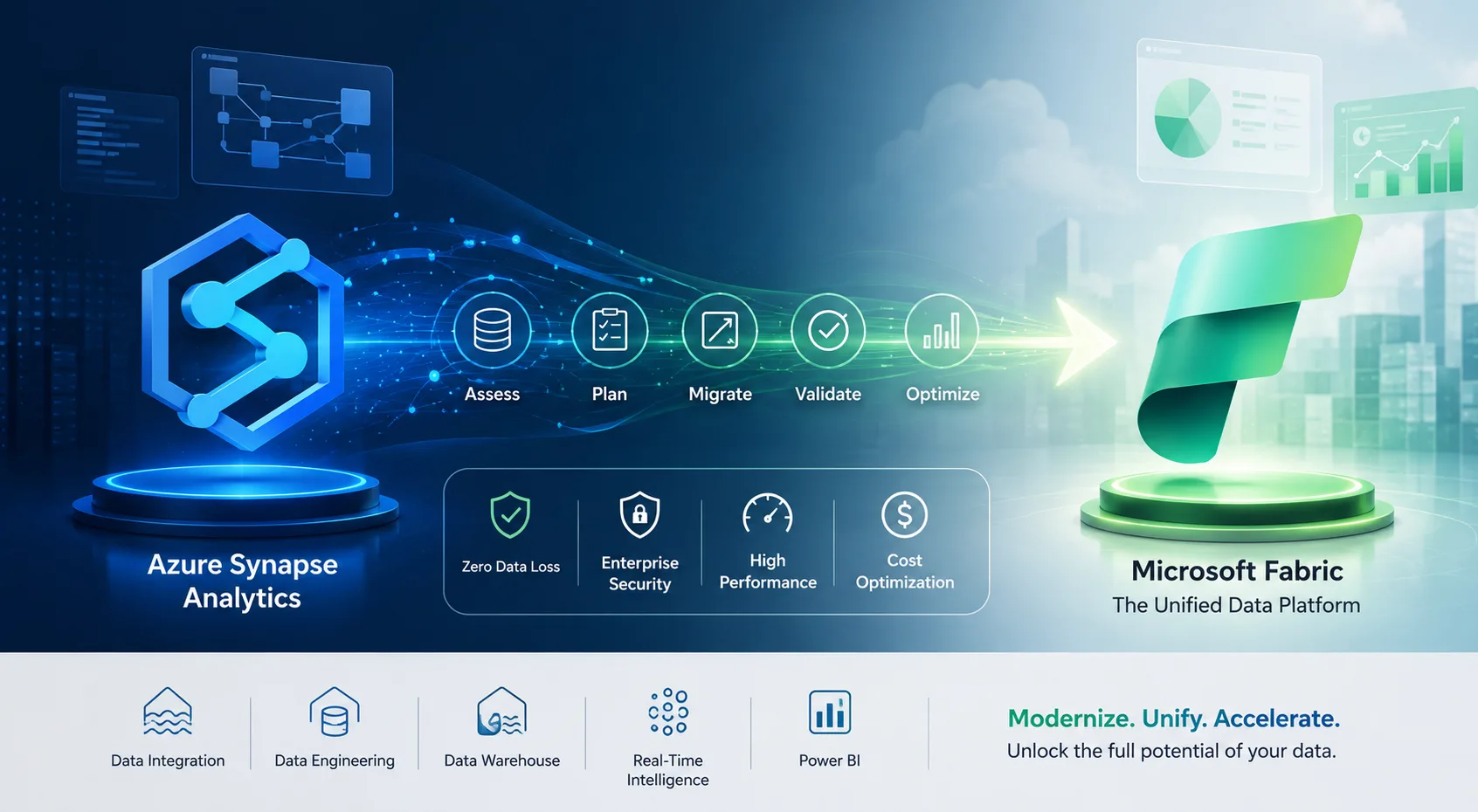
The August 2026 cliff edge - August 1, 2026. That is the exact date the trusted-services function goes dark inside Azure Synapse Analytics. Deadlines do not get much harder than that. Getting pushed off the Synapse platform might actually save your data team, though. Synapse is an aging PaaS architecture heavily reliant on Dedicated SQL Pools. Companies purchase specific Data Warehouse Units (DWUs) to keep things running. Compute power does not scale natively. Say a massive financial batch job kicks off at two in the morning. An engineer physically has to log in, click the buttons, and manually dial up the DWUs. Miss the alert, and queries queue up for hours. Morning reports fail. Everyone panics.
Microsoft engineered Fabric to eliminate that exact nightmare. Fabric operates as a true SaaS product, handling compute provisioning invisibly in the background. It manages virtual networks and firewall rules natively. Transitioning to OneLake means IT finally stops patching servers. They stop wrestling with private endpoints.
The nightmare of capacity planning
Guessing which Fabric F-SKU to buy based on an old Synapse DW1000c node will bankrupt an IT department. The hardware requirements never map one-to-one. Modern architecture physically separates compute from storage via OneLake. System planners actually need to rip open historical telemetry logs from the legacy Synapse catalog. They must analyze peak memory usage over a rolling ninety-day window. Tracking active query concurrency is mandatory.
Historical telemetry strictly dictates the baseline capacity reservation. Fabric uses a backend trick called smoothing. It borrows compute power from future idle periods to process today's heavy workloads. But a baseline usage that stays too high kills the smoothing runway entirely. Microsoft clamps down and throttles the environment. Power BI dashboards freeze. Scheduled pipelines time out completely. Purchasing the correct F-SKU upfront avoids this throttling penalty.
Why your legacy SQL scripts will break
Porting raw database tables takes almost no effort. Translating the underlying code is what absolutely destroys project timelines. Fabric Data Warehouses run a different T-SQL dialect than Synapse. Developers cannot simply copy their old stored procedures, paste them into the new UI, and clock out. The updated engine flat-out rejects legacy functions like result-set caching. System stored procedures changed entirely. Human eyes need to review every single script.
Pipelines relying on complex distribution keys require total rewrites to fit the Delta Parquet format. Synapse Data Factory pipelines refuse to automatically convert into the new workspace. Got Spark notebooks in the environment? Engineers have to run the Spark Migration Assistant and manually resolve broken PySpark library dependencies. An outdated library that Fabric rejects means the job fails instantly.
The internal resourcing bottleneck
Internal IT departments usually drown in daily help desk tickets as it is. Keeping the legacy Synapse environment stable while simultaneously building its replacement is practically impossible. Finding spare hours to rewrite hundreds of broken SQL scripts just does not happen. Companies hire Microsoft Fabric consulting for this exact reason. An external crew takes over the translation work entirely. They clear out the massive refactoring backlog.
Bringing in Microsoft Fabric consultants lets internal staff keep the lights on without suffering total burnout. Safe migrations demand a parallel run phase. Both platforms must operate side-by-side for a few weeks. Daily data ingestion hits both systems simultaneously. Outputs must match flawlessly down to the last decimal point. Contracting Microsoft Fabric consulting services provides the raw technical manpower necessary to run those reconciliation scripts and verify the math before anyone unplugs the legacy servers.
Rebuilding semantic models
Fixing the backend storage only covers the data engineering side. Presentation layers usually demand total overhauls. Old Synapse views currently feed existing Power BI datasets, meaning those connections must point to new Fabric SQL endpoints. Reporting in Fabric relies heavily on DirectLake mode, reading data straight from OneLake. It runs incredibly fast. But DirectLake is notoriously fragile.
Messy star schemas force DirectLake to drop down into DirectQuery mode. DirectQuery introduces brutal query latency. Semantic models require a ruthless audit. Enterprises frequently hire data visualization consulting services during the cutover phase just to untangle legacy import-mode datasets. These consultants rewrite DAX measures specifically for the new semantic layer. Final cutovers only happen when executive dashboards load instantly and display perfect metrics.
Fixing the broken security guardrails
Do not expect security policies to migrate cleanly. Synapse leans on traditional role-
based access control and strict firewall configurations locked at the server level. Fabric flips the script to a workspace-level permission model. Every user directory needs a fresh audit. Administrators have to map old Synapse security groups to new Fabric roles. Deciding who gets Viewer access versus Contributor access takes time.
Botched permission mapping leads to disaster. Users either lose access to critical daily reports or accidentally gain visibility into restricted HR files. Administrators must establish Row-Level Security on the semantic models to dynamically filter records based on active logins. Testing these filters is a painfully slow, highly manual slog. Skipping the security audit, however, guarantees a massive compliance breach the moment the platform goes live.