
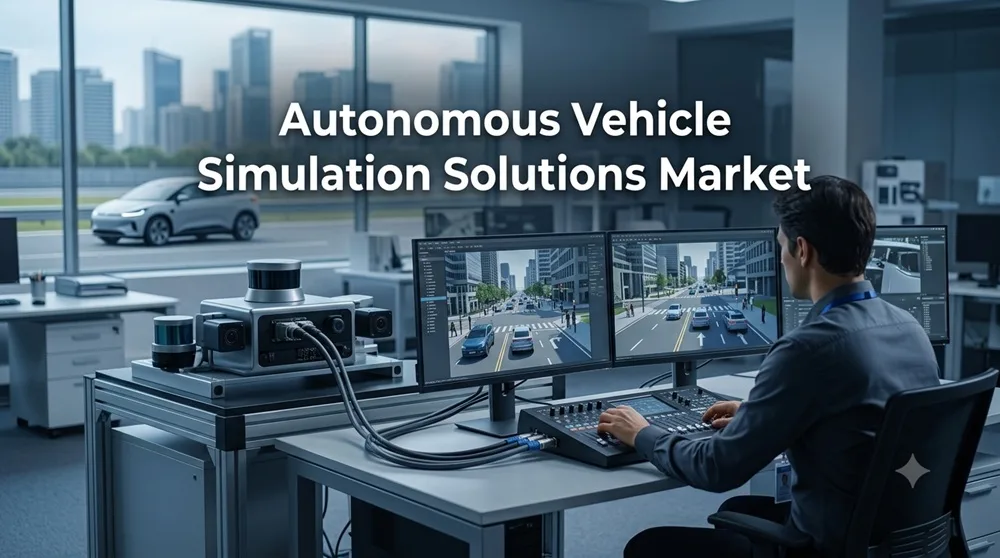
The autonomous vehicle simulation solutions market is becoming increasingly important as automakers and technology developers seek safer, faster, and more efficient ways to develop autonomous driving systems. Simulation platforms create virtual environments that replicate traffic, weather, terrain, vehicle behavior, and sensor interactions, allowing developers to test hardware and software before extensive physical road testing.
The autonomous vehicle simulation solutions market was valued at $1,307.1 million in 2024 and is expected to grow at a CAGR of 12.03% and reach $4,614.2 million by 2035.
What is driving the autonomous vehicle simulation solutions market?
- Growing adoption of ADAS and autonomous vehicles: The expansion of advanced driver-assistance systems and autonomous driving technologies is increasing the need for comprehensive virtual testing and validation.
- Demand for cost-effective testing: Simulation enables developers to evaluate large numbers of driving scenarios without depending entirely on costly physical prototypes and road tests.
- Need for high-fidelity simulations: Realistic virtual environments help developers assess vehicle behavior, sensor performance, traffic interactions, and challenging driving conditions.
- Increasing focus on road safety: Simulation enables potentially dangerous or difficult scenarios to be evaluated in controlled virtual environments, reducing testing risks while supporting system validation.
What are the key trends shaping the autonomous vehicle simulation solutions market?
- AI-driven simulation and digital twins: Artificial intelligence and digital-twin technologies are improving the ability to reproduce complex vehicle and environmental conditions in virtual settings.
- Cloud-based and real-time simulation: Cloud platforms are creating opportunities for scalable simulation and collaborative development, while real-time capabilities support faster testing and validation.
- Data-driven simulation: Technologies such as Neural Radiance Fields (NeRF), Gaussian splatting, generative models, reinforcement learning, and other data-driven approaches are expanding the capabilities of virtual environments.
- Advanced sensor and edge simulation: Increasingly sophisticated simulation of LiDAR, radar, cameras, sensor fusion, connectivity, and edge computing is supporting the development of more complex autonomous systems.
Get A Sample for Autonomous Vehicle Simulation Solutions Market
How are end users adopting autonomous vehicle simulation solutions?
Automotive OEMs and autonomous driving technology development companies represent a major end-user segment because they use simulation throughout vehicle and autonomous-system development. Tier-1 and Tier-2 component manufacturers apply these platforms to validate individual systems and components. Universities, research centers, technology companies, and regulatory bodies also use simulation for research, testing, technology assessment, and regulatory development.
The report segments the market by automotive OEMs and autonomous driving technology development companies; Tier-1 and Tier-2 component manufacturers; and universities and research centers, technology companies, and regulatory bodies.
Which levels of vehicle autonomy are influencing demand?
Simulation requirements vary according to the level of vehicle automation. Levels 1 and 2 are particularly important because ADAS features such as adaptive cruise control, lane-keeping assistance, and automated parking require extensive validation across diverse driving conditions. Simulation also supports the development of Levels 3 and 4 systems and, ultimately, Level 5 autonomous vehicles by enabling increasingly complex scenarios to be tested virtually.
Why is software important to the market?
Software represents a key product segment because simulation platforms provide the virtual environments, scenario-generation capabilities, vehicle models, sensor models, and analytical tools required for autonomous-system development. Solutions from companies such as Applied Intuition, rFpro, and aiMotive support virtual testing across different driving scenarios and vehicle functions. Services complement these software platforms by supporting implementation, integration, testing, and other specialized requirements.
How is deployment influencing the market?
The market is divided into on-premises and cloud deployment models. On-premises solutions remain important because automotive companies often require extensive control over proprietary data, intellectual property, and simulation infrastructure. Cloud-based platforms, meanwhile, are gaining attention because they can provide scalable computing resources and facilitate collaboration across development teams.
What is the regional outlook for the market?
The global market is segmented into North America, Europe, Asia-Pacific, and Rest-of-the-World, with country-level analysis covering the U.S., Canada, Mexico, Germany, France, the U.K., Spain, China, Japan, and South Korea. North America dominated the market in 2024, supported by strong R&D investment, established automotive and technology companies, advanced digital infrastructure, and regulatory initiatives supporting autonomous vehicle development and testing.
What challenges and opportunities are shaping market development?
High costs associated with simulation software and hardware can create barriers, particularly for organizations requiring sophisticated high-fidelity environments. Another challenge is accurately reproducing complex real-world conditions, including unpredictable traffic behavior, weather, pedestrians, and rare driving events. Data privacy and security are additional considerations when simulation platforms process large volumes of vehicle and environmental data.
Opportunities are emerging from the development of smart cities and connected infrastructure. As vehicles increasingly interact with roads, traffic systems, communication networks, and other connected assets, simulation can help developers evaluate these interactions before deployment. Growing interest in cloud-based platforms also creates opportunities for scalable testing and collaborative development.
Which companies are key players in the autonomous vehicle simulation solutions market?
The competitive landscape includes established engineering software providers, automotive technology companies, simulation specialists, and emerging technology firms.
- Altair Engineering, Inc.
- ANSYS, Inc.
- Applied Intuition, Inc.
- AVL List GmbH
- Cognata
- Dassault Systèmes
- dSPACE GmbH
- Foretellix
- Hexagon AB
- LG Electronics
- NVIDIA Corporation
- rFpro
- The MathWorks, Inc.
- aiMotive
- OPAL-RT TECHNOLOGIES, Inc.
Click Here to Download the ToC
Conclusion
The autonomous vehicle simulation solutions market is expected to remain an important technology segment as autonomous driving and ADAS systems become more sophisticated. Advances in artificial intelligence, digital twins, sensor modeling, real-time simulation, and data-driven methodologies are expected to improve the accuracy and efficiency of virtual validation. The combination of regulatory requirements, safety priorities, and the need to shorten vehicle development cycles will continue to support the adoption of simulation technologies across the automotive ecosystem.