A hiring team may have hundreds of candidate profiles yet struggle to find suitable talent when a new position opens. Promising past applicants often go overlooked, forcing recruiters to repeat searches and rebuild relationships.
An Applicant Tracking System (ATS) helps manage applications and move candidates through active hiring stages. A Recruitment CRM (Candidate Relationship Management system) focuses on building talent pipelines and maintaining relationships with potential hires over time.
Although their capabilities increasingly overlap, each serves a distinct purpose. This article explores the key differences between ATS and Recruitment CRM software, how they work together, and when hiring teams can benefit from both.
What is an Applicant Tracking System (ATS)?
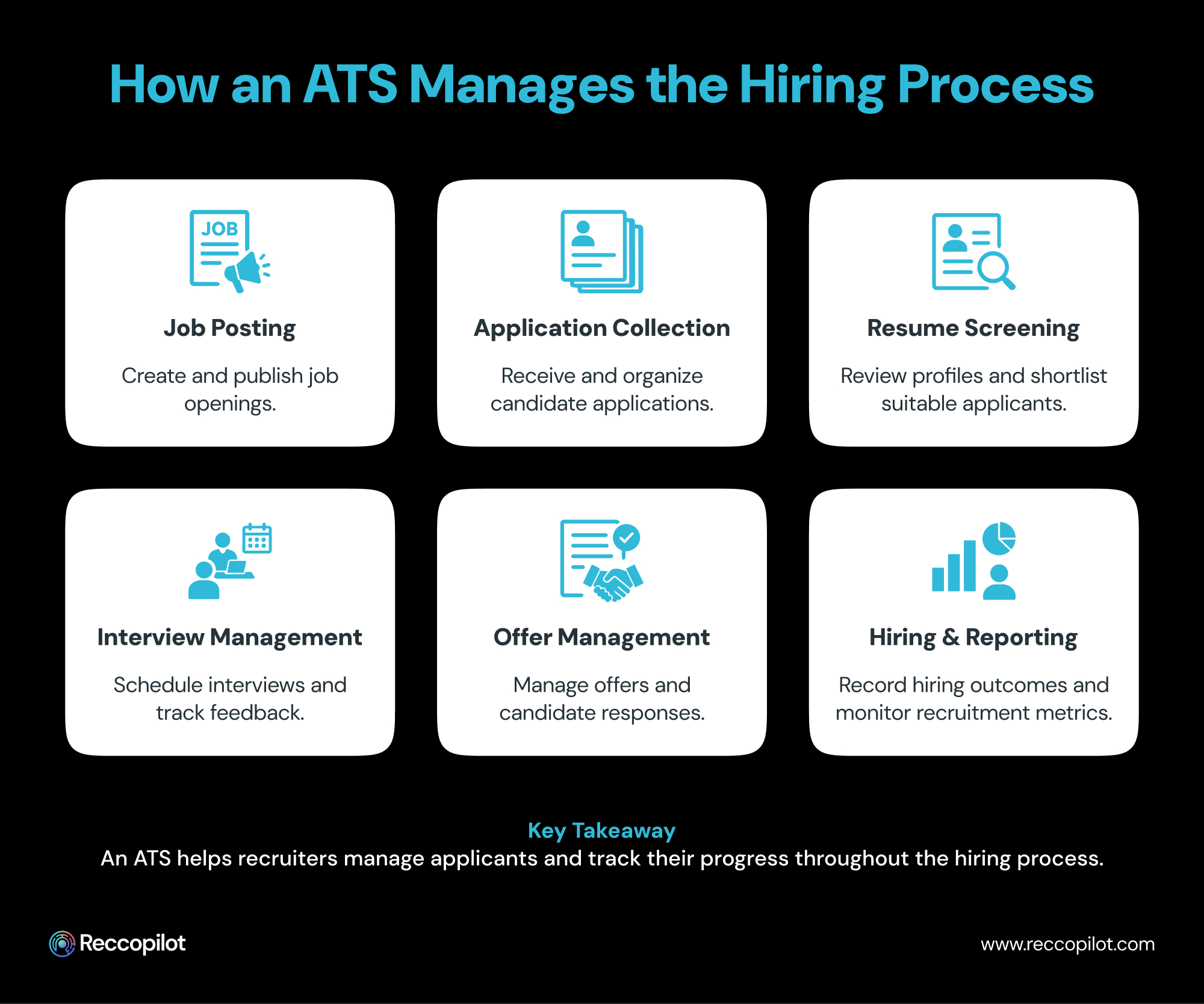
An Applicant Tracking System is recruitment software used to organize applications and manage the hiring process for open roles. Instead of tracking resumes, interview notes, and candidate statuses across spreadsheets and inboxes, recruiters can coordinate these activities in one system.
Common ATS capabilities include:
- Job and application management: Publish openings, collect applications, and organize applicant records.
- Resume screening: Review qualifications and shortlist applicants against role requirements.
- Candidate tracking: Move applicants through screening, interviews, assessments, and offers.
- Interview coordination: Schedule conversations and collect hiring-manager feedback.
- Reporting: Monitor application volumes, stage conversion, and time-to-hire.
An ATS is particularly useful when hiring teams need consistent processes, clear ownership, and visibility across active vacancies.
Depending on the product, an ATS may also support resume parsing, standardized evaluation forms, offer approvals, and collaborative feedback. These features help teams document why candidates move forward and identify stages that create delays. Still, an ATS alone may not provide the sustained outreach and relationship-building activities needed to develop a future talent pipeline.
ATS in the hiring process: Benefits
What is a Recruitment CRM?
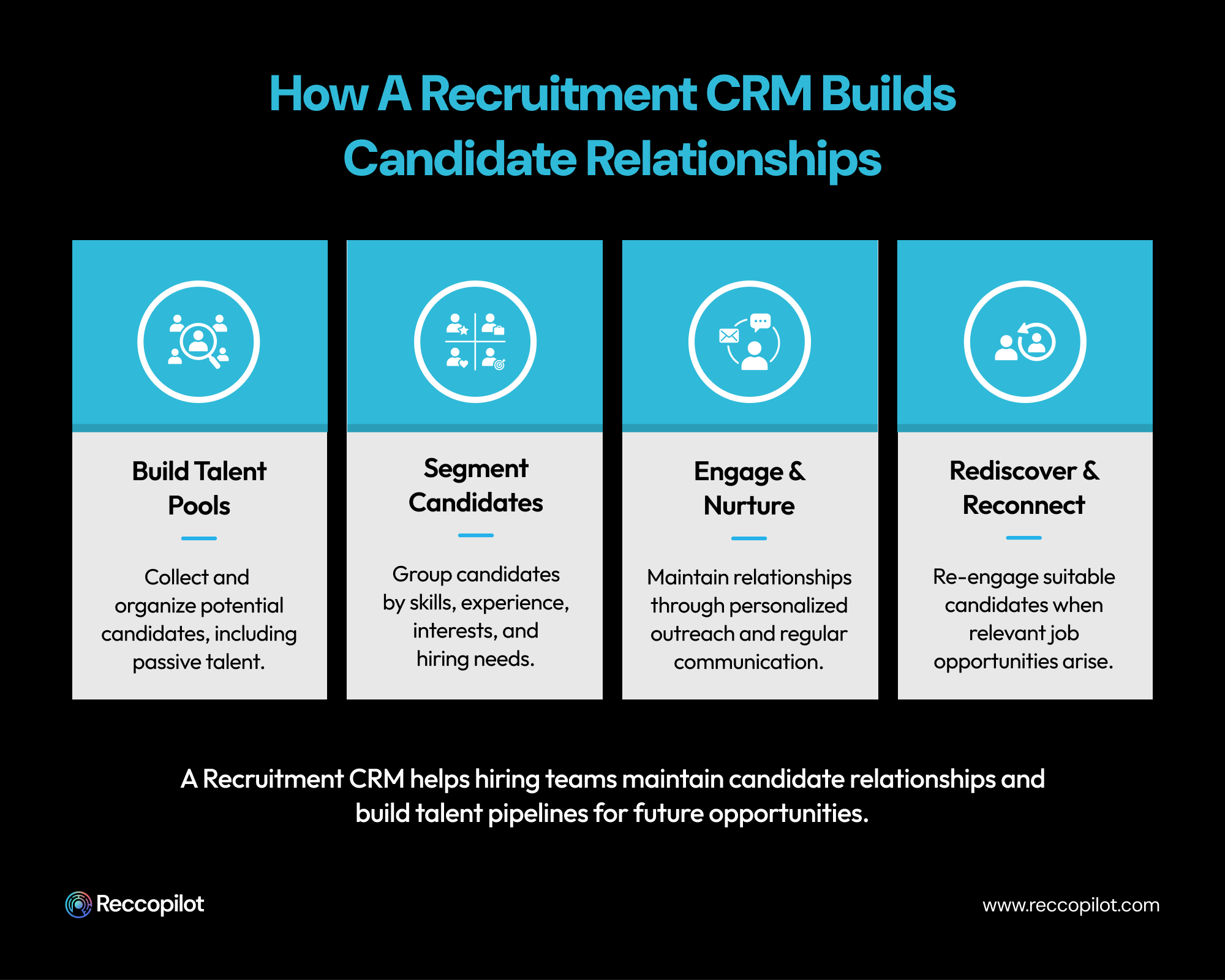
A Recruitment CRM, or Candidate Relationship Management system, helps recruiters develop and maintain connections with potential hires, including people who have not applied for a current opening. Its emphasis is on sustaining talent relationships beyond an individual hiring cycle.
Recruiting CRM capabilities commonly include:
- Talent pools: Organize prospects and previous applicants by skills, interests, or hiring needs.
- Candidate segmentation: Group contacts for relevant outreach and future opportunities.
- Engagement campaigns: Share personalized messages, updates, and follow-ups.
- Candidate nurturing: Stay connected with passive candidates over time.
- Talent rediscovery: Reconnect with suitable people when new roles open.
For example, a company hiring specialized engineers can build relationships with qualified professionals before positions become available. When a matching role opens, recruiters already have a relevant talent pipeline to revisit.
A Recruitment CRM is useful when hiring is not tied to an immediate vacancy. For instance, recruiters can segment people by location, experience, or areas of interest and send relevant updates instead of generic messages. Candidate preferences, data accuracy, and appropriate consent matter when maintaining these longer-term relationships.
Recruitment CRM: Advantages
ATS vs Recruitment CRM: Key Differences
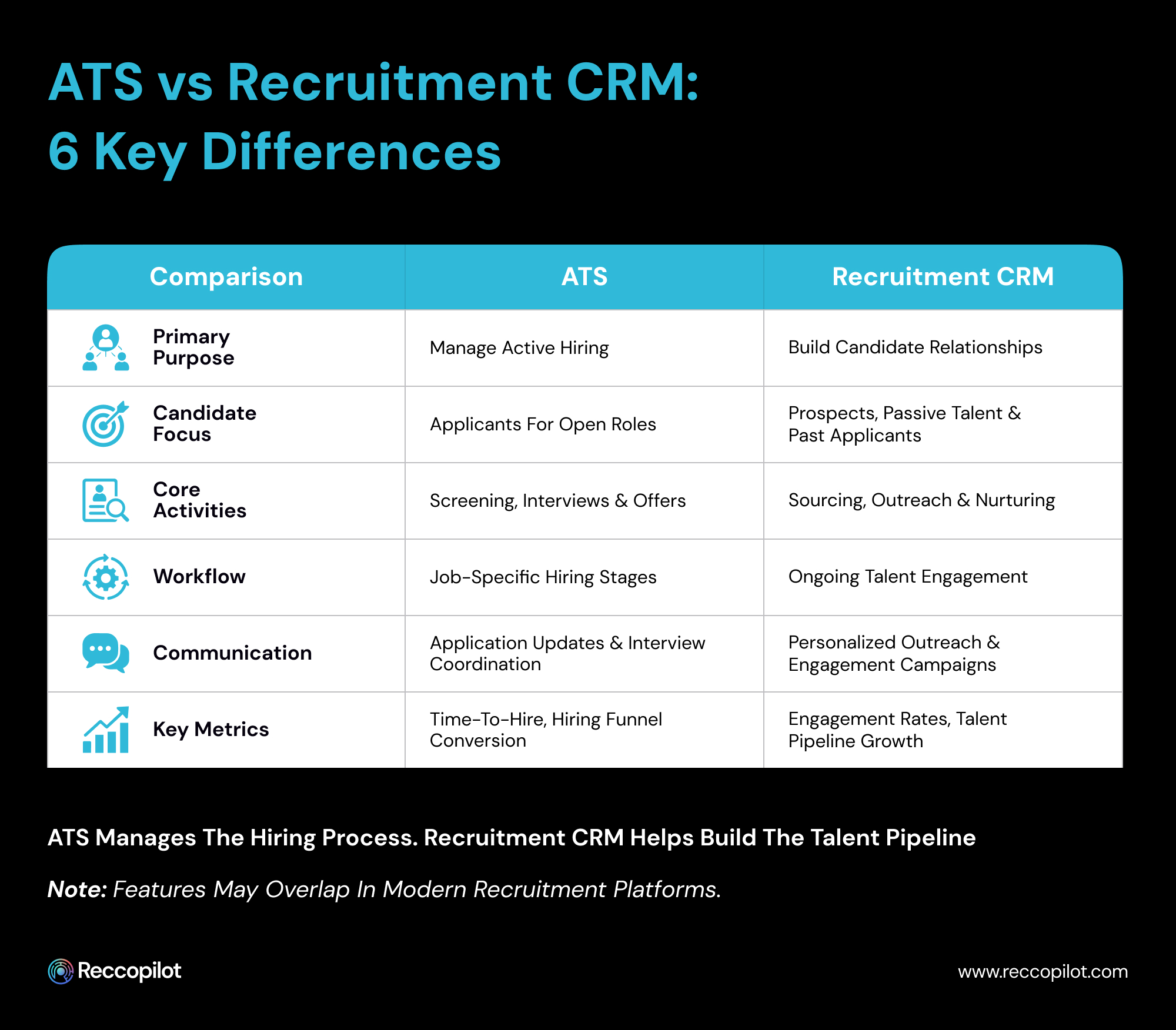
The central difference is purpose: an ATS primarily manages active applications, while a recruitment CRM supports longer-term candidate relationships. Their features may overlap, but the workflows they prioritize are different.
These distinctions are not fixed product boundaries. Many modern ATS products include CRM features, and some recruitment platforms combine both capabilities.
The difference also appears in reporting. ATS analytics commonly examine applications, interview progression, time-to-hire, and offer outcomes. CRM analytics may focus on response rates, engagement, and the strength of talent pools. Reviewing these measures together provides a fuller picture of recruitment effectiveness.
ATS and Recruitment CRM: Main Differences
How ATS and Recruitment CRM Work Together
- Consider a business planning to grow its engineering team. Before vacancies are approved, recruiters use a CRM to identify prospects, group them into talent pools, and maintain relevant contact. Once an opening becomes available, interested candidates can apply and enter the ATS workflow for screening, interviews, feedback, and offers.
- Candidates who are not selected may remain eligible for future opportunities, provided their data is retained and used in line with applicable requirements and communication preferences.
- When ATS and CRM systems share accurate records, hiring teams can reduce duplicate entry, view previous interactions, rediscover qualified candidates, and measure the journey from initial outreach to application and hiring. The value depends on reliable integration, appropriate access controls, and consistent candidate information.
- For the handoff to work smoothly, recruiters should be able to see which role a person applied for, when they were contacted, and whether they expressed interest in future opportunities. Teams should agree on candidate ownership, status definitions, duplicate-record handling, and permissions before connecting tools. Otherwise, information may be fragmented even when both systems are available.
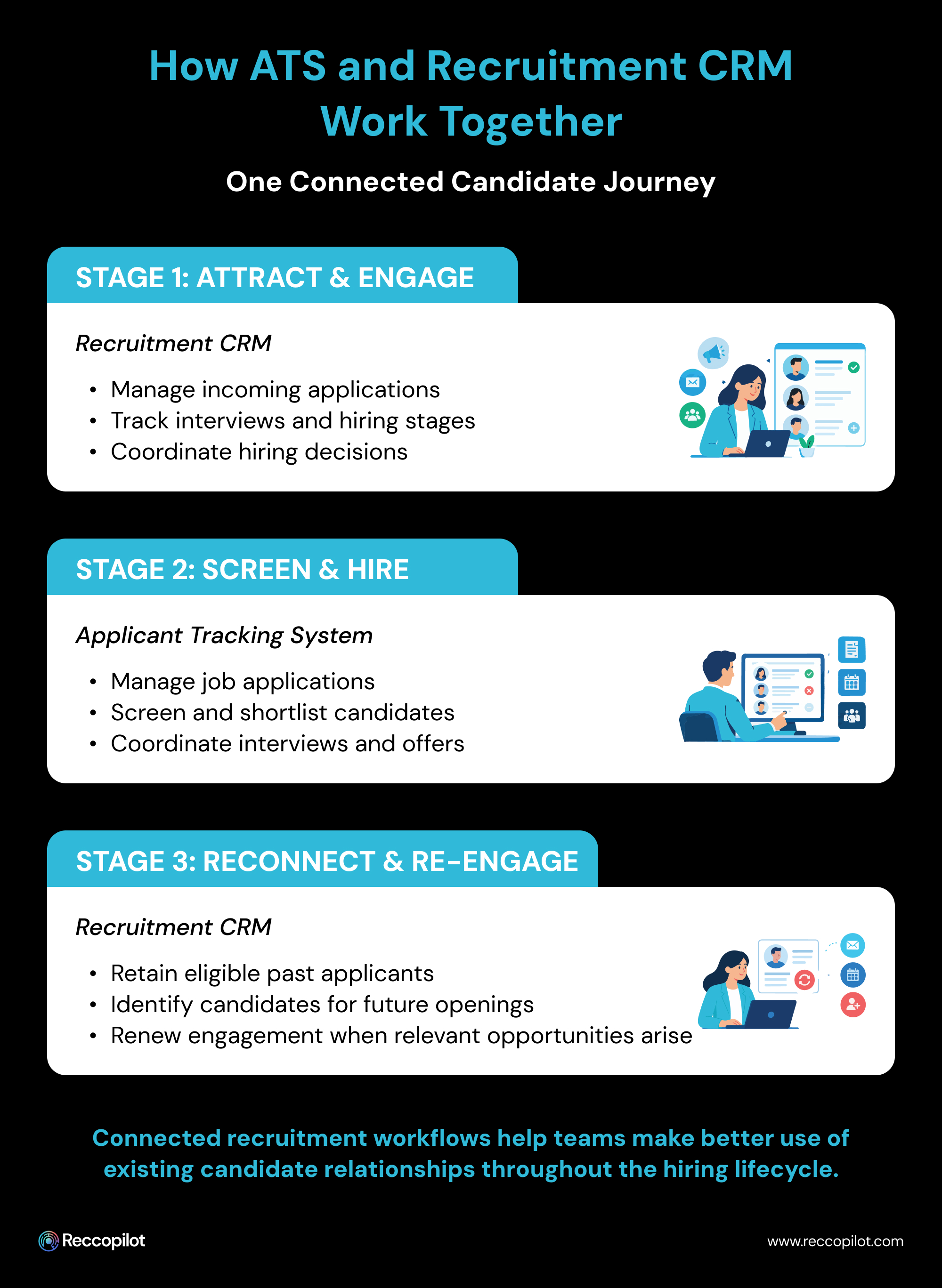
ATS and CRM together for Recruitment
When Do You Need an ATS, a Recruitment CRM, or Both?
An ATS May Be Enough
If a smaller organization mainly recruits for current vacancies, an ATS may cover its immediate needs. Application collection, structured screening, interview tracking, and hiring decisions take priority over continuous outreach to passive talent.
Recruitment CRM Capabilities Become Important
A recruiting CRM becomes valuable when a team repeatedly hires for similar roles, searches for specialized skills, or wants to engage prospects before positions open. Staffing agencies and talent acquisition teams managing ongoing pipelines can particularly benefit from segmentation and candidate nurturing.
Both Capabilities Make Sense
Organizations handling active applications while continuously developing future pipelines often need both sets of functions. That does not necessarily mean purchasing two products: some platforms offer ATS and CRM in one environment.
A retailer filling seasonal positions may prioritize application tracking for current openings while maintaining relationships with returning applicants. A specialist recruiting agency may place greater emphasis on sourcing and ongoing engagement. In both cases, the decision should reflect the hiring process, not the assumption that every team needs the same technology stack.
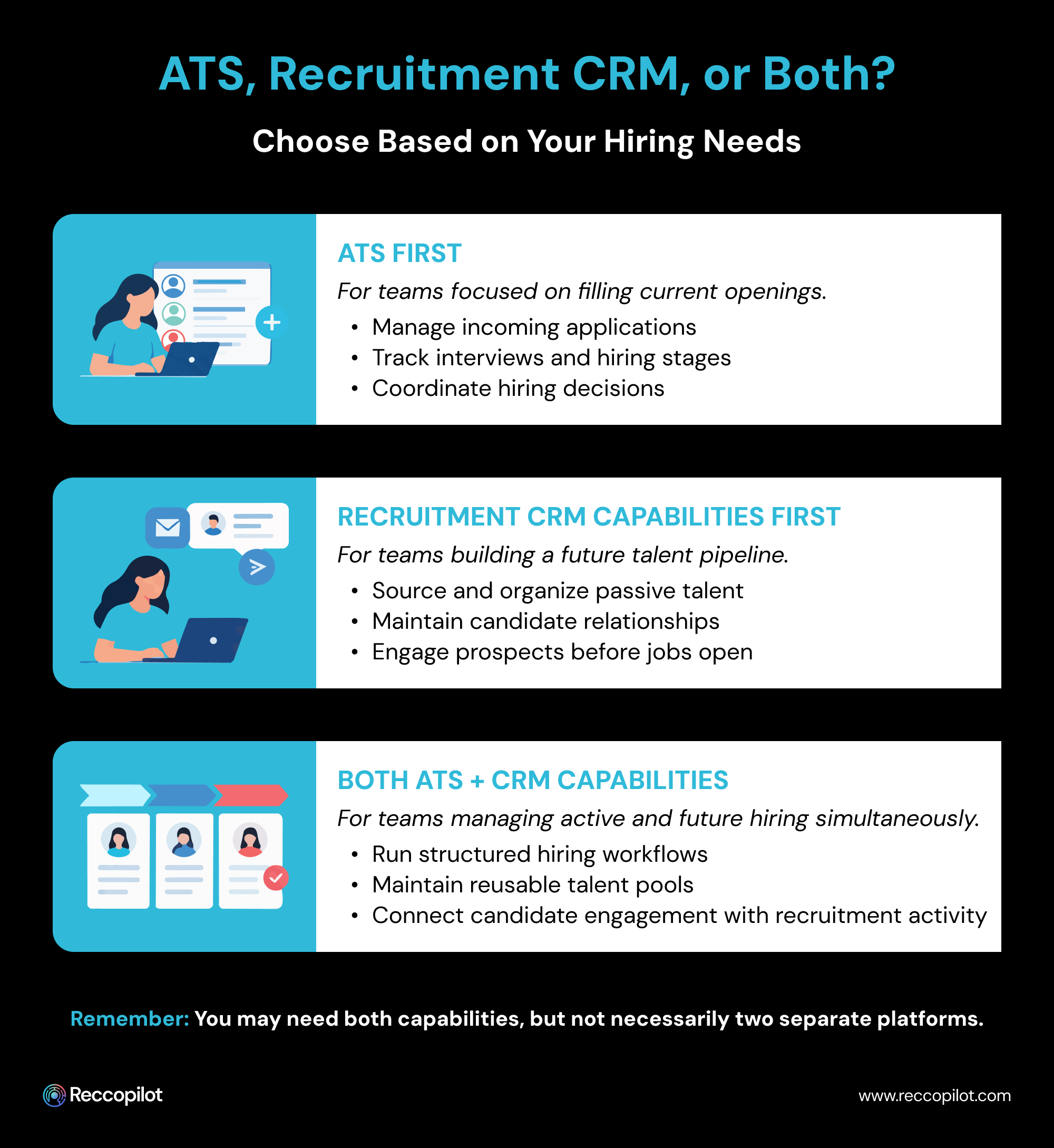
ATS or Recruitment CRM? : Which Works Best?
5 Signs Your Hiring Team Needs Both ATS and CRM
- Every new vacancy triggers a fresh search, despite an existing candidate database.
- Promising applicants are rarely reconsidered after a position closes.
- Passive candidates receive little contact between hiring cycles.
- Candidate conversations and application records sit in disconnected tools.
- Recruiters focus on immediate vacancies while future talent pools go unattended.
These issues may point to a need for stronger CRM functionality, better ATS integration, or a more connected recruitment platform.
These signs are also useful for evaluating current software. Before investing in another tool, check whether existing features are underused, whether candidate records can be searched effectively, and whether recruiters have an agreed process for following up with eligible past applicants.
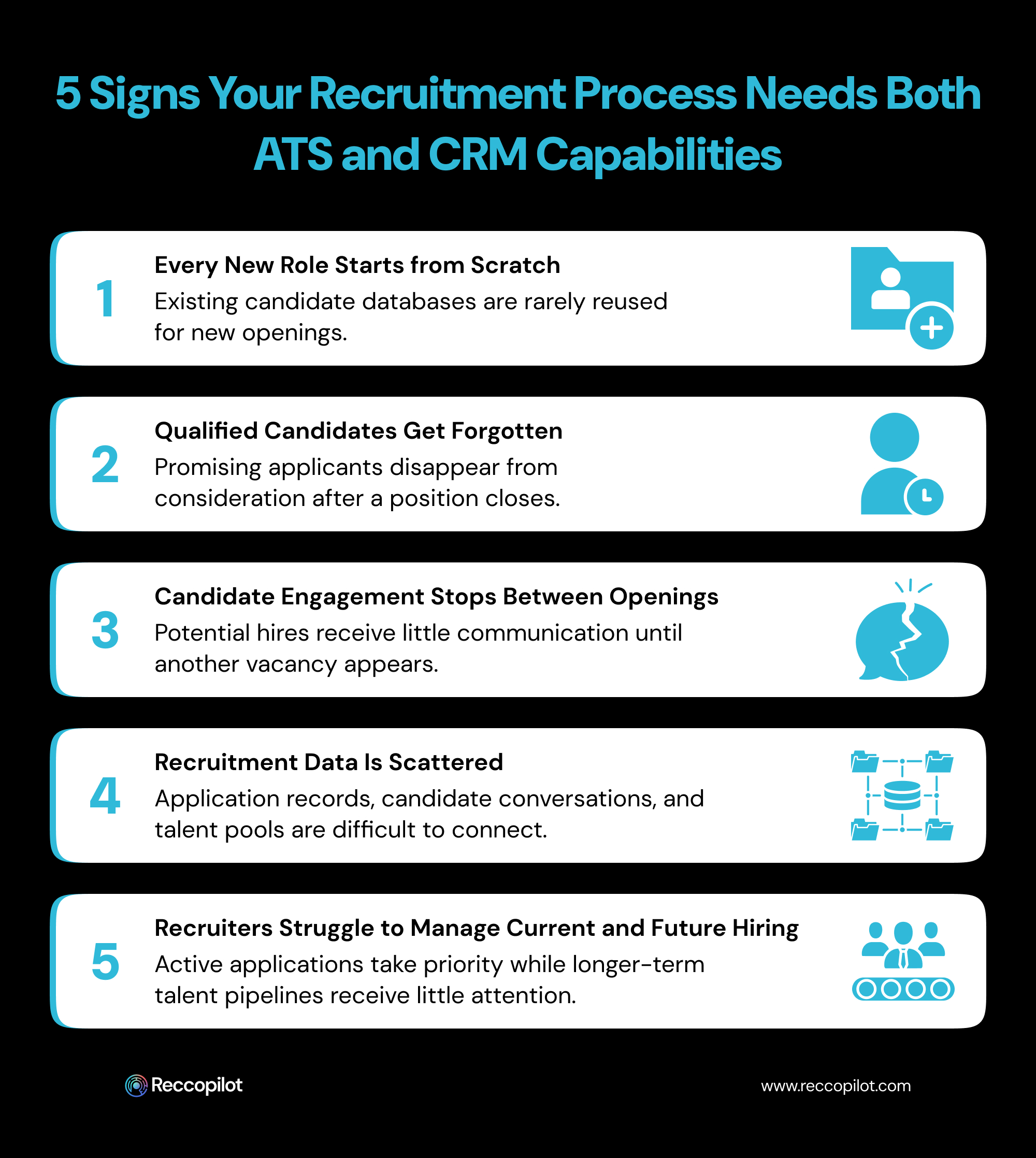
When Do Companies Need Both ATS and Recruitment CRM?
Integrated ATS and CRM vs Separate Systems
- An integrated ATS CRM platform can provide shared candidate records and a simpler workflow, reducing the need to transfer information between tools. However, buyers should check whether its relationship management and active hiring features meet their actual requirements.
- Separate systems can offer deeper specialist functionality, particularly when an organization already uses an established ATS. The trade-off is additional integration work, data synchronization, administration, and potentially higher overall costs.
- Before selecting software, evaluate candidate data flow, recruiter experience, automation options, reporting, privacy controls, total cost, and the flexibility to scale. Choose the setup that supports the recruitment process, not simply the one with the fewest tools.
- During a software evaluation, test everyday scenarios rather than relying on feature lists. Can a recruiter find a previous applicant, review communication history, invite the candidate to a new opening, and track the resulting application without copying data manually? Confirm which integrations are native, which require configuration, and what information is shared between systems.
Where AI Recruitment Automation Fits in
- Organizing applicants and maintaining candidate relationships do not automatically eliminate routine recruiting work. Recruiters may still spend time reviewing resumes, coordinating interviews, sending reminders, updating records, and locating suitable candidates in existing databases.
- AI recruitment automation can support these tasks through role-based screening, relevant candidate matching, automated follow-ups, talent rediscovery, and workflow triggers. Reporting tools can also highlight bottlenecks and candidate movement across hiring stages.
- These capabilities complement ATS and CRM software. They help recruiters act on the information available while keeping people responsible for evaluating recommendations and making final hiring decisions.
- For example, automation may help identify people whose recorded skills align with an open role and prompt appropriate follow-up. Recruiters still need to review the underlying evidence, check for outdated information, and apply job-related screening criteria consistently. Candidate communication should remain relevant and respectful rather than becoming a high-volume sequence of impersonal messages.
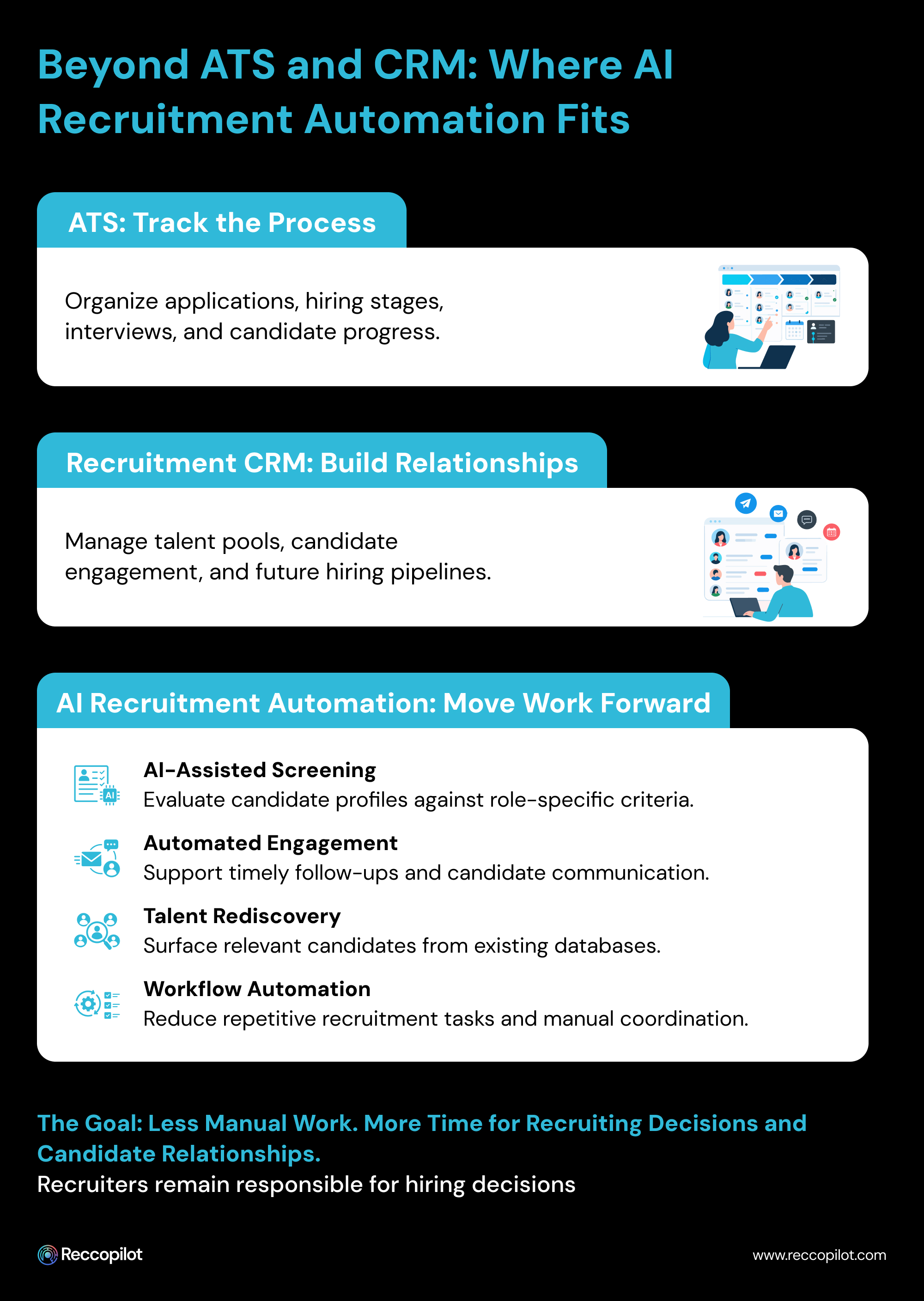
AI Automation in Recruitment
How Reccopilot Supports Connected Hiring Workflows
Reccopilot is an AI recruiter agent designed to support hiring activities from job requirements through sourcing, screening, engagement, and hiring coordination. It helps recruiters reduce repetitive tasks without giving up control over candidate evaluation and decisions.
Its capabilities include AI-assisted candidate sourcing and resume screening, role-specific matching, automated candidate communication, talent pool rediscovery, and hiring analytics. Reccopilot also supports ATS connectivity, helping teams introduce automation alongside existing recruitment workflows.
For hiring teams evaluating ATS vs CRM software, Reccopilot illustrates how AI-assisted workflows can complement structured applicant tracking and ongoing candidate engagement.
Explore Reccopilot to learn how an AI recruiter agent can support your hiring process.
In a typical workflow, the team can refine a job requirement, identify potential matches, coordinate screening, and follow up with candidates while monitoring progress. The value is in reducing the manual steps between recruiting activities, not in replacing the hiring team’s judgment. Organizations should assess how these capabilities fit their existing systems and processes.
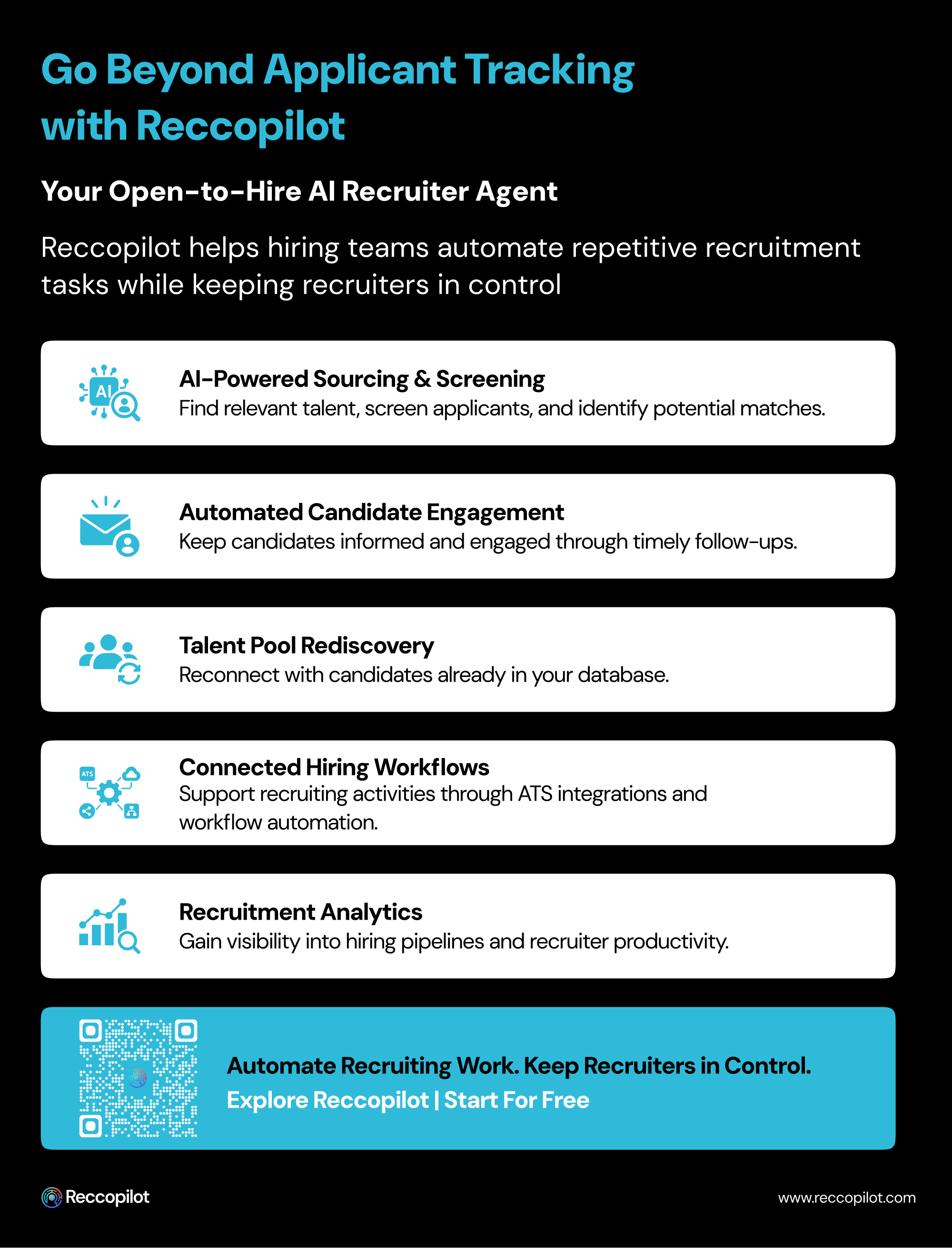
Reccopilot for Recruitment
Conclusion
An ATS helps manage active hiring, while a Recruitment CRM builds and maintains talent relationships for future opportunities. Teams with both immediate and ongoing hiring needs can benefit from combining these capabilities, whether within one platform or across connected systems. AI recruitment automation can further reduce repetitive work and help recruiters make better use of candidate information while retaining human oversight.
Can an ATS replace a Recruitment CRM?
Sometimes. An ATS with talent pools, candidate search, and ongoing communication features may cover basic CRM needs. A dedicated Recruitment CRM may offer more advanced segmentation, recruitment marketing, and candidate nurturing. The right choice depends on the features available and how the team recruits.
How does AI recruitment automation work with ATS and CRM systems?
AI tools can help screen applicants, identify matches, rediscover existing talent, automate follow-ups, and report on recruitment activity. Their value depends on appropriate configuration and oversight; recruiters remain responsible for final hiring decisions.
Which is better for small businesses: an ATS or a Recruitment CRM?
For a small business focused on filling open jobs, an ATS is often the starting point. CRM capabilities become more useful when the company hires repeatedly, sources passive candidates, or wants to maintain talent pipelines before positions open.
What are the benefits of using ATS and CRM in one platform?
An integrated platform can connect application history, candidate communication, talent pools, and hiring stages. This may reduce duplicate data entry and improve recruiter visibility, provided the system offers suitable functionality and data management controls.