
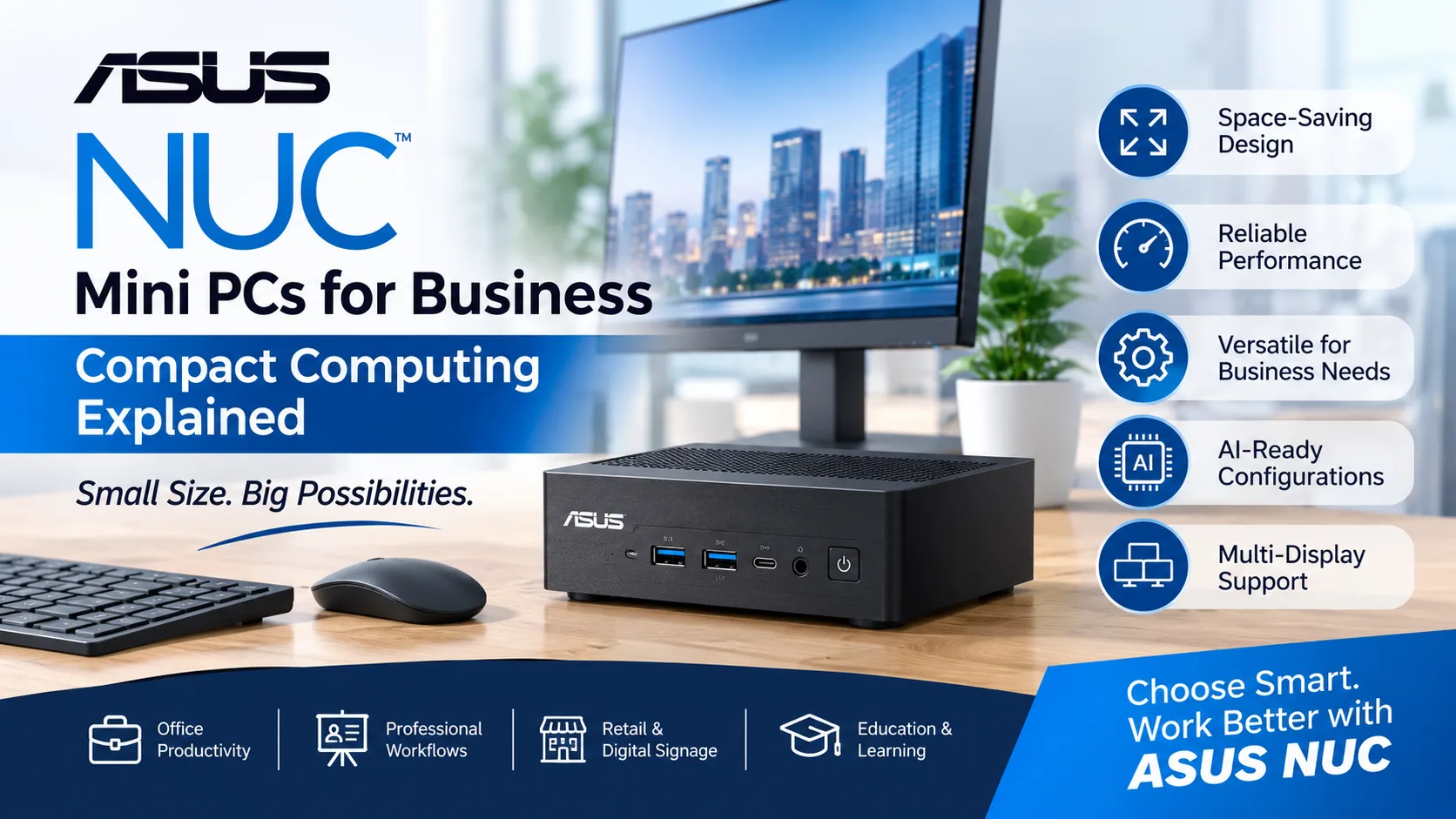
Businesses today need computers that can handle everyday workloads without occupying unnecessary office space. From startups and IT departments to retail stores and professional workspaces, organisations are increasingly considering compact computing solutions that offer flexibility, connectivity, and suitable performance.
An ASUS NUC mini PC is one option for businesses looking to build space-efficient desktop environments. These compact systems are available in different configurations, allowing users to select hardware according to their applications, performance requirements, and budget.
Understanding the available configurations and their intended uses can help businesses and individual buyers make more informed purchasing decisions.
What Makes Compact Computers Useful for Modern Businesses?
Traditional desktop computers can be suitable for demanding workloads, but their larger cabinets may not be ideal for every environment. Compact computers provide an alternative when desk space, workstation layout, and flexible installation are important considerations.
An ASUS NUC system can be used in suitable office environments for productivity applications, web-based business software, video conferencing, and administrative work.
Its compact design can also be useful in reception areas, meeting rooms, retail counters, and other locations where a conventional desktop tower may be inconvenient.
However, the physical size of a computer does not determine its performance. Buyers should compare processor capabilities, memory, storage, graphics, and connectivity to ensure the selected system meets their actual requirements.
ASUS NUC for Office Productivity and Professional Work
A business computer must support the applications employees use every day. These may include spreadsheets, presentations, accounting tools, customer relationship management software, browser-based applications, and communication platforms.
For these workloads, buyers should evaluate the processor, available RAM, SSD capacity, operating-system compatibility, and support for the required peripherals.
Businesses that run several applications simultaneously may benefit from additional memory. Professionals who regularly handle large files should also consider storage capacity and expansion options.
For organisations purchasing multiple computers, standardising on an appropriate configuration can simplify deployment, maintenance, and IT support.
Can ASUS NUC Mini PCs Support AI Workloads?
Artificial intelligence is becoming increasingly relevant to business computing, from productivity assistants and content tools to local model experimentation and specialised professional applications.
Some modern ASUS NUC configurations include processors with dedicated AI acceleration capabilities. Depending on the model, these systems may be suitable for selected AI-assisted applications and development workflows.
However, AI performance varies considerably across configurations. Processor architecture, GPU capabilities, memory capacity, software support, and the size of the model being used all influence what a system can accomplish.
A compact AI-ready computer should not automatically be considered equivalent to a dedicated AI workstation or a high-performance AI server.
Businesses evaluating local AI applications should identify their intended workloads first. Running lightweight AI-assisted productivity tools may have very different hardware requirements from developing large models or performing computationally intensive inference.
The most appropriate ASUS NUC configuration will depend on the application's memory requirements, processing demands, and compatibility with the selected hardware.
Connectivity and Multi-Display Workstations
Many professional environments rely on more than one display. Developers may use separate screens for code and documentation, analysts may need spreadsheets and dashboards open simultaneously, and office employees may prefer a dedicated display for video meetings.
Depending on the model, ASUS NUC systems can provide connectivity options such as USB, HDMI, Thunderbolt, Ethernet, and wireless networking.
Some configurations support multiple monitors, making them worth considering for compact professional workstations.
Before purchasing, verify the number of available display outputs, supported resolutions, refresh rates, and any requirements for adapters or compatible cables.
Businesses should also check network connectivity and the number of USB ports needed for printers, storage devices, webcams, and other office peripherals.
ASUS NUC Barebone Kits: A Flexible Computing Option
Some ASUS NUC products are sold as barebone kits. These systems provide a configurable hardware platform, but the components included can differ from those supplied with a fully configured mini PC.
Depending on the model, a barebone kit may require additional RAM, storage, and an operating system before it is ready for use.
This approach can be useful for technically knowledgeable buyers who want to select compatible components for their specific requirements.
Before purchasing an ASUS NUC barebone system, consider the following factors:
- Memory compatibility: Check the supported memory type, capacity, and installation requirements.
- Storage: Confirm the supported SSD form factor, interface, and expansion options.
- Operating system: Verify whether an operating system is included and whether additional licensing is required.
- Connectivity: Ensure the available ports support your monitors and peripherals.
- Total cost: Calculate the cost of the complete system, including any additional components.
Comparing the complete configuration rather than the barebone price alone helps buyers understand the actual investment required.
Choosing an ASUS NUC in India
The Indian market includes buyers with different computing requirements, from home-office users to businesses managing multiple workstations.
When evaluating an ASUS NUC mini PC, start by identifying the applications it needs to run. Then compare the processor, memory, storage, graphics capabilities, connectivity, and upgrade options of the available models.
It is also important to consider warranty coverage, technical support, software requirements, and the final purchase price.
For small businesses, the right computer is not necessarily the most powerful or expensive option. It is the one that meets the workload requirements without unnecessary expenditure.
For professional users, investing in an appropriate configuration at the beginning can also help avoid compatibility problems and premature upgrades.
Where to Explore ASUS NUC Mini PCs
Buyers researching compact computers can compare the available ASUS NUC models according to their intended applications and hardware requirements.
Vishal Peripherals offers a dedicated collection of ASUS NUC systems featuring selected Pro and Pro Plus configurations. These products provide options for buyers exploring compact computing solutions for business and professional use.
You can explore the available ASUS NUC mini PCs through the Vishal Peripherals collection to review listed models and their specifications.
When comparing products, check whether memory and storage are included, whether the system requires additional components, and which connectivity features are available. Product specifications, prices, and availability should always be confirmed against the individual listing before ordering.
Frequently Asked Questions
What is an ASUS NUC mini PC?
An ASUS NUC mini PC is a compact computer designed to provide desktop computing capabilities in a small form factor. Depending on the model, it can support office productivity, professional applications, digital signage, and other compatible workloads.
Is an ASUS NUC suitable for business use?
Yes. An appropriately configured ASUS NUC can support office applications, communication tools, web-based business software, and selected professional workloads. The appropriate configuration depends on the software and performance requirements.
Can ASUS NUC computers be upgraded?
Upgrade options depend on the specific model. Some systems support upgrades to memory or storage, while other components may be integrated or subject to platform-specific limitations. Always consult the manufacturer's specifications before purchasing.
What should I check before buying an ASUS NUC barebone kit?
Check the processor, supported memory, storage compatibility, operating-system requirements, available ports, and the additional components needed to complete the system.
Are ASUS NUC mini PCs suitable for AI applications?
Some models offer AI acceleration features and can support selected AI workloads. However, suitability depends on the processor, GPU, available memory, software compatibility, and the computational demands of the application.
Conclusion
Compact computers have a useful role in modern workplaces where space efficiency, flexible installation, and appropriate computing performance matter.
ASUS NUC mini PCs provide different configurations for office productivity, professional applications, and selected AI-assisted workflows. Understanding the differences between models, checking component compatibility, and calculating the total system cost can help buyers make better decisions.
Whether you are equipping a home office, setting up a professional workstation, or planning a small business deployment, evaluate the intended workload before selecting a system. This ensures that the computer you choose aligns with your actual requirements and budget.