Market Overview:
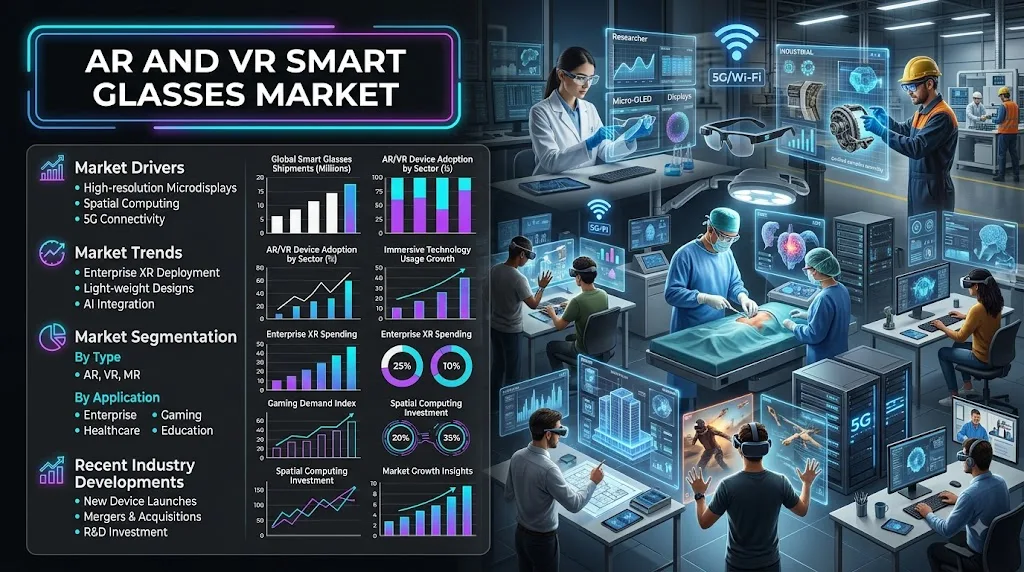
According to IMARC Group's latest research publication, "AR and VR Smart Glasses Market: Global Industry Trends, Share, Size, Growth, Opportunity and Forecast 2026-2034", The global AR and VR smart glasses market size was valued at USD 20.8 Billion in 2025. Looking forward, IMARC Group estimates the market to reach USD 54.3 Billion by 2034, exhibiting a CAGR of 10.89% from 2026-2034.
This detailed analysis primarily encompasses industry size, business trends, market share, key growth factors, and regional forecasts. The report offers a comprehensive overview and integrates research findings, market assessments, and data from different sources. It also includes pivotal market dynamics like drivers and challenges, while also highlighting growth opportunities, financial insights, technological improvements, emerging trends, and innovations. Besides this, the report provides regional market evaluation, along with a competitive landscape analysis.
How AI and Lightweight Hardware Are Reshaping the AR and VR Smart Glasses Market
• Consumer expectations are shifting from bulky headsets toward everyday-wearable eyewear, pushing manufacturers to prioritize comfort, familiar frame styles, and all-day battery life over raw display power.
• Real-time AI assistance is emerging as the core value proposition for smart glasses, with features like live translation, visual search, and contextual navigation giving users a reason to wear a device on their face instead of reaching for a phone.
• Major technology companies are converging around shared operating platforms for AR hardware, allowing device makers to focus on optics and industrial design while relying on a common software and AI assistant layer.
• Enterprise adoption is expanding faster than many expected, with global spending on AR and VR technology by businesses projected to approach USD 12 Billion in 2026 as companies deploy glasses for remote assistance, training, and warehouse navigation.
• In February 2026, Vuzix launched all-in-one Enterprise Solutions Kits pairing its smart glasses with pre-configured collaboration software, including native support for common video-conferencing tools, aimed at simplifying hands-free deployment for frontline workers in field service, logistics, and manufacturing.
Download a sample PDF of this report: https://www.imarcgroup.com/ar-vr-smart-glasses-market/requestsample
Key Trends in the AR and VR Smart Glasses Market
• Advancements in Lightweight, Power-Efficient Hardware Design: Manufacturers are focused on shrinking device bulk while improving display clarity and battery efficiency, addressing long-standing comfort and aesthetics concerns that have limited everyday wearability. In 2025, a major chipmaker filed a patent for smart glasses designed to resemble ordinary eyewear, featuring an AR display architecture built to improve power efficiency and reduce device size.
• Miniaturization of Optical Engines: Continued shrinking of projector and optical components is enabling manufacturers to fit high-quality displays into standard eyeglass frames without sacrificing comfort or outdoor visibility. In 2025, an optics supplier introduced an upgraded engine featuring a smaller projector, improved brightness, and greater power efficiency alongside a higher-performance variant for more demanding use cases.
• Convergence of AI and Holographic Display Technology: Companies are blending transparent optics with immersive digital overlays while keeping devices in a familiar eyewear form factor, aiming to support multitasking, calls, and contextual assistance directly through the lens. A leading social media company has already introduced early AR glasses combining large holographic displays with built-in AI for select employees and partners.
• Platform Consolidation Around Shared Operating Systems: Several major technology companies are building smart glasses on a shared spatial-computing operating system, letting hardware partners focus on frame design and optics while relying on common AI assistant and app ecosystem support, which is expected to accelerate the pace of new product launches through 2026 and 2027.
• Rising Enterprise Deployment Across Field Operations: Businesses in logistics, manufacturing, and field service are increasingly issuing smart glasses to frontline workers for remote expert assistance and hands-free data access, supported by growing bundles of pre-configured enterprise software and device management tools.
We explore the factors propelling the AR and VR smart glasses market growth, including technological advancements, consumer behaviors, and regulatory changes.
Growth Factors in the AR and VR Smart Glasses Market
• Rising Demand for Immersive Digital Experiences: Growing consumer and enterprise appetite for interactive, spatial computing experiences is accelerating adoption of AR and VR smart glasses across gaming, entertainment, and professional applications alike.
• Advancements in Display and Sensor Technology: Continuous progress in miniaturized displays, sensors, and energy-efficient processors is making smart glasses more practical for everyday use, removing many of the comfort and battery-life barriers that previously limited mainstream adoption.
• Expanding High-Speed Connectivity: The growing reach of 5G networks is enabling real-time data processing and low-latency AR and VR experiences, allowing smart glasses to deliver more responsive navigation, translation, and collaboration features.
• Growing Enterprise Use Cases Beyond Consumer Entertainment: Expanding applications in healthcare training, industrial field service, remote collaboration, and defense are diversifying demand beyond gaming and consumer electronics, broadening the addressable market for smart glasses manufacturers.
• Strong Investment from Major Technology Companies: Sustained R&D spending by leading technology firms in spatial computing platforms, content ecosystems, and hardware innovation continues to push smart glasses closer to mainstream, everyday-wearable status.
Leading Companies Operating in the Global AR and VR Smart Glasses Industry:
Meta HTC Corporation Vuzix Corporation Snap Inc. Magic Leap, Inc.
AR and VR Smart Glasses Market Report Segmentation:
Breakup By Type:
• Optical See Through
• Video See Through
Video see through technology accounts for the largest share at 60%, driven by its use of outward-facing cameras to capture real-world surroundings and project digitally processed imagery, allowing more precise integration of virtual elements for gaming, simulation-based training, and immersive entertainment.
Breakup By End Use:
• Gaming Industry
• Healthcare
• Education
• Military and Defense
• Others
The gaming industry accounts for the largest share at 34%, supported by rising demand for immersive, interactive experiences that extend beyond traditional console and PC gaming through spatial tracking, gesture control, and 3D visual integration.
Breakup By Region:
• North America (United States, Canada)
• Asia Pacific (China, Japan, India, South Korea, Australia, Indonesia, Others)
• Europe (Germany, France, United Kingdom, Italy, Spain, Russia, Others)
• Latin America (Brazil, Mexico, Others)
• Middle East and Africa
North America holds the leading position with a 31% share, supported by strong technology infrastructure, the presence of leading device manufacturers, high consumer adoption rates, and substantial R&D investment across gaming, healthcare, and defense applications.
Recent News and Developments in the AR and VR Smart Glasses Market
• June 2025: A leading social media and messaging company announced plans to launch new lightweight, immersive AR eyewear in 2026, positioned as a next-generation wearable computer that blends digital experiences with the physical world through built-in AI and spatial computing features.
• February 2026: Vuzix launched all-in-one Enterprise Solutions Kits bundling its smart glasses with pre-configured collaboration software, including native support for common video and messaging platforms, to simplify hands-free deployment for frontline workers in field service, logistics, and manufacturing.
• May 2026: Two major technology companies gave the first official look at jointly developed smart glasses built on a shared spatial-computing platform, shown in two eyewear-partner design styles, with an audio-and-camera first generation confirmed for a fall 2026 launch and a display-equipped version expected on the 2027 roadmap.
Note: If you require specific details, data, or insights that are not currently included in the scope of this report, we are happy to accommodate your request. As part of our customization service, we will gather and provide the additional information you need, tailored to your specific requirements. Please let us know your exact needs, and we will ensure the report is updated accordingly to meet your expectations.
About Us:
IMARC Group is a global management consulting firm that helps the world's most ambitious changemakers to create a lasting impact. The company provides a comprehensive suite of market entry and expansion services. IMARC offerings include thorough market assessment, feasibility studies, company incorporation assistance, factory setup support, regulatory approvals and licensing navigation, branding, marketing and sales strategies, competitive landscape and benchmarking analyses, pricing and cost research, and procurement research.
Contact Us:
IMARC Group
134 N 4th St. Brooklyn, NY 11249, USA
Email: [email protected]
Tel No: (D) +91 120 433 0800
United States: +1-201-971-6302