Amazon US is the market many international brands aim for first, and it is also the one that punishes a rushed launch. Account verification can stall for weeks over a mismatched document. A listing written for European shoppers can miss how Americans search. And since January 2026, Amazon no longer preps or labels inventory for sellers in the US, so a single inbound mistake can delay your launch before a customer ever sees your product.
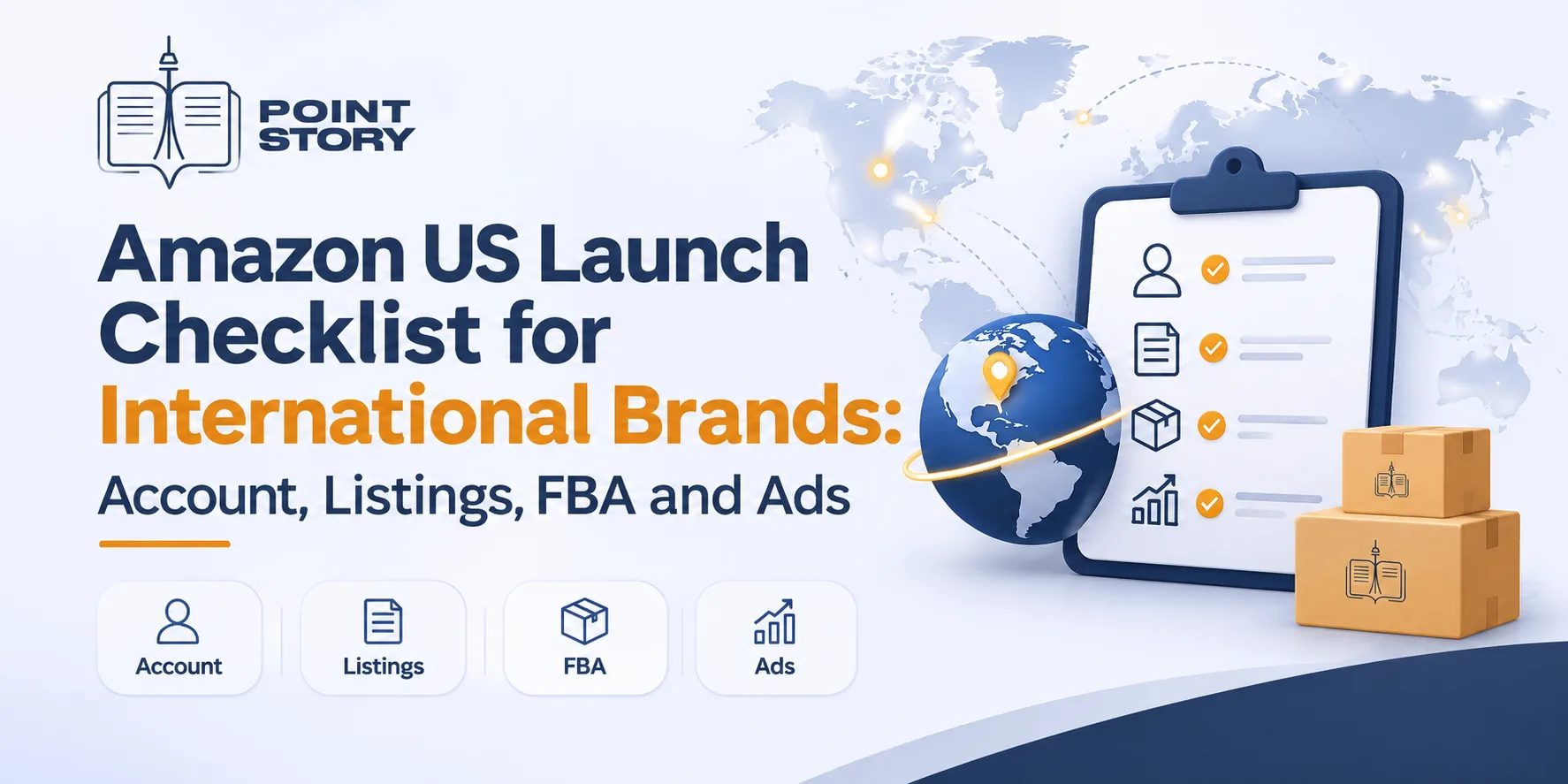
This checklist walks international brands through the four areas that decide whether an Amazon US launch goes smoothly: your account, your listings, FBA and your launch advertising. Use it before you ship a single unit.
1. Account Setup and Verification
Amazon verifies every seller's identity and business before they can sell. International sellers register through Amazon's global selling process and complete the same core steps as US sellers, with a few differences.
Checklist:
- Choose the Professional selling plan. It currently costs $39.99 per month with no per-item fee and is required for advertising, bulk listing tools and many restricted categories.
- Prepare business documents. Company registration documents, a government ID for the primary contact, and proof of address. Names and addresses must match exactly across every document.
- Have an internationally chargeable credit card for Amazon's fees.
- Set up a payout method that can receive USD, such as a US bank account or a supported multi-currency payment service.
- Complete the tax interview. Non-US sellers typically complete a W-8BEN (individuals) or W-8BEN-E (entities) instead of the W-9 that US sellers use. Speak with a cross-border tax advisor about US sales tax and income tax obligations.
- Translate documents into English where needed, and keep certified copies ready in case verification asks for more.
2. Brand Registry and Brand Protection
Brand Registry unlocks A+ Content, Sponsored Brands ads, brand analytics and the tools to report infringement. For an international brand, it also helps stop resellers or counterfeiters who list your products on Amazon US before you arrive.
Checklist:
- Confirm your trademark is eligible. Amazon accepts registered trademarks, and pending applications from a set of accepted trademark offices. Accepted offices include the USPTO and EUIPO, but check Amazon's current list for your country.
- Consider Amazon IP Accelerator if you have no eligible trademark yet. It connects you with vetted law firms and can give access to Brand Registry while the application is pending.
- Make sure your brand name or logo appears on the product or packaging, and matches the trademark record exactly.
- Search Amazon.com for your brand before launch to see whether anyone is already selling your products.
3. Product Compliance and Importing
This is the step international brands most often underestimate. Amazon US enforces category rules, and US law applies to the product itself.
Checklist:
- Check your category requirements in Seller Central. Some categories, such as toys, supplements, cosmetics and electronics, need approval or documentation before you can list.
- Confirm US regulatory requirements for your product type, which can differ from EU rules even when your product is fully compliant at home.
- Arrange an importer of record. Amazon does not act as the importer for your goods, so your company, a US entity or a customs broker must handle import and duties.
- Review US labeling rules for your category, including units of measure, warnings and country of origin.
4. Listings Built for US Shoppers
A direct translation of your home-market listing is rarely enough. American shoppers use different search terms, expect imperial units and compare products differently.
Checklist:
- Research US keywords with US search data, not translated keywords. The way people search for a product in Germany or Poland may not match how they search in the US.
- Write titles, bullet points and descriptions in US English, with US spelling and measurements in inches, ounces and pounds alongside metric where helpful.
- Use Amazon's image requirements: a pure white background for the main image, plus lifestyle and infographic images that answer common questions.
- Add A+ Content and a Brand Store once Brand Registry is approved.
- Set US pricing after factoring in referral fees, FBA fees, shipping, duties and your advertising budget.
- Plan for reviews through Amazon's own programs, such as Amazon Vine where eligible. Never offer incentives for reviews.
5. FBA Preparation and Shipping
Fulfillment by Amazon gives your products Prime eligibility, which matters a great deal to US shoppers. But 2026 brought real changes that every new seller needs to plan around.
Checklist:
- Plan for prep and labeling yourself. Amazon discontinued its FBA prep and item labeling services for US inbound shipments from January 1, 2026. Your manufacturer, a prep center or a 3PL must handle it.
- Label every unit with its FNSKU unless you hold the Brand Representative role in Brand Registry and qualify to use your manufacturer barcode. Amazon ended commingled stickerless inventory in 2026.
- Check carton limits. The maximum box length rose to 36 inches in 2025, and the standard weight limit remains 50 pounds per box.
- Understand capacity limits. New sellers have limited FBA storage at first, based on sales history, so plan inventory in stages rather than one large shipment.
- Choose a freight forwarder experienced with Amazon deliveries and US customs.
6. Launch Advertising
New listings have no sales history, so advertising does the early work of getting your products seen and gathering data.
Checklist:
- Start with Sponsored Products, using automatic campaigns to discover search terms and manual campaigns for your priority keywords.
- Add Sponsored Brands once Brand Registry is active, to put your logo and product range in front of shoppers.
- Protect your brand terms with branded campaigns so competitors cannot take your own search traffic.
- Set a launch budget and clear goals. Early ACoS is usually higher while Amazon learns your listings, so judge the first weeks on visibility and data, not profit alone.
- Review search terms weekly, adding winning terms and negating wasted spend.
- Track TACoS, total ad spend divided by total sales, to see whether ads are lifting organic sales over time.
The Right Order to Work Through It
Many of these steps depend on each other, so sequence matters:
- Start the trademark and account verification first. Both can take time and block everything else.
- Check compliance and arrange importing while verification runs.
- Build and test your listings once the account is active.
- Prepare and ship your first FBA inventory in a manageable quantity.
- Launch advertising as soon as inventory is live and available.
- Review weekly for the first few months, then scale what works.
Final Thoughts
An Amazon US launch rarely fails because of one big mistake. It usually fails because of several small ones: a document that did not match, a listing that missed US search terms, a shipment that arrived without labels, or ads that ran without a plan. Working through this checklist in order removes most of those risks before they cost you time and money.
If you would rather have one team handle the whole process, PointStory helps international brands launch and grow on Amazon US, from account setup and listings to FBA planning and launch advertising, with a team in the Seattle area and in Krakow, Poland. Talk to PointStory about your Amazon US launch
Frequently Asked Questions
Can a non-US company sell on Amazon US?
Yes. Amazon allows businesses from many countries to register and sell on Amazon.com. You will need valid business documents, an internationally chargeable credit card, a way to receive USD payouts and a completed tax interview.
Do I need a US company to sell on Amazon US?
Not always. Many international brands sell through their home-country company. Some choose to form a US entity for banking, tax or importing reasons, which is a decision to make with a cross-border tax or legal advisor.
Do I need a US trademark for Amazon Brand Registry?
Not necessarily. Amazon accepts trademarks from a list of supported offices, which includes the EUIPO as well as the USPTO. Many brands still file in the US for stronger local protection, so check Amazon's current requirements and get legal advice.
Does Amazon still label and prep my FBA inventory?
No, not in the US. Amazon stopped offering FBA prep and item labeling services for US inbound shipments from January 1, 2026. Sellers must prep and label units themselves or use a prep center or 3PL.
Should I use FBA or ship orders myself?
Most international brands start with FBA because it gives products Prime eligibility and handles US delivery and returns. Fulfilling orders yourself from outside the US usually means slower delivery, which hurts conversion.
How much should I spend on advertising at launch?
There is no single right number. It depends on your category, competition and margins. Plan a dedicated launch budget, expect higher costs in the first weeks while Amazon learns your listings, and judge results on visibility, data and TACoS over time.
How long does it take to launch on Amazon US?
It varies by brand. Account verification, trademark status, category approvals and freight times all affect the timeline, so start the slowest steps, verification and trademark, as early as possible.