
A production manager at a mid-sized auto components unit in Pune starts her morning the same way most weeks: checking last night's inventory report, which is already twelve hours old. By the time she walks the shop floor, two work orders have stalled because a critical raw material hasn't arrived, procurement is still waiting on a stock update from the warehouse team, and the plant head wants to know why yesterday's production target was missed — again.
None of this happens because people aren't working hard. It happens because the systems recording what's going on in the plant aren't talking to each other in real time. Inventory data sits in one spreadsheet, purchase orders in another system, and machine status gets relayed over phone calls or WhatsApp messages. By the time information reaches the person who needs to act on it, the situation on the ground has already changed.
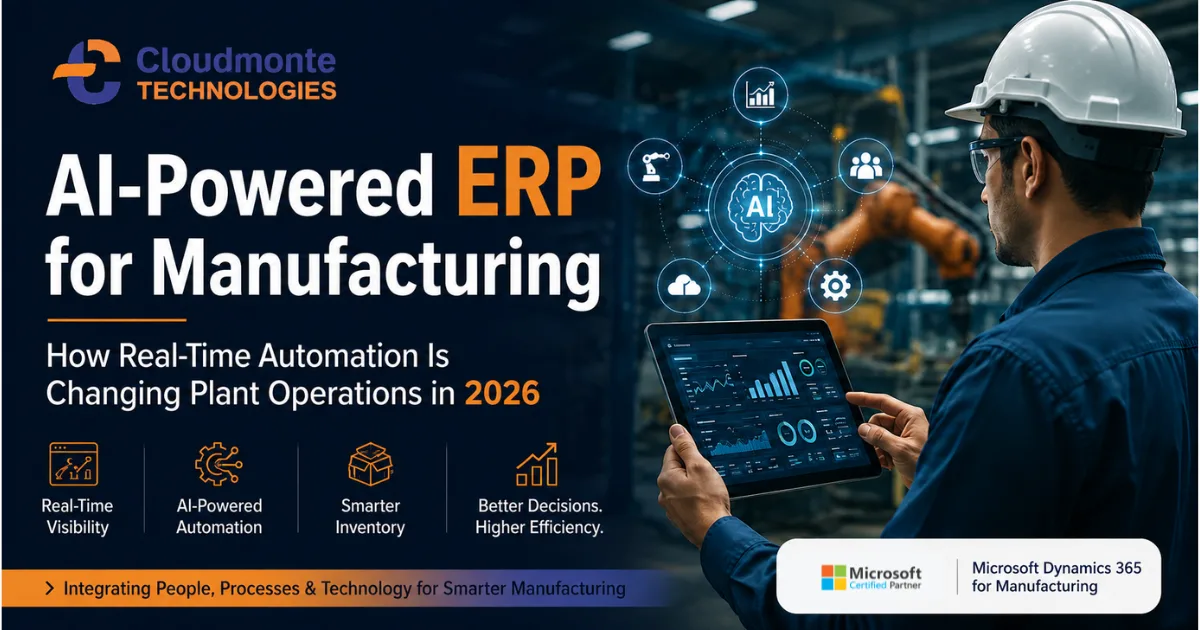
This is the gap that AI-powered ERP is built to close. Not by replacing the shop floor team's judgment, but by giving them—and everyone above them—a current, connected view of what's actually happening, along with the automation to act on it faster.
What Is AI-Powered ERP for Manufacturing?
A traditional ERP system is, at its core, a record-keeping engine. It stores your bill of materials, tracks purchase orders, logs inventory transactions, and consolidates financial data. It's reliable for reporting on what already happened. Where it often falls short is helping you respond to what's happening right now.
AI-powered ERP builds on the same transactional backbone but adds a layer of intelligence on top of it. Instead of just recording that a raw material stock fell below the reorder point, the system can flag the risk earlier by analysing consumption trends, lead times, and pending sales orders together. Instead of a planner manually checking machine availability against a new customer order, the system can suggest a feasible production schedule based on current capacity and material readiness.
Take a simple example: a fabrication unit receives a rush order for 500 units. In a conventional ERP, the planner checks stock manually, calls the stores team to confirm material availability, and then manually slots the job into the production schedule — a process that might take half a day. In an AI-powered ERP, the same system can cross-check inventory, open work orders, and machine capacity within minutes and present the planner with two or three realistic scheduling options, along with the impact on other pending orders.
The "AI" part isn't a separate product bolted onto the ERP. It's a set of capabilities—machine learning models, pattern recognition, natural language interfaces, and automation rules—working directly on the data your ERP already holds.
Why Real-Time Visibility Matters on the Manufacturing Floor
Most manufacturing decisions are time-sensitive. A delay of even a few hours in knowing about a material shortage, a machine breakdown, or a quality deviation can cascade into missed delivery dates, idle labour, or excess safety stock sitting on the balance sheet.
Consider how a lack of real-time data typically plays out:
- Production teams plan schedules based on inventory numbers that may already be outdated by the time the shift starts.
- Procurement reacts to shortages instead of anticipating them, often resulting in rush purchases at higher prices.
- Order fulfillment slips because sales teams commit to delivery dates without visibility into actual shop-floor capacity.
- Machine utilization stays lower than it should, because downtime isn't reported until someone notices during a walk-through.
- Working capital gets tied up in excess inventory, held as a buffer against uncertainty rather than based on actual demand signals.
This is the difference between reactive manufacturing and data-driven manufacturing. Reactive plants respond to problems after they've already affected output. Data-driven plants catch the early signals—a slowing consumption rate, a supplier running late, a machine showing early signs of wear—and adjust before the problem reaches the shop floor.
How AI-Powered ERP Is Changing Plant Operations
Smarter Production Planning
Production planning has traditionally relied on a planner's experience and a fixed set of assumptions about demand and capacity. AI-powered ERP adds a data-backed layer to this process. By analysing historical order patterns, seasonal demand shifts, machine availability, and material lead times together, the system can highlight scheduling conflicts before they occur — for instance, flagging that two large orders scheduled for the same week will overload a particular machine group.
This doesn't replace the planner's decision-making. It gives them a more complete picture before they make the call.
Better Inventory Management
Inventory is where a lot of manufacturing cash quietly gets stuck. AI-enabled ERP systems can continuously track consumption patterns against reorder points, flag slow-moving or excess stock, and calculate more realistic safety stock levels based on actual variability in demand and supplier lead times — rather than a static buffer set years ago and never revisited.
For a manufacturer running multiple locations, this matters even more. Stock sitting idle at one plant while another plant places an emergency purchase order for the same material is a common, avoidable inefficiency once inventory data is connected across locations.
More Efficient Procurement
When procurement teams can see real inventory positions, open production orders, and incoming demand in one place, purchasing decisions improve. Instead of ordering based on habit or a rough estimate, teams can time purchases against actual consumption, negotiate better with suppliers because they're not buying under panic, and reduce the number of emergency, high-cost purchase orders.
Real-Time Shop-Floor Visibility
This is often the most visible change for plant teams. Dashboards showing live production progress, order status, machine availability, and work-in-progress give managers a way to spot exceptions — a delayed batch, a machine running below expected output, a material shortfall — without walking the entire floor or waiting for an end-of-shift report.
For a plant head managing multiple lines or multiple locations, this real-time exception visibility is often more valuable than a detailed report generated a day later.
Predictive Maintenance and Equipment Insights
Predictive maintenance gets discussed often, sometimes with more promise than accuracy. It's worth being precise here: an ERP system alone doesn't predict equipment failure. Predictive maintenance becomes possible when machine or IoT sensor data — vibration, temperature, run-hours, and similar signals — is connected into the ERP or an integrated platform, and AI models are trained on that data to flag early signs of wear.
For manufacturers without sensor-enabled machines or the right integrations in place, predictive maintenance isn't automatically available just because the ERP has AI capabilities. It's a capability that depends on the right data pipeline being built first. Where that groundwork exists, though, it can meaningfully reduce unplanned downtime and extend equipment life.
Quality Management
Connected ERP data also helps with quality patterns that are hard to spot manually. If a particular raw material batch, shift, or machine is consistently associated with higher rejection rates, that pattern is much easier to identify when inspection data, production data, and material data live in the same system rather than in separate quality logs and spreadsheets. This also strengthens traceability—useful both for internal root-cause analysis and for customer or regulatory audits.
Each of these benefits shows up differently depending on the size and complexity of the manufacturing operation, which is exactly why the next section — how to evaluate ERP options — matters more than any single feature list.
Microsoft Dynamics 365 for Manufacturing
Microsoft Dynamics 365, specifically its Supply Chain Management application, is one of the more established cloud ERP platforms built with manufacturing operations in mind. It's worth understanding where it genuinely fits and where its capabilities depend on how it's configured and implemented.
Dynamics 365 Supply Chain Management <cite index="9-1">supports discrete, process, and lean manufacturing across different production strategies and includes real-time production views intended to help manage the shop floor and reduce downtime. </cite> On the planning side, it offers <cite index="5-1">demand planning built on ready-to-use forecast models and in-memory supply planning designed to give near real-time insight into requirement changes for material planning and production scheduling. </cite>
The platform also brings finance, procurement, inventory, and reporting into a single data model, which is what allows the cross-department visibility discussed earlier in this article to actually work in practice — rather than needing separate systems stitched together after the fact.
A few points worth being clear about:
- Manufacturing and planning functionality is native to the platform, but how well it fits a specific plant's processes depends on configuration and implementation quality.
- AI and predictive capabilities, including forecasting and Copilot-based features, are built into the product roadmap, but the depth of what an individual manufacturer can use depends on licensing, the modules deployed, and how clean the underlying data is.
- IoT-driven predictive maintenance works when equipment data is connected in—it isn't something that switches on by default for every manufacturer using the platform.
Dynamics 365 is a strong option for manufacturers who want manufacturing, finance, and supply chain on one connected platform, particularly those already in the Microsoft ecosystem. It is not the only credible ERP option, and the right platform for a given business depends on scale, industry-specific requirements, budget, and existing systems.
What Should Indian Manufacturers Look for in the Best ERP Software for the Manufacturing Industry?
Choosing an ERP is less about picking the platform with the longest feature list and more about matching capabilities to how your plant actually operates. A practical evaluation should cover:
1. Manufacturing functionality—Does it support your specific production type (discrete, process, job-shop, or mixed)?
2. Production planning—Can it handle multi-level BOMs, capacity constraints, and schedule changes without heavy manual rework?
3. Inventory management—Does it give accurate, real-time stock visibility across all locations, not just the main plant?
4. Procurement—Can it connect purchasing decisions to actual consumption and production plans?
5. Financial integration—Is manufacturing data connected to finance, or does it need separate reconciliation?
6. Real-time reporting—Can managers get current dashboards, or only periodic exports?
7. Automation capabilities—How much manual, repetitive work can genuinely be eliminated?
8. AI and analytics—Are these built-in and usable, or dependent on costly add-ons?
9. Scalability—Will it support additional plants, product lines, or higher transaction volumes without a full re-implementation?
10. Integration capabilities—Can it connect with existing shop-floor systems, IoT devices, or third-party tools?
11. User experience—Will shop-floor and office teams actually adopt it, or resist it?
12. Implementation and support—Is there a partner who understands manufacturing, not just generic ERP deployment?
13. Total cost of ownership—Licensing is only part of the cost; factor in implementation, customization, training, and ongoing support.
ERP Implementation Challenges Manufacturers Should Consider
ERP implementations don't fail because of the software. They usually run into trouble because of how the transition is managed. Some of the most common challenges:
- Data migration—Years of inconsistent or incomplete data in legacy systems take real effort to clean before it can move into a new ERP.
- Employee adoption—Shop-floor and office staff used to older workflows may resist a new system unless the transition is handled with proper training and clear communication.
- Process standardization — Multi-location manufacturers often run slightly different processes at each plant, which need to be aligned before a single ERP can serve all of them well.
- Integration with existing systems—Machines, MES tools, or third-party software already in use need to connect cleanly with the new ERP.
- Customization—Over-customizing the system to match every existing manual process can make future upgrades harder and more expensive.
- Change management—Without visible leadership support, new processes tend to get quietly bypassed.
- Implementation timelines—Rushed timelines often lead to incomplete testing and post-go-live issues.
None of these are reasons to avoid ERP modernization. They're reasons to plan the implementation carefully, with a partner who has actually managed manufacturing rollouts before.
The Future of AI-Powered ERP in Indian Manufacturing
A few directions look reasonably clear for the next few years, based on where platforms and adoption are heading:
- AI-assisted decision-making will become more embedded directly into ERP workflows, rather than existing as a separate analytics tool.
- Predictive analytics and intelligent forecasting will keep improving as more manufacturers connect machine and IoT data into their systems.
- Automated, exception-based management — where systems flag only what needs human attention instead of generating routine reports for everything — will become more common, reducing time spent on manual review.
- Connected manufacturing, linking ERP with IoT, MES, and quality systems, will keep expanding, particularly among mid-market manufacturers who have historically run these as separate tools.
- Real-time dashboards will increasingly replace static, periodic reports as the default way plant leaders track performance.
None of this means every manufacturer needs to adopt every capability at once. It means the direction of ERP investment is shifting from basic transaction recording toward systems that actively support faster, better-informed decisions.
Conclusion
The real value of AI-powered ERP isn't that it has "AI" in the product description. It's that it gives manufacturers a way to turn scattered operational data — inventory levels, machine status, procurement timelines, quality patterns — into decisions and actions that happen while they still matter, not after the fact.
For Indian manufacturers weighing ERP modernization, the starting point isn't picking a platform. It's understanding where your current processes lose time and visibility and then matching that to a system and implementation approach that actually fits how your plant runs.
If your manufacturing business is evaluating ERP modernization, Cloudmonte Technologies can help assess your current processes, identify automation opportunities, and determine which ERP approach — including Microsoft Dynamics 365 or Odoo — fits your operational needs. Cloudmonte works with manufacturers on ERP implementation, business automation, and broader digital transformation, with the goal of making sure the system you invest in is one your teams will actually use.