
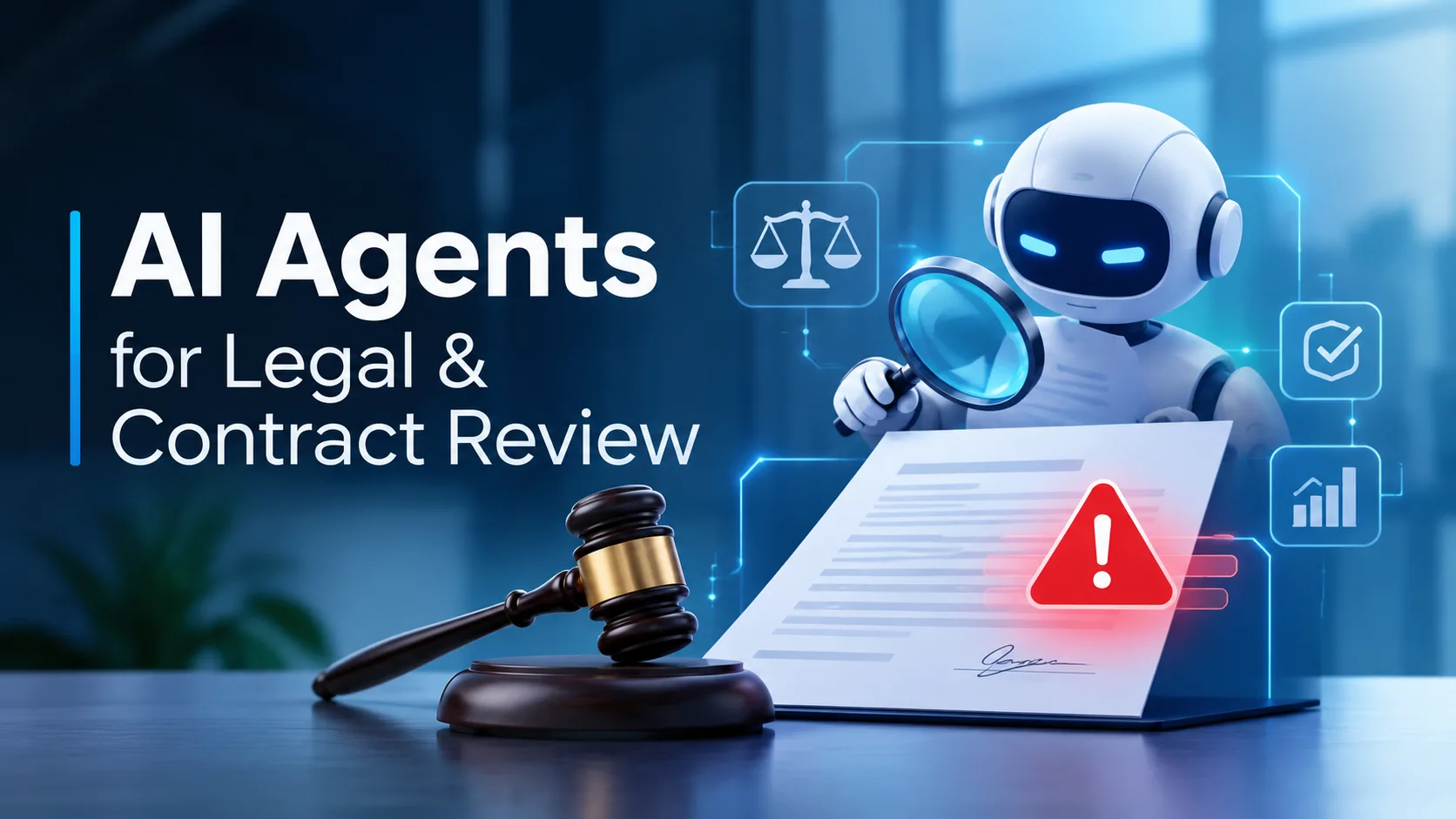
Quick answer: AI agents accelerate legal work by analyzing contracts at scale, flagging risky clauses and missing terms, and automating routine compliance checks. They compress hours of document review into minutes. But law is high-stakes, so the model is strict human-in-the-loop: the agent surfaces and drafts, a qualified lawyer decides.
Legal review is high-volume, detail-heavy, and expensive, which makes it a strong AI agent use case. It is also a domain where a single missed clause can cost millions, so autonomy is bounded tightly. Here is where agents help and where the hard line sits.
1. Document analysis
An agent can read long contracts, extract key terms (parties, dates, obligations, liabilities, renewal and termination clauses), and summarize them in a fraction of the time manual review takes. For teams processing large contract volumes, this is the headline benefit: speed and consistency across documents that would otherwise take hours each.
The challenge is accuracy over long, dense documents. The agent must retrieve and reason over the right passages, not skim. This is a context and retrieval problem, covered in our guide on context engineering for AI agents.
2. Risk flagging
Beyond extraction, an agent can compare clauses against your standards and flag problems: unusual liability terms, missing protections, non-standard language, or deviations from your playbook. It acts as a tireless first-pass reviewer that never gets tired on contract number forty.
Crucial boundary: the agent flags, the lawyer judges. A flag is a prompt for human attention, not a verdict. Legal, financial, and reputational stakes make unsupervised autonomy inappropriate here.
3. Compliance automation
Agents can run routine compliance checks, confirm required clauses are present, verify terms against policy, and keep an audit trail of what was reviewed. This is also where regulation meets your own build: agents operating in regulated contexts carry governance obligations of their own, which ties back to AI governance and the EU AI Act.
Why security is non-negotiable here
Legal agents handle your most sensitive documents. Confidentiality and defense against manipulation are mandatory, not optional. Before any legal agent touches real contracts, read our guide on AI agent security and stopping prompt injection. A leaked or manipulated legal agent is a worst-case scenario.
What agents do vs what lawyers keep
TaskAgentLawyerReading and summarizing contractsYesReviews outputExtracting key termsYesVerifiesFlagging risky or missing clausesYesJudges and decidesRoutine compliance checksYesSigns offLegal advice and final decisionsNoAlwaysNegotiation strategyNoAlwaysIs an agent even the right tool here?
If your need is a simple clause lookup or a fixed checklist, you may not need an agent at all. Our AI agents vs chatbots vs RPA comparison helps you right-size it. But if the work involves reasoning over varied, unstructured contracts at volume, an agent fits. Scope it carefully with our AI agent project brief guide, since legal use cases need especially clear requirements and boundaries.
Build it with the right guardrails
A legal review agent needs accuracy, confidentiality, auditability, and strict human oversight built in from the start. Our AI Agent Development Services cover exactly that kind of high-stakes, human-in-the-loop build, and our guide to hiring AI agent developers helps if you are assembling the team.
Key takeaway: Use legal agents to analyze, flag, and check at scale, with a lawyer always on the decisions. Speed is the win; human judgment is the guardrail.
FAQ
Can an AI agent replace a lawyer?
No. It accelerates review, extraction, and flagging, but legal judgment, advice, and final decisions stay with a qualified lawyer.
Is it safe to put confidential contracts through an AI agent?
Only with strong security: confidentiality controls, access restrictions, and defenses against manipulation. Treat security as a prerequisite, not a feature.
What is the realistic benefit of a legal review agent?
Speed and consistency on high-volume review. It compresses first-pass analysis dramatically while keeping a lawyer on the decisions that matter.