
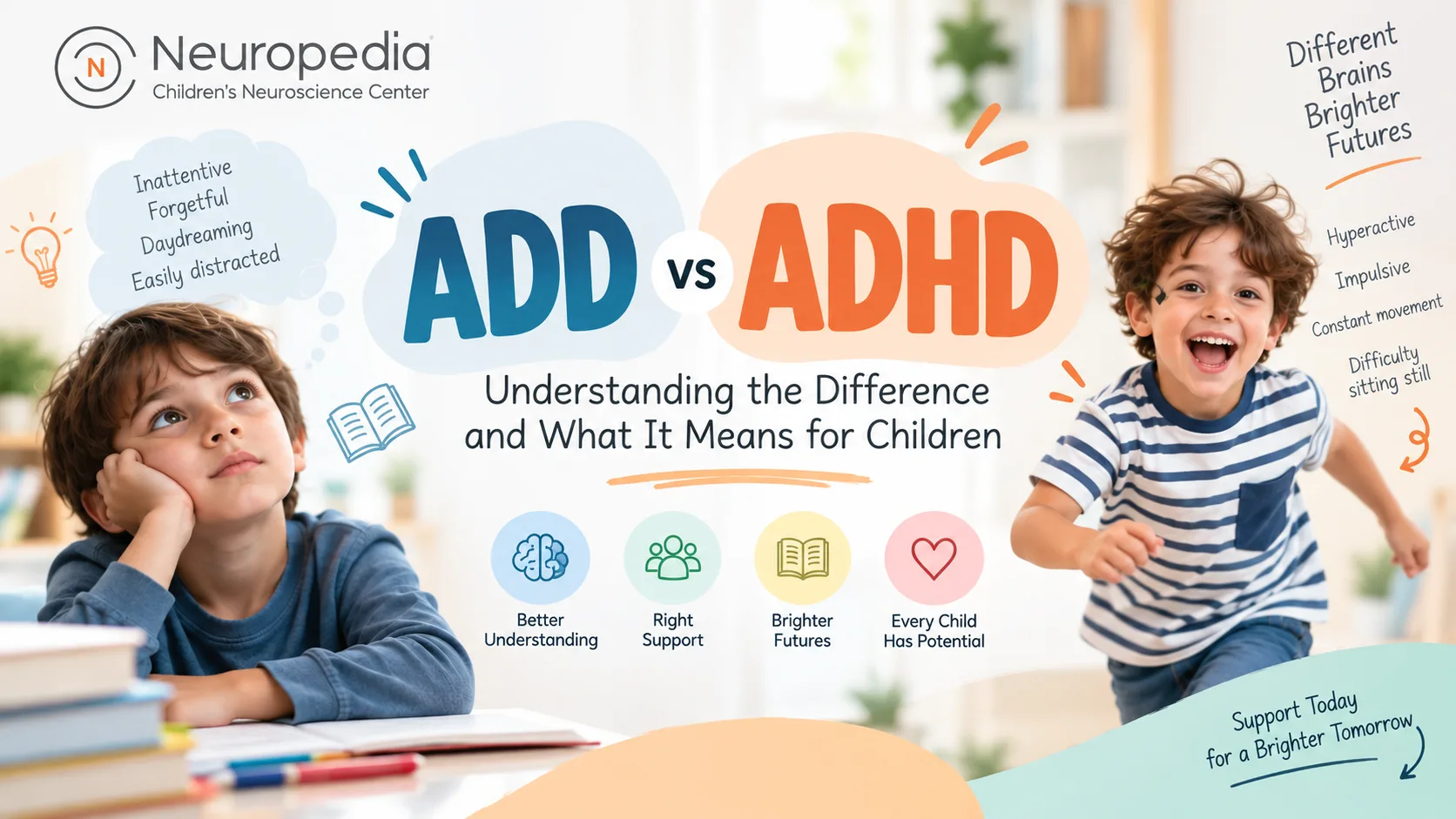
Parents often hear the terms ADD and ADHD used almost interchangeably. Sometimes a child is described as having “ADD” because they seem distracted, forgetful, or lost in their own thoughts. Another child may be diagnosed with ADHD because they are constantly moving, interrupting conversations, or struggling to sit still.
So, are ADD and ADHD actually different conditions?
The short answer is: ADD is an older term that is no longer used as a formal medical diagnosis. ADHD, or Attention-Deficit/Hyperactivity Disorder, is the current clinical term. But the confusion makes sense because ADHD does not look the same in every child.
Some children are noticeably hyperactive. Others may be quiet and dreamy but have significant difficulty paying attention, organising tasks, remembering instructions, or completing schoolwork. Both can have ADHD.
Understanding this distinction can help parents recognise what is really happening rather than assuming that attention difficulties must always look like hyperactivity.
What Is ADD?
ADD stands for Attention Deficit Disorder. It was commonly used in the past to describe children who had problems with attention but did not show obvious hyperactivity.
You may still hear someone say, “My child has ADD,” particularly in everyday conversations or when discussing an older diagnosis. However, ADD is not the diagnostic term currently used in the major clinical classification systems.
Today, children who primarily experience difficulties with attention may be diagnosed with ADHD, predominantly inattentive presentation.
That change in terminology is important because it reflects a broader understanding of ADHD. A child does not have to be physically restless or constantly interrupting others to experience significant attention-related difficulties.
A child with predominantly inattentive ADHD might:
- Have trouble concentrating on tasks
- Easily become distracted
- Frequently lose school supplies or personal belongings
- Forget instructions
- Make careless mistakes
- Struggle to finish homework
- Avoid tasks requiring sustained mental effort
- Appear not to listen when spoken to
- Have difficulty organising schoolwork
- Seem forgetful in everyday activities
From the outside, this child may not appear particularly disruptive. In fact, they can sometimes be described as quiet, shy, lazy, or simply “not trying hard enough.”
That is where misunderstanding can become a problem.
What Is ADHD?
ADHD stands for Attention-Deficit/Hyperactivity Disorder. It is a neurodevelopmental disorder associated with persistent difficulties involving attention, impulse control and/or hyperactivity.
ADHD can affect children in different ways, and symptoms can change as a child grows.
Some children have mainly inattentive symptoms. Others have primarily hyperactive and impulsive symptoms. Some experience a combination of both.
The three recognised presentations are:
1. Predominantly Inattentive Presentation
This is the presentation that most closely resembles what people historically called ADD.
The main difficulties involve attention, organisation, memory and completing tasks.
A child might understand a lesson perfectly well but still forget to bring the completed homework to school. They may start a project enthusiastically and then lose track of it halfway through.
2. Predominantly Hyperactive-Impulsive Presentation
These children may have more noticeable difficulties with restlessness and impulse control.
They may:
- Fidget frequently
- Struggle to remain seated
- Talk excessively
- Interrupt others
- Find it difficult to wait their turn
- Act without considering consequences
- Seem constantly “on the go”
It is worth remembering that occasional restlessness or impulsive behaviour does not automatically mean a child has ADHD. Children naturally have varying energy levels, particularly when they are tired, excited or bored.
3. Combined Presentation
Some children have significant symptoms of both inattention and hyperactivity/impulsivity.
This is sometimes the version of ADHD that people picture first. However, it is only one presentation of the condition.
ADD vs ADHD: What Is the Main Difference?
When looking at ADD vs ADHD, the biggest point to remember is that ADD is essentially an outdated term.
The medical diagnosis is ADHD, and inattentive symptoms can occur without obvious hyperactivity.
ADDADHDOlder terminologyCurrent diagnostic terminologyOften used to describe attention difficulties without hyperactivityIncludes inattentive, hyperactive-impulsive, or combined presentationsNot currently a separate formal diagnosisRecognised neurodevelopmental disorderOften associated with what is now called inattentive presentationCovers a broader range of symptomsSo, if a parent says, “My child has ADD but isn't hyperactive,” the more accurate modern description may be ADHD, predominantly inattentive presentation, assuming the child meets the appropriate diagnostic criteria.
Why Doesn't Every Child With ADHD Look Hyperactive?
This is one of the most important things for parents to understand.
Hyperactivity is not always running around a classroom or climbing on furniture.
In some children, it can appear as internal restlessness, excessive talking, frequent movement, difficulty waiting, or an ongoing need for stimulation. In others, hyperactivity may become less obvious with age.
And some children simply do not have prominent hyperactive symptoms.
This is particularly relevant when considering girls. Although ADHD can affect children of any sex, inattentive symptoms can sometimes be less noticeable than disruptive behaviour. A child who sits quietly in class but is consistently unable to organise work or follow through with tasks may not attract the same attention as a child who frequently leaves their seat.
That does not mean the difficulties are less significant.
How ADHD Can Affect School and Everyday Life
ADHD is not simply about being distracted.
Attention and executive functioning are involved in many ordinary activities. Children may struggle with planning, time management, working memory, organisation, emotional regulation and completing multi-step tasks.
For example, a child might be able to solve a difficult mathematics problem but forget to write their name on the worksheet. Another child might remember that they have homework but become distracted while getting the required books from another room.
Parents sometimes find this confusing because the child clearly can concentrate at certain times.
That is an important observation, but it does not necessarily rule out ADHD.
Children with ADHD may become highly focused on activities they find especially interesting or rewarding. The difficulty is often with regulating attention consistently across different situations, particularly when a task is repetitive, lengthy or requires sustained mental effort.
When Should Parents Consider an Evaluation?
Every child gets distracted. Every child forgets something occasionally.
The question is whether the pattern is persistent and whether it is interfering with the child's daily functioning.
Parents may consider seeking professional advice when attention, impulsivity or hyperactivity is consistently affecting areas such as:
- Academic performance
- Homework completion
- Friendships
- Family routines
- Following instructions
- Organisation
- Behaviour at school
- Participation in activities
- Confidence and self-esteem
A proper evaluation is important because several other issues can produce symptoms that look similar to ADHD.
Sleep difficulties, learning difficulties, anxiety, emotional stress, hearing or vision problems, and other developmental or behavioural concerns can sometimes affect concentration and behaviour.
This is why an ADHD diagnosis should not be based simply on a checklist or on a parent's observation of one or two symptoms.
How Is ADHD Diagnosed?
There is no single blood test, scan or laboratory test that confirms ADHD.
A clinical assessment usually involves gathering information from multiple sources and looking carefully at the child's developmental and behavioural history.
Depending on the child's age and circumstances, a clinician may consider:
- Symptoms and when they began
- Behaviour at home and school
- Academic performance
- Developmental history
- Family observations
- Teacher feedback
- Social functioning
- Attention and executive functioning
- Other medical, developmental or emotional factors
An important part of the process is determining whether symptoms are persistent, occur in more than one setting and cause meaningful impairment.
The aim is not simply to attach a label to a child. It is to understand why they are struggling and identify the support that may help.
ADHD Treatment Is Not One-Size-Fits-All
Once a child has been assessed, treatment can be tailored to their individual needs.
For families looking for ADHD Treatment in Dubai, it is useful to think beyond the idea of a single treatment or quick solution. Management may involve several approaches depending on the child's age, symptoms, developmental profile and circumstances.
Support can include behavioural strategies, parent guidance, educational accommodations, psychological interventions and, when clinically appropriate, medication.
For younger children, parent-focused behavioural strategies can be particularly important. At school, practical adjustments may also help. These might include breaking large assignments into smaller steps, providing clear instructions, allowing appropriate movement breaks, or helping the child use organisational tools.
For some children, medication may be considered by a qualified clinician. If medication is prescribed, monitoring and follow-up are important to assess effectiveness and possible side effects.
The goal is not to change a child's personality.
It is to help them manage difficulties that are getting in the way of learning, relationships and everyday life.
What Parents Can Do at Home
Small changes can sometimes make daily routines much easier.
Children with attention difficulties often benefit from predictable routines. Instead of giving five instructions at once, parents may find it more effective to give one or two clear instructions and check that the child has understood them.
Visual reminders can also help. A morning checklist, for example, can reduce the amount of information a child has to hold in working memory.
Other practical strategies include:
- Keeping school materials in designated places
- Using consistent bedtime and morning routines
- Breaking lengthy tasks into shorter periods
- Reducing unnecessary distractions during homework
- Praising specific positive behaviours
- Giving clear and realistic expectations
- Allowing appropriate physical activity
- Using calendars, timers or visual schedules
These strategies do not replace professional assessment or treatment, but they can complement a child's overall care.
ADD vs ADHD: What Should Parents Remember?
The terminology can be confusing, especially when parents find older information online or hear different terms from different people.
The simplest way to think about ADD vs ADHD is this: ADD is an older term, while ADHD is the current diagnosis. A child can have ADHD without being obviously hyperactive.
What matters most is not whether a child fits the stereotype of ADHD. What matters is understanding the pattern of their difficulties and how those difficulties affect their life.
A quiet child who constantly loses homework deserves the same thoughtful attention as a child who cannot sit still in class.
If you notice persistent difficulties with attention, organisation, impulsivity or activity levels, consider discussing them with a qualified child-development or paediatric specialist. Early recognition can help families understand their child's needs and put appropriate support in place.
For families seeking ADHD Treatment in Dubai, Neuropedia provides specialised care focused on children's neurological and developmental needs. A comprehensive assessment can help clarify whether attention difficulties are related to ADHD or whether another factor may be contributing to the child's challenges.
The terminology may have changed over the years. The underlying goal has not: understand the child in front of you, identify what is making things difficult, and provide the right support at the right time.