
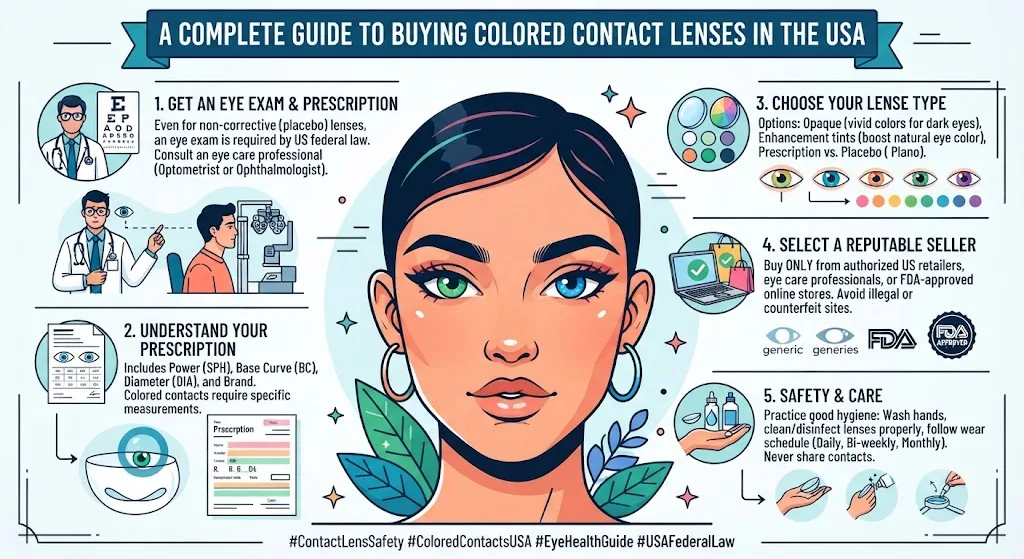
Colored contact lenses have grown into a popular way for people to change or enhance their eye color, whether for special occasions, costumes, or everyday personal style. While they may seem like a simple cosmetic accessory, colored contact lenses are classified as medical devices in the United States and are subject to federal regulation. Understanding these rules, along with the practical steps involved in choosing and using colored lenses safely, is essential before making a purchase.
Understanding Colored Contact Lenses
Colored lenses are generally grouped into three categories based on how they alter appearance:
Visibility tints carry a faint tint, typically light blue or green, added only to make the lens easier to spot if dropped. They do not meaningfully change eye color.
Enhancement tints are translucent and intensify your natural eye color rather than replacing it. These work best for people who already have lighter eyes and want a subtler, more natural-looking change.
Opaque tints contain a solid color pattern capable of fully changing eye color, regardless of your natural shade. These are the most common choice for dramatic transformations, such as achieving gray, violet, green, or hazel eyes.
Colored lenses are also available with or without corrective power. Non-prescription lenses, often called "plano" or "zero-power" lenses, are used purely for cosmetic effect, while prescription colored lenses combine vision correction with a change in eye color.
The Legal Requirement for a Prescription
One of the most important facts for consumers in the United States to understand is that all contact lenses, including purely cosmetic or zero-power lenses, are regulated by the Food and Drug Administration (FDA) as medical devices. Under the Fairness to Contact Lens Consumers Act, it is illegal for retailers to sell any contact lens, decorative or otherwise, without a valid prescription from a licensed eye care professional.
This requirement exists because contact lenses, regardless of whether they correct vision, sit directly on the cornea and carry real risks if the fit, material, or hygiene practices are wrong. Novelty or costume shops, street vendors, and unlicensed online sellers offering "no prescription needed" lenses are operating outside the law, and lenses obtained this way pose a significantly higher risk of eye infection, corneal abrasion, and in rare cases, permanent vision damage.
Getting a Prescription and Fitting
To legally obtain colored contact lenses, a visit to an optometrist or ophthalmologist is required. During this visit, the eye care provider measures the curvature and diameter of your eye, evaluates your overall eye health, and determines whether contact lens wear is suitable for you. Even individuals with no vision correction needs must undergo this fitting process specifically for cosmetic lenses, since a prescription for corrective lenses does not automatically apply to colored or decorative ones.
Your prescription will specify the base curve, diameter, and brand or lens type suitable for your eyes, and this information should match exactly what you purchase.
Where to Buy Colored Contact Lenses
Once you have a valid prescription, colored contact lenses can be purchased through several legitimate channels:
Your eye doctor's office often sells lenses directly and can order specific brands or colors on request.
Licensed optical retailers, both in physical stores and online, are required to verify your prescription before completing a sale. Reputable online retailers will typically ask for your prescription details or contact your eye doctor directly to confirm them.
Pharmacy chains and major retailers with optical departments also offer colored lenses, generally requiring the same prescription verification process.
When buying coloured contact lenses online in USA, look for retailers that are transparent about verification procedures, display clear manufacturer and lot information on packaging, and are compliant with FDA regulations. Avoid any seller that offers to sell lenses without requesting prescription information, regardless of how convenient or inexpensive the offer appears.
Lens Care and Safety Practices
Proper hygiene significantly reduces the risk of complications. Always wash your hands thoroughly before handling lenses. If using reusable lenses, store them in fresh solution recommended by your eye doctor, and never reuse old solution or top it off. Daily disposable lenses eliminate much of this maintenance and are often recommended for occasional or first-time wearers of colored lenses.
Avoid sleeping in lenses unless specifically approved for extended wear, and never share lenses with another person, even briefly, as this can transmit infection. If you experience redness, pain, excessive tearing, or blurred vision at any point, remove the lenses immediately and consult your eye care provider.
Conclusion
Colored contact lenses can be a safe and enjoyable way to change your look, provided they are obtained and used correctly. In the United States, this means securing a proper fitting and prescription from a licensed eye care professional and purchasing only from verified, compliant retailers. Taking these steps protects not just the way your eyes look, but their long-term health as well.