In every market, across every industry, the first question a potential customer asks about a business they have not dealt with before is the same: can I trust them?
The answer used to be formed through physical signals. The quality of the shopfront. The professionalism of the team. The weight of the business card. The reputation passed through word of mouth in a community where people knew each other.
Today, that question is answered online. Before a meeting is requested, before a proposal is reviewed, before a referral is followed up — the potential customer visits the website. What they find there either confirms or contradicts every other impression they have formed. And it takes, on average, less than seven seconds for that judgement to be made.
A professional website is no longer a supplementary marketing tool. It is the primary vehicle through which a business communicates its credibility to the world.
THE PSYCHOLOGY OF FIRST IMPRESSIONS IN DIGITAL ENVIRONMENTS
Research consistently confirms that humans form visual impressions in milliseconds. The brain processes colour, layout, proportion, and consistency almost instantaneously — before any conscious evaluation of content has begun. By the time a visitor has read a single word on a website, they have already formed an aesthetic impression that colours everything that follows.
This has significant implications for business credibility. A website that is visually inconsistent, poorly structured, or aesthetically amateur communicates something about the business behind it — not its products, not its expertise, not its customer service — but its standards. And those inferred standards are applied to everything else the visitor encounters.
A website that is clean, well-structured, visually consistent, and clearly professional communicates the opposite. It says: this business takes itself seriously. It pays attention to detail. It can be trusted to bring that same attention to the work it does for clients.
This is not a superficial judgement. It is a rational inference based on the available evidence. And the website is the most prominent piece of evidence most businesses present to the world.
WHAT SPECIFIC ELEMENTS BUILD CREDIBILITY
Understanding which elements of a website most directly influence credibility allows businesses to invest in the right areas.
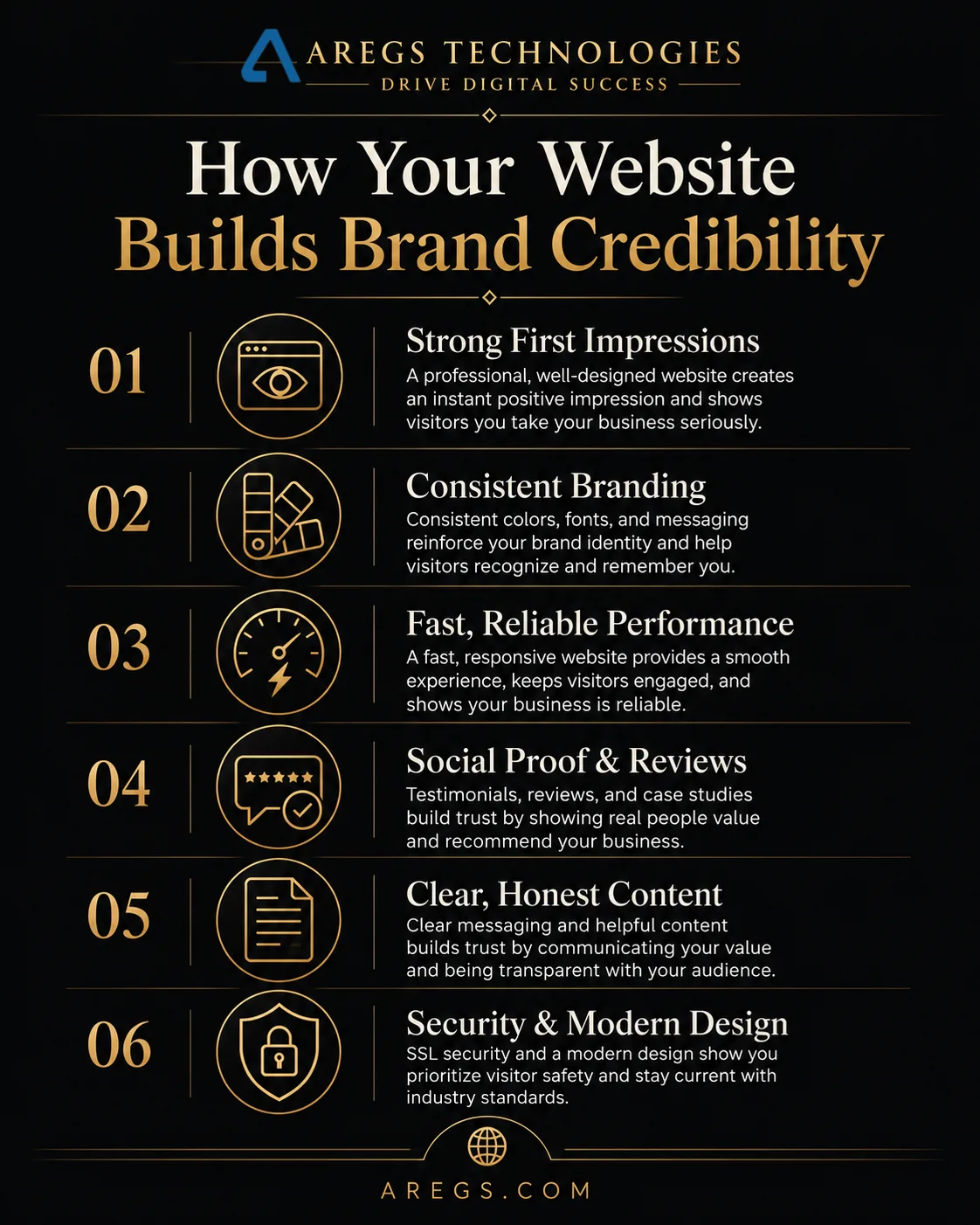
Design quality and consistency. A website with a coherent visual identity — consistent typography, a defined colour palette, a clear layout system — signals professionalism and attention to detail. Inconsistency across pages, misaligned elements, or a visual style that feels assembled rather than designed signals the opposite.
Genuine photography. Stock imagery of staged business scenarios communicates nothing about the actual business. Photographs of real team members, real premises, and real work create a human connection that generic imagery cannot. Visitors are measurably more willing to trust businesses where they can see the real people involved.
Specific and credible testimonials. Social proof is one of the most reliable mechanisms for building trust. The most effective testimonials are specific — they describe a real situation, a real process, and a real outcome. Generic endorsements contribute little. Detailed accounts of real experiences contribute significantly to a visitor's confidence in the business.
Transparent contact information. Businesses that display their physical address, phone number, and email address prominently are businesses that have nothing to hide. The visible presence of this information — particularly a physical address — significantly reduces the perception of risk for first-time visitors.
Content depth and expertise. A website that describes services in specific, knowledgeable terms — demonstrating understanding of the problems customers face and the approaches taken to address them — signals genuine expertise. Vague descriptions of services that could apply to any business in any context signal the opposite, regardless of the actual quality of the underlying work.
Security and technical correctness. A secure connection, a website free of broken links and error pages, and pages that load quickly all communicate that the business maintains its digital presence with care. Technical failures create disproportionately negative impressions because they suggest a lack of attention that visitors extend to other aspects of the business.
THE CREDIBILITY GAP
There is a specific business problem worth naming here: the credibility gap.
The credibility gap is the distance between how good a business actually is and how good its website suggests it might be. For many businesses — particularly small and medium enterprises that have invested in their actual service or product quality while neglecting their digital presence — this gap is significant.
The consequences are measurable. Potential customers who would have converted, had they experienced the business rather than its website, never reach that stage. Referrals from satisfied clients are not followed up because the website fails to confirm the referral's recommendation. Advertising spend generates impressions and clicks but not conversions because the landing experience does not match the promise.
Closing this gap is not about misrepresentation. A professional website does not make a mediocre business appear excellent. It removes a barrier that was preventing an actually excellent business from being perceived as such. It allows the business to be evaluated on what it genuinely offers.
For businesses looking to close this gap, the most effective path is working with a professional web design agency that understands both the design and the strategic dimensions of credibility-building — and can translate the genuine quality of a business into a digital experience that communicates that quality accurately.
CREDIBILITY IS BUILT OVER TIME
A professional website at launch is the foundation. The businesses that build the strongest brand credibility online are those that treat their website as a living asset rather than a completed project.
Regularly published content that demonstrates expertise — articles, case studies, guides — positions the business as a trusted authority in its field. Each piece of content adds to a growing record of knowledge and perspective that visitors and search engines both assess positively over time.
Updated testimonials and case studies reflect current performance. Fresh photography shows the team and the work as they actually are today. Credentials, certifications, and recognitions added as they are achieved build an evidence base of continuous professional development.
The cumulative effect of consistent investment in a website is a brand credibility that compounds. The website becomes not just a representation of the business at a single point in time, but a record of its development — and a signal that the business takes its reputation seriously enough to invest in it continuously.
This is the standard worth building toward. Not a website that exists, but a website that earns the trust of every visitor who arrives — and converts that trust into the business relationships that sustain growth.
If building that kind of credibility is a priority for your business, the right website design company makes the difference between a digital presence that represents your business and one that undersells it.