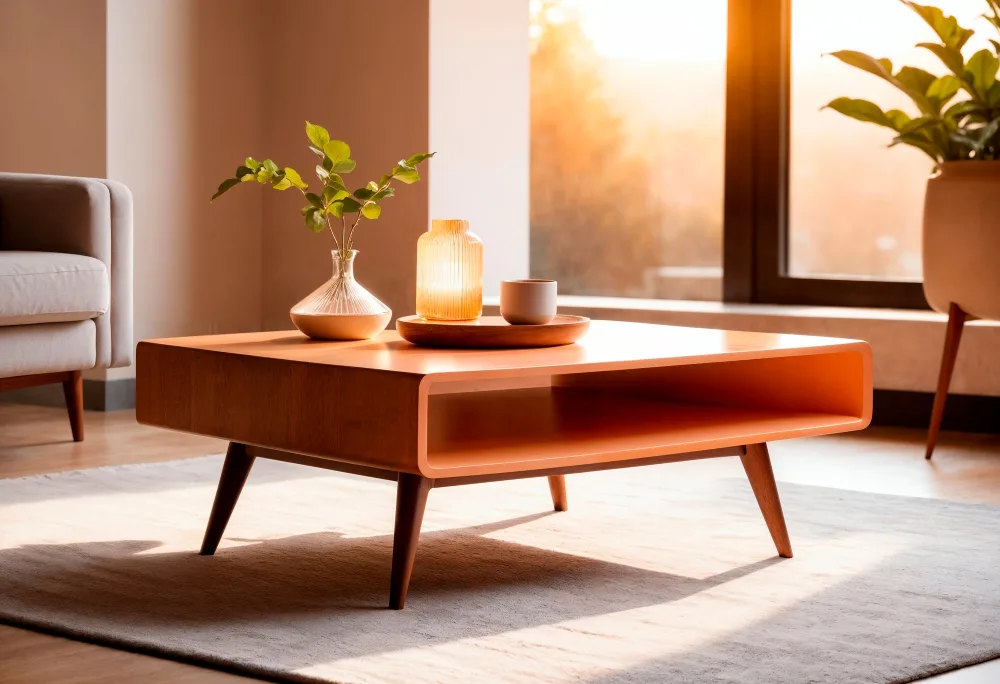
A coffee table does more daily work than any other piece in a living room. It holds drinks, catches books, grounds the seating arrangement, and sits at eye level from the sofa. Most people spend more time looking at their coffee table than at any other single surface in the home, which makes it the piece where design decisions matter most. Getting it right changes the whole room.
Why Shape Matters More Than You Think
The shape of a coffee table is the first decision, and it follows directly from the sofa. A long rectangular sofa wants a table with a horizontal form that matches its scale. A curved or sectional sofa almost always reads better with a round or oval piece that mirrors the flow of the upholstery. Square tables work in compact rooms where proportion is tight. The mistake most buyers make is choosing the shape they like rather than the shape the room needs.
Height is the other dimension people overlook. A coffee table should sit roughly level with the seat cushion of the sofa, give or take a few centimetres. Too low, and it's uncomfortable to reach. Too high, and it changes the whole visual weight of the seating area.
What Material Does for the Room
Material is where a coffee table shifts from functional to considered. A sculptural coffee table Dubai, the kind built around a strong base, an interesting silhouette, or a material with real visual weight, changes the room's register entirely. It stops being background furniture and starts being the piece that the room is organized around.
A few materials stand out for Dubai homes in particular. Solid wood brings warmth and grain. Terrazzo adds texture and handles daily wear beautifully. Glass keeps things light and airy but shows every mark. And microcement coffee table designs in Dubai have become increasingly popular for exactly the reason you'd expect: the matte, monolithic surface brings sculptural mass without visual noise, holds up to heat and humidity, and sits quietly next to almost any other material in the room.
One More Thing: The Base and the Floor
A detail that often gets skipped is how the base interacts with the floor covering. A heavy cylindrical base in microcement reads differently on a light-toned rug than on dark herringbone parquet. A glass top on a slim-leg base can disappear on a patterned rug, while a solid wood or terrazzo top on the same base becomes more visible and grounded. It sounds minor, but the combination of base material, top material, and floor finish is what makes a coffee table feel like it was chosen for the room rather than placed in it.
For open-plan Dubai homes with large tiled or polished concrete floors and minimal rugs, a microcement coffee table Dubai with a cylindrical base tends to land particularly well; the material palette already speaks the same language as the floor, and the piece reads as an extension of the architecture rather than an object sitting on top of it.
How to Choose for Your Room
A few questions help narrow it down:
- How much traffic does the room get? High-traffic homes with kids or frequent guests should lean toward microcement, terrazzo, or steel, materials that handle daily contact well and hide light wear.
- What is the room's primary material? A wood-heavy room often wants a coffee table in a contrasting material. A neutral, light-toned room can carry something in a deeper or more textured finish.
- What is the base doing? A sculptural base (cylindrical, pedestal, or an unusual geometric form) reads as the design statement. A simple four-leg base lets the top surface carry the room.
- What size is the room? Measure before committing. The table should leave at least 45cm of clearance on all sides so movement around the seating area stays easy.
The Piece That Anchors the Room
There is a version of this decision that ends with a coffee table nobody notices, and a version that ends with the piece that guests mention when they walk in. The difference is usually not price; it is whether the shape, material, and scale were chosen for the specific room rather than pulled from a generic catalogue.
A sculptural coffee table in a Dubai home works not because it is decorative but because it does its job at scale, in a material that holds up, and in a form that the room earns its look from. That is the threshold worth aiming for.
Studio Obliq designs and produces coffee tables in solid wood, microcement, stainless steel, and terrazzo from its Dubai workshop, with each piece built to the proportions and daily life of the room it lives in.