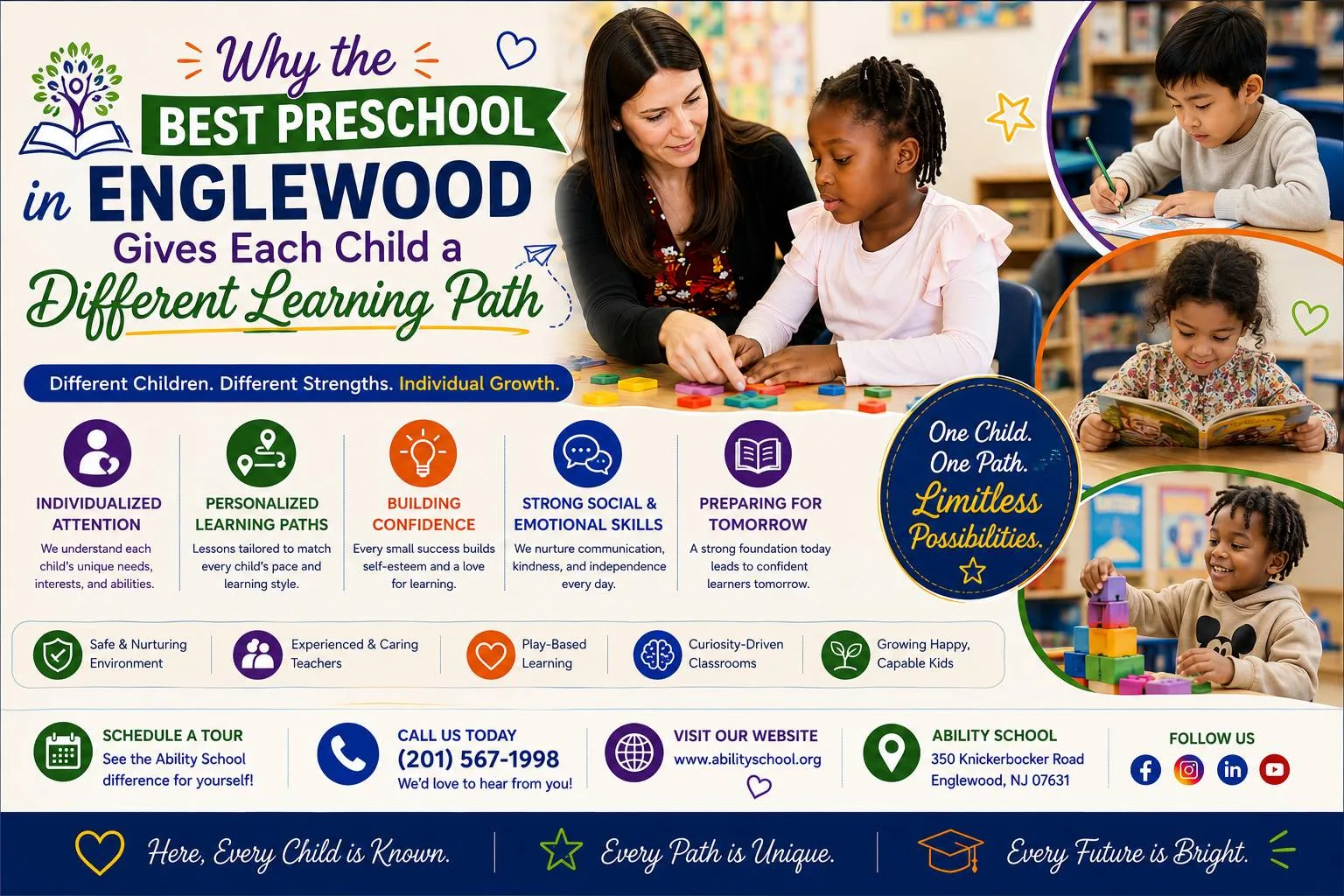
What happens when two children of the same age are ready for completely different work? One may recognize simple words. Another may still be learning letter sounds. A preschool can place both children in one room, but that does not mean both should learn in the same way.
Parents comparing the best preschool in Englewood, the best preschool in NJ, or the best preschools in NJ need to look beyond the classroom and ask a harder question: what happens when children progress at different speeds?
Individualized Learning Starts With What a Child Can Do
Age gives a school a starting point. It does not tell a teacher everything. Two four-year-olds can have different strengths in language, early math, or attention. A fixed lesson sequence can leave one child confused and another underchallenged. Individualized instruction starts with what the child already understands, then builds from there without skipping the basics.
Ability School uses a self-paced model, so a child can spend longer on a skill that needs practice or move ahead. For families searching for the best preschool in Englewood, that gives them something concrete to assess.
Mastery Should Come Before The Next Lesson
Preschool learning gaps can look small at first. They can become harder to correct later. A child may know the alphabet but struggle to connect letters with sounds. Another may count correctly while still finding quantity difficult to understand. Moving straight to harder work can hide those gaps.
A mastery-based approach keeps the sequence clearer. The child works on a concept until the teacher sees real understanding, not just repetition. Parents comparing the best preschool in NJ should ask how teachers decide when a child is ready to move forward. Finishing an activity is not the same as learning from it.
Early Reading Needs More Than Letter Recognition
Early literacy often gets reduced to alphabet practice. That is only one part. Young children also need vocabulary, listening skills, sound awareness, comprehension, and confidence with language. A child who can pronounce a short word but cannot explain it is still building the skill.
A strong preschool reading program connects recognition with meaning. Stories, conversation, pictures, sounds, and short reading activities help teachers notice where understanding breaks. That creates a stronger base.
What Parents Should Look For In Personalized Preschool Learning
“Individualized” appears on many school websites, so parents need to test what it means in practice. When comparing the best preschools in NJ, these signs are more useful:
- Teachers change work when a child needs more practice.
- Children move forward after showing understanding, not because the calendar changed.
- Reading activities involve comprehension and not just memorization.
- Early math, science, language, and movement are integrated through practical activities.
- Feedback from the teacher is targeted at specific skills, not general comments.
- Children are taught what to do if they make a mistake.
This information reveals if personalization translates into changes in instruction.
Hands-On Work Should Connect Back To A Skill
Preschool children will often grasp an idea better if they can do something with it. Classification can be added to sorting objects. Comparing blocks can reinforce concepts of size, number, and sequence. Observing plants or simple materials can introduce scientific language. The activity itself is not the goal.
The teacher should know which skill the child is practicing and what the activity reveals. Hands-on learning also gives teachers another way to see what a child knows.
Learning How To Learn Starts Early
School readiness is not only about letters, numbers, or colors. Children also need to know how to approach unfamiliar work.
They need practice following directions, asking for clarification, finishing a task in stages, correcting an error, and trying again. Those habits support greater independence later.
Ability School includes this idea in its wider educational approach. For parents looking at the best preschool in Englewood, it is worth asking whether a program teaches only content or also shows children how to work through confusion.
Flexible Pre-K Options Still Need Structure
A family may need a full-day program. Another may prefer half days or a mixed schedule. Some children may also need an early kindergarten option because they miss New Jersey’s age cutoff.
Flexibility helps, but parents should still ask what learning continues across each schedule. The best preschools in NJ should explain how literacy, practical work, social development, and foundational skills fit together.
Conclusion
Choosing a preschool takes more than comparing schedules, classroom photos, or polished descriptions. Parents should ask how teachers identify readiness, what happens when a child struggles, how reading develops beyond memorization, and what determines the move to harder work.
Those questions reveal the structure behind the program. For families evaluating the best preschool in Englewood, the stronger choice is one that lets children progress differently while keeping expectations and academic foundations clear.