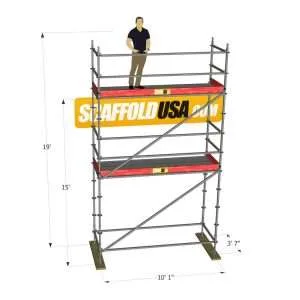
Traditional tube and clamp scaffolding requires skilled labor and significant assembly time, a combination that modular systems were specifically designed to improve upon.
The scaffolding and accessories market is projected to grow by $4.4 billion between 2026 and 2030, according to recent industry data, growth driven largely by increasing adoption of modular scaffold systems over older, more labor-intensive designs.
Why Standardized Components Speed Up Assembly
Modular systems use a limited set of standardized parts that fit together in predictable ways, reducing both assembly time and the specialized training required to build safely.
How Bolt-Free Designs Improve Job Site Safety
Systems designed around simple locking mechanisms rather than traditional bolted connections reduce both assembly errors and the physical strain of repetitive fastening.
Why This Matters for Project Timelines
Faster assembly and disassembly translate directly into more usable labor hours on the actual project rather than scaffold construction, a meaningful efficiency gain on tight schedules.
What Makes a Modular System Well Designed
- A genuinely limited number of distinct component types.
- Clear, intuitive locking mechanisms requiring minimal training.
- Compatibility with common accessories like platforms and guardrails.
Why Modular Systems Suit a Range of Project Types
From masonry and painting to general construction and maintenance work, modular scaffolding's flexibility allows the same core system to adapt across many different job types.
Considering Upfront Cost Against Labor Savings
Modular systems often carry a higher upfront equipment cost than basic tube and clamp setups, but the labor savings from faster assembly frequently offset this over multiple projects.
Why Rental Availability Has Expanded Alongside Adoption
As modular systems have become more popular, rental availability has expanded too, giving contractors a lower-commitment way to access this equipment without a large upfront purchase.
What Crew Training Requirements Look Like in Practice
Even with simpler locking mechanisms, crews still benefit from basic training on the specific system in use, ensuring consistent, safe assembly across every job site.
Why Weather Resistance Affects Modular Component Longevity
Modular components left exposed to repeated rain, freeze-thaw cycles, or intense sun over multiple seasons can degrade faster than their rated service life suggests without proper care. Galvanized or otherwise coated components resist this wear considerably better than bare steel, making coating quality worth checking before a bulk purchase.
Contractors operating in harsher climates should factor expected weather exposure into their equipment selection, not just upfront cost. A system that holds up reliably through several years of outdoor use ultimately costs less than one requiring frequent early replacement.
How Standardization Simplifies Multi-Site Inventory Management
Contractors running several active job sites benefit from a modular system's limited component variety, since interchangeable parts can move between sites without compatibility concerns. This flexibility reduces the risk of a project stalling because the wrong component type ended up at the wrong location.
Tracking inventory across multiple sites becomes considerably simpler when every site uses the same standardized component set, rather than a mix of different scaffolding types accumulated over time. This operational simplicity is an often-overlooked benefit of committing to one modular system company-wide.
What Inspection Routines Keep a Modular System Safe Over Time
Regular inspection of locking mechanisms, welds, and load-bearing components catches wear before it becomes a safety hazard, particularly on equipment that sees frequent assembly and disassembly cycles. Establishing a documented inspection schedule, rather than relying on informal visual checks, creates accountability for equipment condition.
Components that fail inspection should be removed from service immediately rather than returned to the rotation with a note to watch them. This discipline protects crew safety and also gives a contractor a clearer picture of when to budget for equipment replacement.
Why Compatibility Across Brands Is Rarely Guaranteed
Contractors sometimes assume modular scaffolding components from different manufacturers will interlock reliably, but proprietary locking mechanisms often prevent true cross-brand compatibility. Mixing brands without confirming compatibility first can produce connections that look secure but do not meet the same safety standard as a matched system.
Standardizing on a single manufacturer, or at minimum verifying compatibility claims independently before mixing brands, avoids this risk entirely. This consideration becomes especially important when renting additional components to supplement an existing owned inventory.
Why Documentation Availability Affects Long-Term System Support
A modular system backed by clear manufacturer documentation, including load charts and assembly guides, gives crews a reliable reference when questions arise on site rather than relying on memory or guesswork. Systems with thin or hard-to-find documentation create more risk of assembly errors, particularly with newer crew members.
Contractors evaluating a modular system for the first time should confirm documentation quality and availability before committing to a large purchase, since this support resource matters for as long as the equipment stays in service.
Why Manufacturer Responsiveness Matters When Components Wear Out
A modular system is only as useful as a contractor's ability to replace worn or damaged components quickly, and manufacturers with slow fulfillment on replacement parts can leave equipment sitting idle waiting for a single missing piece. Checking typical lead times for replacement components before committing to a system avoids this frustration down the line.
Contractors with active job sites benefit from working with manufacturers or distributors who keep common replacement parts in ready stock, rather than sourcing them on demand for every request.
Modular scaffold systems have become the preferred standard by genuinely reducing assembly time and labor complexity compared to older designs. This shift reflects a broader industry trend toward speed and safety, not simply a passing preference.