Medical disclaimer — This article is for general educational purposes and does not replace evaluation, diagnosis, or treatment from a licensed healthcare professional. CoCardio services are designed to complement, not replace, standard medical care. Sudden, severe, or worsening chest pain requires emergency medical care.
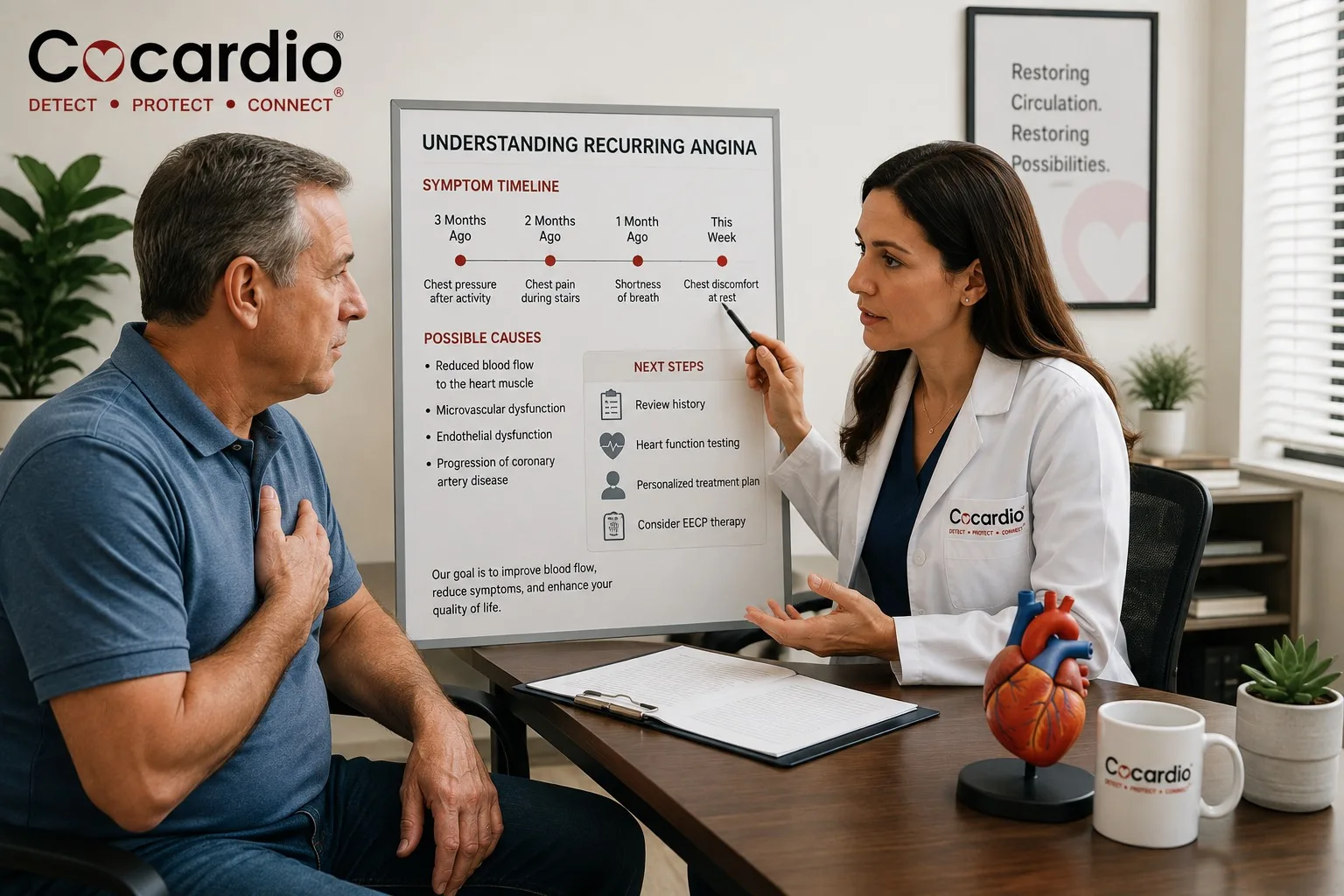
Recurring angina can happen when the heart muscle is not receiving enough blood flow during activity or stress. For selected people with stable symptoms, eecp therapy for angina may be discussed as a non-invasive way to support circulation, but it is not an emergency treatment and it is not appropriate for everyone. The first step is to understand the symptom pattern, rule out urgent causes, and review heart function and treatment history.
CoCardio’s Encinitas services are designed to complement standard medical care with consultation, testing, and circulation-focused options. If you have ongoing or recurring chest discomfort after urgent causes have been ruled out and want to discuss an evaluation, call +1 (858) 500-1399.
Why Angina Can Keep Returning
CoCardio describes angina as chest discomfort that occurs when the heart muscle does not receive enough blood flow, particularly during exertion or stress. People may describe pressure, tightness, heaviness, or exertional discomfort that improves with rest. Because chest pain can also come from non-cardiac causes, symptoms should not be self-diagnosed.
A return of chest discomfort does not automatically tell you why it is happening. The useful clinical questions include whether the symptoms are stable or changing, whether they are triggered by exertion, what previous cardiac testing has shown, what treatments have already been tried, and whether there are other structural or circulation concerns.
- New, severe, or worsening chest pain needs emergency evaluation.
- Recurring or exertional discomfort deserves medical assessment even when previous tests were reassuring.
- Stable angina and acute chest pain are not interchangeable terms.
How eecp therapy for angina Is Evaluated
CoCardio states that for individuals with stable angina, ECP may be an appropriate option after consultation and heart function testing. The goal is not to promise a cure. The service is described as circulation-focused support that may improve blood flow to the heart muscle, reduce angina symptoms, and increase exercise tolerance for appropriately selected patients.
The separate supplied guide on persistent angina emphasizes that diagnosis, symptom burden, treatment history, and clinician review all matter. It says EECP may be discussed with selected patients who have chronic stable or refractory angina despite guideline-directed therapy, particularly when additional PCI or bypass surgery is not feasible, has not controlled symptoms, or presents excessive risk.
- Evaluation should come before treatment promises.
- A stable diagnosis and symptom pattern matter.
- Treatment history and cardiology coordination are part of candidacy.
- No responsible provider should guarantee a response.
What external counterpulsation therapy Does During a Session
During external counterpulsation therapy, inflatable cuffs are placed around the lower body and timed with the heartbeat. CoCardio describes the cuffs as inflating and deflating in sequence to support circulation during the resting phase of the cardiac cycle. Because the treatment is delivered externally, patients commonly describe it as a non invasive heart treatment.
The supplied educational guide explains the mechanism in more clinical terms: ECG-timed cuffs inflate during diastole and deflate before the next heartbeat, with the goal of supporting coronary perfusion, symptoms, and functional capacity. The same guide is clear that the treatment does not physically remove plaque, replace a medically necessary procedure, or guarantee prevention of a future cardiac event.
Testing and Risk Context Before ecp therapy
CoCardio uses heart function testing, also called an echocardiogram, to look at pumping function, valves, heart structure, wall motion, and circulation patterns. For recurring chest discomfort, the clinic says this information can help identify findings that may contribute to angina symptoms and help determine whether CoCardio Boost™ or another prevention-focused strategy may be appropriate.
The supplied persistent-angina guide also says pre-treatment review can include the diagnosis, symptom pattern, medications, blood pressure, rhythm, vascular health, bleeding risk, recent procedures, and relevant testing. That is an important distinction when comparing eecp therapy centers: a high-quality center should explain why a treatment is being considered, not simply sell a session.
Where Epigenetic biomarker testing May Fit Into Prevention-Focused Care
Epigenetic biomarker testing is a separate CoCardio service. The clinic describes it as a way to examine DNA methylation signals and broader patterns associated with lifestyle, environment, stress, aging, and cardiovascular risk. It should not be confused with a test that diagnoses the cause of active chest pain.
For a person dealing with stable angina, this type of testing may belong to a broader prevention conversation rather than the immediate symptom-evaluation pathway. The angina question remains more direct: are symptoms stable, has urgent disease been ruled out, what does heart testing show, and is a circulation-focused therapy appropriate?
EECP therapy cost, Local Access, and the Questions to Ask
The supplied CoCardio pages do not state a fixed treatment price, so a responsible article should not invent a package cost or insurance guarantee. Instead, patients should ask what evaluation is needed, how the treatment plan is structured, what is included, and what payment or coverage questions apply to their case.
Someone searching forECP therapy near me is usually close to taking action. CoCardio is in Encinitas and serves the greater San Diego area. Its contact page lists the patient line as +1 (858) 500-1399 and provides appointment options for people who want to discuss their concerns.
To discuss whether an evaluation may be appropriate, call CoCardio at +1 (858) 500-1399.
Common Mistakes When Researching Persistent Angina Treatment
- Waiting on severe or worsening chest pain instead of seeking emergency care.
- Assuming recurring symptoms are harmless because a previous test was normal.
- Choosing an EECP provider that promises a cure or guaranteed response.
- Treating EECP as a replacement for prescribed medication, cardiology follow-up, PCI, or bypass surgery.
- Focusing only on cost before confirming diagnosis, candidacy, and treatment goals.
Key Takeaways
- eecp therapy for angina may be considered for selected people with stable symptoms after evaluation.
- External counterpulsation uses timed lower-body cuffs to support circulation without entering the body.
- Heart function testing and treatment-history review help determine whether ECP is appropriate.
- Patients in Encinitas or the greater San Diego area can call +1 (858) 500-1399 to discuss evaluation.
Frequently Asked Questions
Can EECP be used for active severe chest pain?
No. CoCardio states that sudden, severe, or worsening chest pain requires emergency medical care. Its ECP services are not emergency services.
Does EECP remove plaque?
The supplied persistent-angina guide states that external counterpulsation does not physically clear plaque. It is intended as circulation-focused supportive care for appropriately selected patients.
What does an EECP session involve?
CoCardio describes lower-body cuffs that inflate and deflate in coordination with the heartbeat to support circulation during the heart’s resting phase.
How do I know whether I am a candidate?
CoCardio states that candidacy is determined through consultation and heart function testing, with symptom pattern, treatment history, and safety considerations reviewed before treatment.
Where can I ask about treatment and cost?
CoCardio’s contact page lists its Encinitas patient line as +1 (858) 500-1399. The clinic can explain evaluation steps and treatment-planning questions without relying on a generic online price.
A Practical Next Step for Recurring Stable Angina
If angina keeps returning, the next step is not to assume that one therapy will solve every cause of chest pain. A safer approach is to clarify whether symptoms are stable, review current medical care and testing, and then decide whether a circulation-focused option fits.
For a CoCardio evaluation in Encinitas, call +1 (858) 500-1399.