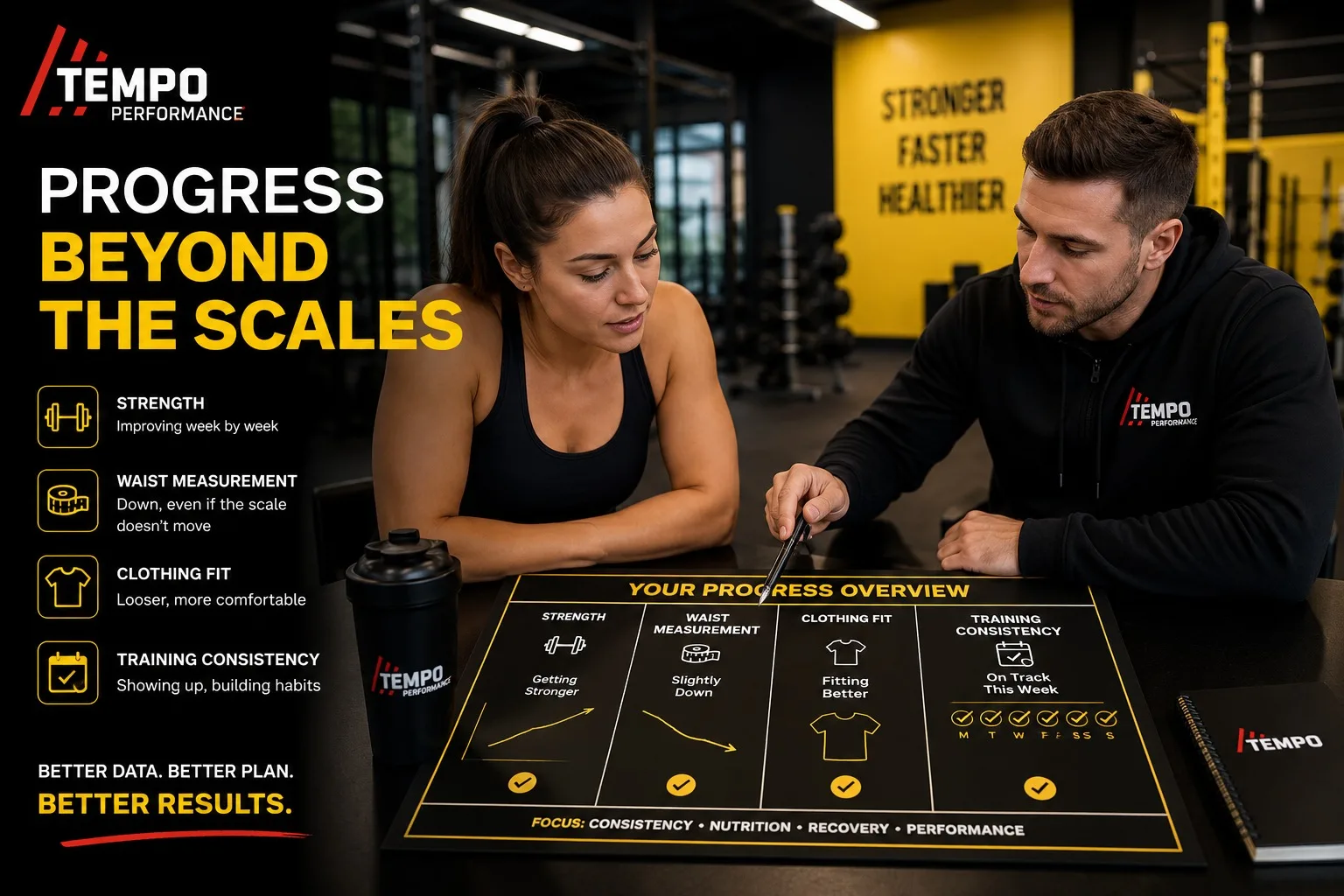
If the number on the scales is falling but your body still does not look as firm or defined as you expected, the issue may be that weight change and body composition are not the same thing. A personal trainer Fitzrovia can help organise resistance training, daily activity, nutrition and recovery around the goal of changing how your body looks and performs rather than chasing scale weight alone.
The useful question is not simply “How much weight have I lost?” but “What is changing as I lose it?” Tempo Performance describes fat loss, muscle building, nutrition and strength work as connected areas of expertise, and its client journey begins by reviewing exercise habits, nutritional patterns, lifestyle factors and goals before creating a personalised action plan.
Why weight loss and a toned appearance are different goals
A lower body weight does not automatically tell you how much muscle you have retained, how strong you are becoming or how your shape is changing. If your plan focuses only on eating less and doing more activity, the scales can become the main measure even when the real goal is a firmer, more athletic appearance.
Tempo Performance’s own approach separates fat loss from muscle building while treating both as part of a broader plan. That distinction matters because the visual result people describe as “toned” usually depends on having enough muscle to create shape while reducing the amount of body fat covering it.
- Use the scales as one data point rather than the only definition of progress.
- Track training performance and whether key lifts or movements are being maintained.
- Review measurements, clothing fit and progress photos consistently rather than reacting to daily fluctuations.
- Judge the plan by whether it supports the body-composition goal you actually care about.
A personal trainer Fitzrovia approach should prioritise resistance training
Resistance training gives your programme a clear reason to preserve and develop useful muscle. Tempo Performance’s strength and conditioning service focuses on qualities including relative strength, power, muscle endurance and functional hypertrophy, while its wider personal-training model is built around goal-oriented coaching rather than a generic workout.
A well-structured personalised training programme should therefore define which movements you are training, how those movements will progress and how much weekly work fits your current experience and recovery. More exercises are not automatically better. The purpose is to create a repeatable training stimulus that can be adjusted as you improve.
For clients who want a stronger performance focus, Strength and Conditioning can sit alongside body-composition work so strength is treated as an outcome worth protecting rather than something sacrificed for a faster change on the scales.
Nutrition should support training rather than compete with it
Body-composition work becomes harder when training and nutrition are treated as unrelated projects. Tempo Performance’s consultation process includes nutritional patterns alongside exercise habits and lifestyle factors, and its online service describes tailored diet programmes as part of the coaching offer.
A personalised diet plan should fit the amount and type of training you are actually doing. The aim is not to make food rules as restrictive as possible. It is to create an approach that supports the intended weight-loss direction while still allowing you to train, recover and maintain consistency.
If your specific concern is preserving performance while reducing body weight, the principle behind Lose weight without losing strength is especially relevant. Training quality, recovery and nutrition need to work together instead of pulling in opposite directions.
Recovery and consistency influence how your programme looks in practice
A plan that looks perfect on paper can fail if it does not fit your working week, sleep, travel or stress. Tempo Performance’s client journey specifically considers the working environment and lifestyle factors before an action plan is created. That makes the schedule itself part of the programme rather than an afterthought.
For a busy Fitzrovia professional, this may mean fewer high-quality sessions that are completed consistently instead of an ambitious routine that is repeatedly skipped. It may also mean adjusting volume during demanding weeks rather than interpreting every schedule change as failure.
Online & Virtual Training can also provide continuity when in-person sessions are difficult. Tempo Performance states that its online coaching includes constructed gym or home workouts, tailored diet programmes, understandable protocols and tracking by online professionals.
Measure progress in a way that matches body composition
If the goal is to look leaner and stronger, your progress review should include more than body weight. A useful review asks whether your training is progressing, whether your clothing fit is changing, whether your measurements are moving in the intended direction and whether your current routine is sustainable.
This does not mean ignoring the scales. It means putting scale weight in context. A single measurement can move for reasons that do not tell you whether the training plan is working, whereas a pattern across several measures gives a more complete picture.
- Choose a consistent schedule for weigh-ins or measurements rather than checking emotionally after every session.
- Track a small set of repeatable strength markers.
- Use the same conditions for progress photos if you use them.
- Review the plan at defined intervals and change one variable at a time where possible.
A realistic example
Consider an office-based client who has already reduced body weight but feels “softer” than expected. An illustrative next step would be to keep weight loss gradual, organise two or more well-planned resistance sessions around the working week, monitor a few core lifts, and use nutrition that supports those sessions rather than cutting food aggressively. The exact session number, exercises and nutritional approach would still depend on the individual assessment.
Common mistakes to avoid
- Chasing the lowest possible scale weight while ignoring strength and performance.
- Replacing most resistance training with extra cardio because progress feels slow.
- Changing exercises so frequently that there is no clear way to judge improvement.
- Using a diet that makes training quality and consistency progressively worse.
- Comparing your rate of change or appearance with someone following a different programme.
Key takeaways
- Weight loss and body composition are related but not identical.
- A firmer, more defined look usually requires resistance training to remain central.
- Nutrition should support the training goal rather than simply drive the fastest possible scale change.
- Recovery, work demands and schedule adherence matter to the programme design.
- Use several repeatable measures to judge progress.
Frequently asked questions
Why am I losing weight but still not looking toned?
Because scale weight alone does not show how much muscle you are retaining or how your body composition is changing. A plan that includes structured resistance training, appropriate nutrition and consistent progress measures is more aligned with a toned or athletic appearance.
Should I do more cardio if I want to look leaner?
Cardio can be useful, but adding more is not automatically the best response. Your weekly plan should balance resistance training, activity, nutrition and recovery according to your goal and current capacity.
Can strength training help during weight loss?
Strength work gives the programme a performance target and helps keep muscle development and strength in focus while body weight is changing. The exact exercises and training volume should be personalised.
Do I need a gym to follow a structured plan?
Not always. Tempo Performance states that its Online & Virtual Training service can provide constructed gym or home workouts, tailored diet programmes and monitored online coaching.
Build the plan around the result you actually want
If your goal is to look leaner without allowing strength and training quality to disappear, focus on body composition rather than scale weight in isolation. Want Better Results From Your Training? Start by reviewing your current routine, nutritional habits, recovery and the measures you use to judge progress, then build a plan that can be progressed consistently.