Every business rolling out an AI-powered phone system runs into the same surprise: the pilot works beautifully, and the real launch doesn't go the same way.
It's an easy trap to fall into. A voice AI agent that handles a clean, quiet test call flawlessly feels ready. But a quiet test call and ten thousand simultaneous customer calls – arriving over spotty mobile connections, with background noise and a range of accents – are two completely different tests. Businesses that skip the second one often find out the hard way, in front of real customers.
The core problem: AI phone systems don't behave like old ones
Older automated phone systems were simple: press a button, hear a fixed recording. Predictable, if a little clunky.
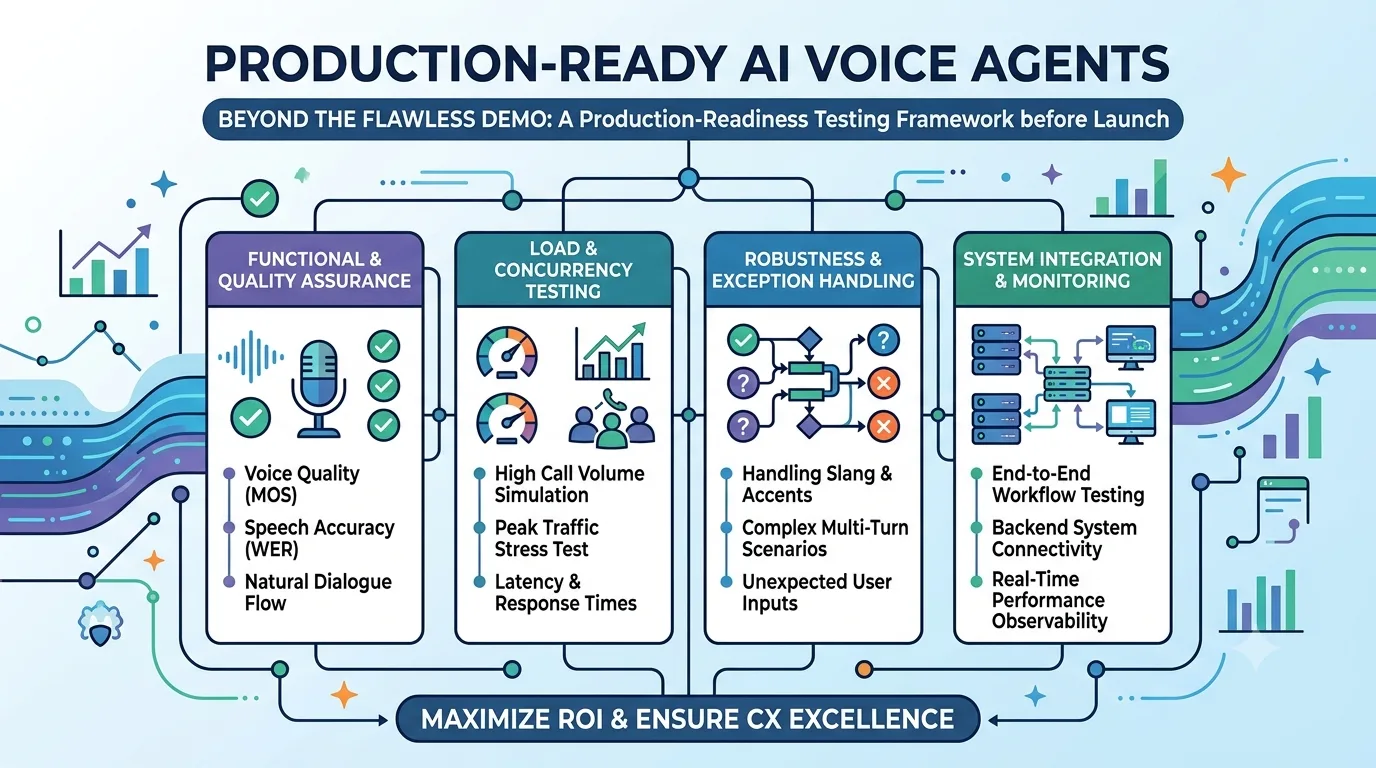
Modern AI voice agents are built differently. They listen continuously, use AI to understand what's being said, generate a spoken reply in real time, and need to handle someone interrupting mid-sentence. Because none of that is fixed or scripted, it has to be tested differently too – for audio quality under real conditions, for how accurately the AI understands different voices and accents, and for how much delay builds up as it listens, “thinks,” and responds.
Compliance can't be an afterthought
If an AI phone agent ever collects payment details, the system needs to guarantee that raw card numbers never get stored in a transcript or fed into the AI model itself – they need to be isolated and masked the instant they're spoken.
There's a second compliance angle many businesses miss: in a growing number of jurisdictions, including parts of the US and the EU, a customer's voice is treated as protected personal data. That means every call needs a clear spoken disclosure that it's being recorded and processed by AI, and any stored data needs to be properly encrypted.
Testing needs to reflect real-world chaos, not ideal conditions
Unlike a website, a phone system can't be load-tested with generic simulated traffic – it has to be tested with real, simultaneous call scenarios: background noise, weak signal strength, and a wide range of speaking styles and accents.
As call volume rises toward a business's actual peak hours, three things commonly go wrong first: the speech-recognition system slows down under load, the AI model hits usage limits during traffic spikes, and a slow backend lookup (checking a customer's account, for instance) creates dead air instead of a natural response like “let me check that for you.”
The performance numbers that determine success
Callers expect a response within roughly a quarter of a second, based on how natural human conversation works. Cross three-quarters of a second, and most people assume something has gone wrong – talking over the system or hanging up entirely.
That's why a production-ready voice agent should respond within 300 to 500 milliseconds, keep speech-recognition errors under 5% on clear audio and under 12% with real-world background noise, and maintain consistently strong audio quality. It also needs to stop speaking almost instantly when interrupted.
A particularly important finding for any business evaluating vendors: research from speech-AI specialists at Deepgram found that real-world phone audio produces error rates six to nine times higher than clean, lab-recorded test audio – and real-time processing adds a further, significant increase in errors compared to offline analysis. In short: a vendor demo using clean sample audio tells you very little about how the system will perform with real customers.
Five questions to ask before launch
Before trusting an AI voice agent with real customer calls, a business should be able to answer yes to five things: Does it respond fast enough to feel natural? Is it accurate enough under real background noise? Can it handle sustained peak call volume without slowing down or failing? Are payment and privacy safeguards actually verified, not just assumed? And is there real-time monitoring in place to catch problems within seconds rather than through customer complaints?
Read this before further : https://www.ecosmob.com/blog/ai-ivr-testing-production-readiness-framework-voice-agents/
The bottom line for decision-makers
An impressive AI voice agent demo is a promising start, not proof of readiness. The businesses that get this right treat production testing as a distinct, non-negotiable phase – not a formality before launch, but the phase that actually determines whether the launch succeeds.