
The lights went out across four million homes and businesses in Southern California in January 2025, as wildfires and hurricane-force winds tore through Los Angeles, Ventura, and San Bernardino counties. In Spain and Portugal three months later, the entire national grid collapsed in under five seconds, wiping out 60 percent of Spain's electricity demand and leaving both countries dark until the following morning. By the end of the year, the U.S. Energy Information Administration would report that Americans had experienced more power interruptions than in any year of the past decade, with the average customer sitting without power for roughly 11 hours — nearly double the norm of the previous ten years.
These are not isolated events. According to Climate Central, weather was responsible for about 80 percent of major U.S. power outages between 2000 and 2023, and the number of weather-driven outages in the most recent decade was double that of the first decade of the century. The U.S. Department of Energy, in a 2025 assessment of grid reliability, warned that the retirement of existing power generation without adequate replacement could push annual outage hours from the single digits today into the hundreds within a few years. Separately, research on U.S. counties found that 62 percent of outages lasting eight hours or longer — long enough to pose real health risks — coincided with extreme weather events like heavy precipitation, heat waves, and hurricanes.
The upshot is a country becoming more dependent, not less, on the machines that are supposed to pick up the slack when the grid goes down. And that creates a problem few people think about until it's too late: standby generators, the backup systems installed specifically for moments like these, have their own well-documented failure rate. Industry estimates commonly cited by generator manufacturers and service providers put that figure at around 30 percent — roughly one in three units failing to start when actually called upon during an outage.
It's a strange kind of unreliability, because the machines themselves aren't usually the issue. A generator's engine is mechanically simple and well understood; when properly maintained, it can run for decades. The failures tend to come from something more mundane — a battery that's quietly lost its charge, a fuel line that's degraded, an alternator that's been slipping for months. None of these problems announce themselves. They simply wait, invisible, until the one moment the generator is asked to perform.
The Case for Watching Machines That Are Supposed to Watch Over Us
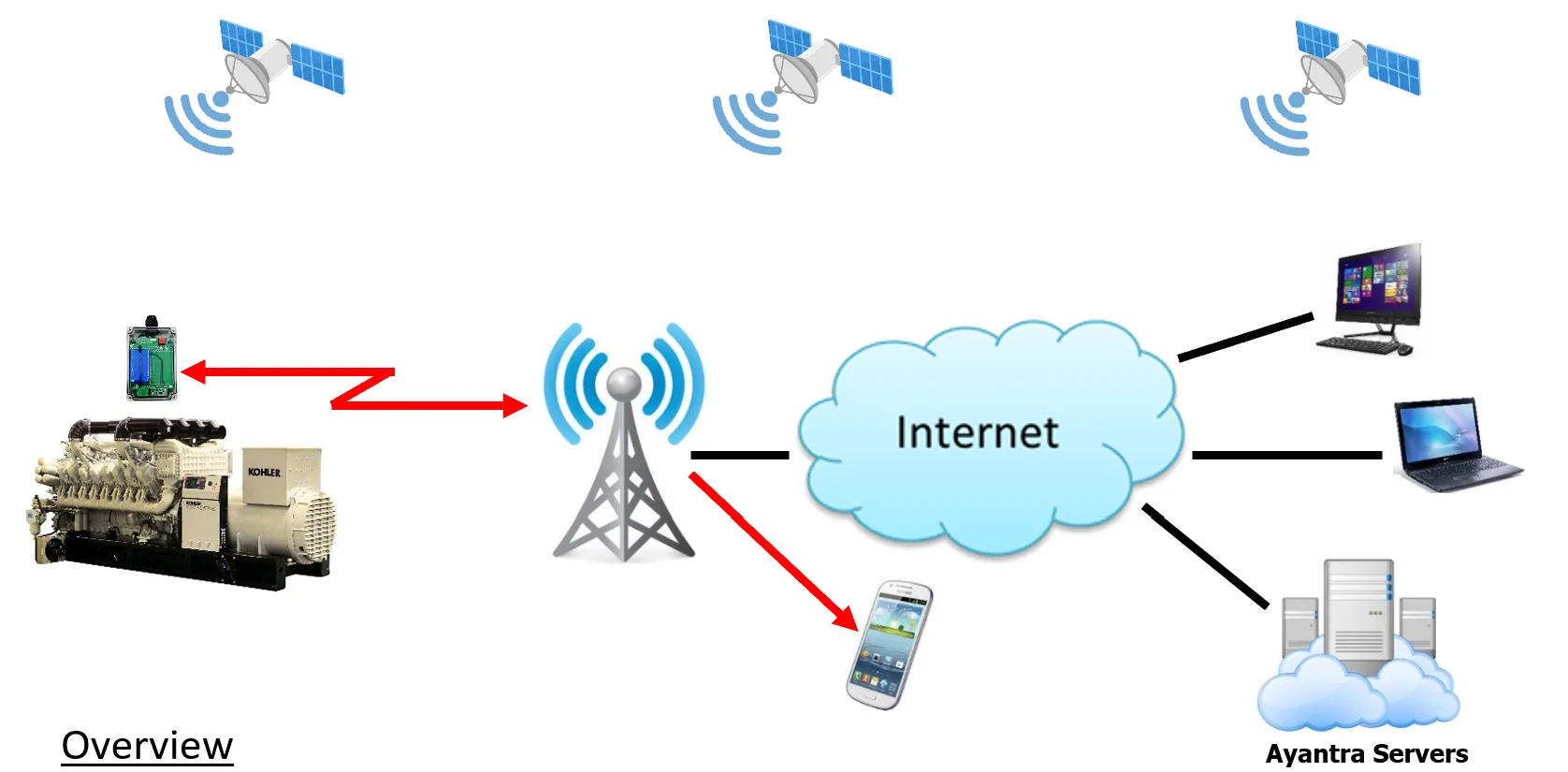
This is the gap that a category of technology known as generator monitoring has emerged to close. The concept is straightforward: attach sensors and a communications module to a generator, and instead of waiting for a scheduled inspection — or worse, an actual outage — to reveal a problem, the system reports the generator's condition continuously, in real time, to a web-based platform. Battery voltage, fuel level, run hours, and fault codes become data points a facility manager, a homeowner's service provider, or a fleet operator can see from a phone or a laptop, long before those numbers translate into a machine that won't start.
What that looks like in practice, however, depends heavily on where the generator sits and what it's protecting.
Hospitals, Data Centers, and the Cost of Not Knowing
In commercial and industrial settings — hospitals, data centers, manufacturing plants — a generator isn't a convenience; it's frequently a life-safety system. A hospital that loses grid power and then loses its backup generator isn't facing an inconvenience, but an emergency with obvious stakes. Commercial generator monitoring systems are built with that reality in mind, typically providing round-the-clock oversight of an entire fleet of generators, sometimes scattered across dozens of sites.
Consider a county government running standby generators at water treatment plants, emergency shelters, and radio towers spread across hundreds of square miles. Historically, confirming that any one of those units was still functional meant sending a technician to physically inspect it — often a multi-hour round trip to discover nothing was wrong. With monitoring, the same team can see a low-battery alert appear on a dashboard, issue a remote command to start the unit and confirm it responds, and dispatch a truck only if the problem persists. A day's drive becomes a two-minute check.
These systems also tend to be built to work across mixed fleets of equipment from different manufacturers — a practical necessity, since large institutions rarely purchase every generator from a single brand over the years — and they typically log utilization data useful not just for maintenance planning but for regulatory compliance, including air-quality reporting requirements in jurisdictions that regulate generator run time.
The Quiet Battery in the Backyard
Residential standby generators carry a different, more personal kind of stakes. For a homeowner running medical equipment, a well pump, or basic heating, a generator that fails during a winter storm isn't a line item — it's a real risk to health and safety. Yet homeowners are, by definition, not generator technicians; most have little visibility into whether their unit's battery, fuel system, or charging circuit is degrading between the annual service visits most people schedule.
Residential generator monitoring systems address this by routing alerts not necessarily to the homeowner, but to the generator dealer or service company that installed the unit — shifting the burden of vigilance to the party equipped to act on it. A gradual decline in battery voltage, invisible to a homeowner checking on the generator once a year, becomes visible to a service provider weeks in advance, prompting a routine part replacement instead of a failure discovered mid-outage. It is, in effect, the same logic increasingly applied to home security and medical alert systems: constant, low-level monitoring replacing periodic, and inherently incomplete, human inspection.
Equipment That Doesn't Stay Put
A third category of generator — the transportable units used on construction sites, at outdoor events, and throughout equipment rental fleets — introduces a different problem altogether. These machines move. They're often left running unattended for days at a stretch, in locations that aren't always secure, and tracking their condition (or their location) the way one might a stationary hospital generator simply isn't practical.
Transportable generator monitoring systems have evolved features specific to that mobility: geofence alerts that flag when a unit leaves the site it was delivered to, curfew alerts if it runs outside approved hours, and — perhaps most consequentially for the rental industry's bottom line — precise run-hour tracking. Equipment rental has traditionally billed by the length of time a unit is checked out, regardless of how much it actually operated; a generator idle for half its rental period costs the same as one running continuously. Run-hour data allows billing tied to actual usage instead, while also making it easier to enforce maintenance schedules based on real operating hours rather than rough estimates.
A Small Piece of a Much Bigger Reliability Problem
None of this technology fixes the electric grid. It doesn't reduce the frequency of hurricanes, cold snaps, or heat waves, and it doesn't reverse the aging transmission infrastructure that agencies like the North American Electric Reliability Corporation have repeatedly flagged as a growing risk to grid stability. What it does is address a narrower, more solvable problem: making sure that when the grid does fail, the backup systems built specifically for that moment are actually ready.
That distinction matters more now than it has in decades. As extreme weather grows more frequent and the grid itself comes under mounting strain from electrification, data center growth, and aging infrastructure, the machines standing between an outage and a genuine emergency are being asked to work harder and fail less. Monitoring technology doesn't make a generator stronger. It simply ensures that if something is wrong, someone finds out in time to fix it — turning a machine that was, for decades, a black box until the moment it mattered, into one that reports its own condition, continuously, before that moment ever arrives.