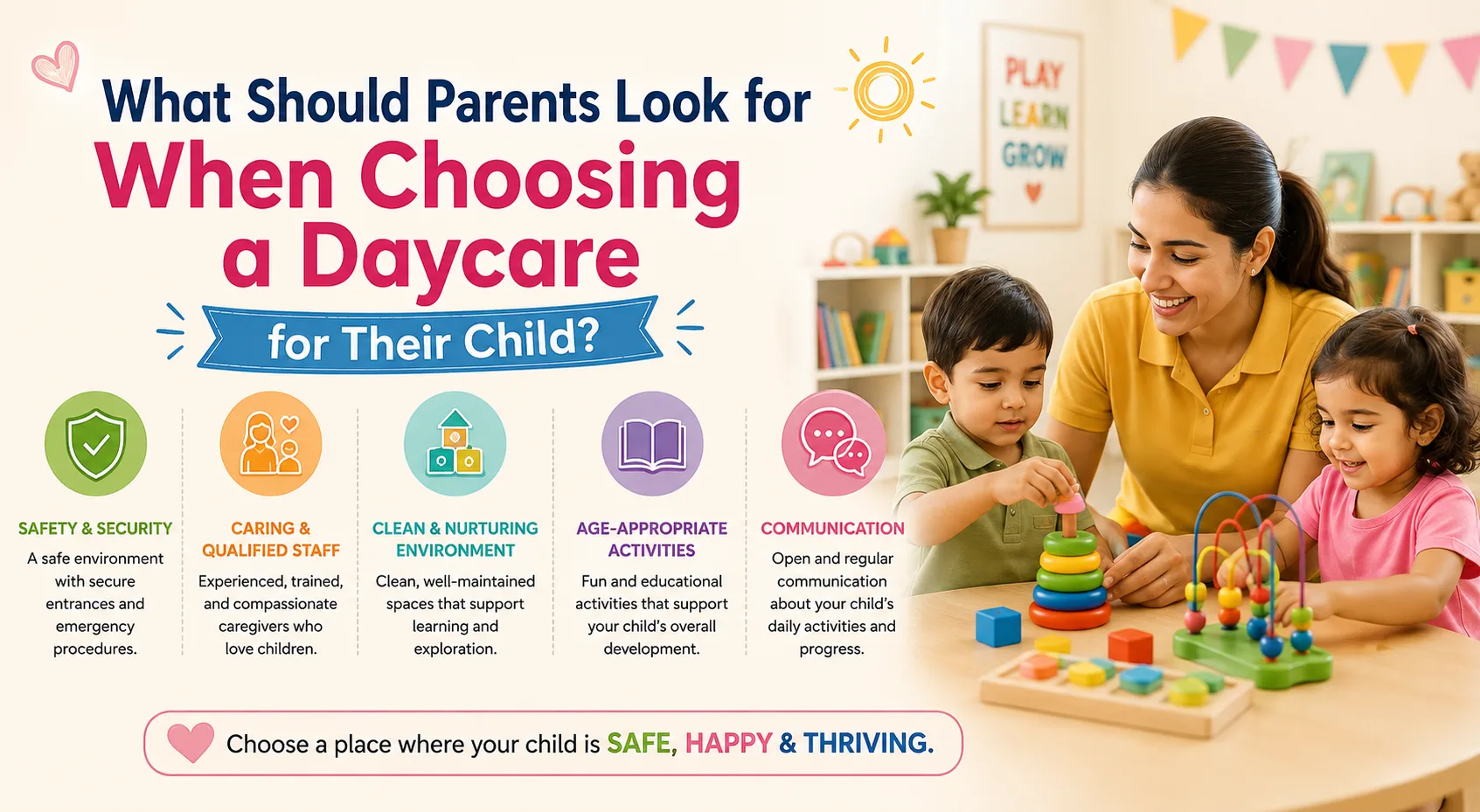
The right daycare is not simply about convenient timings. Parents also need to understand how children are cared for, supported, engaged, and communicated with throughout the day.
Choosing childcare can feel surprisingly complicated.
A centre may look attractive online, have convenient timings, or be located close to home. But parents usually want to know something deeper:
Will my child feel comfortable here, and will they receive appropriate care throughout the day?
For families comparing options, the phrase best daycare in Faridabad may appear frequently in search results. However, a better approach is to create your own checklist and compare each option against the things that actually matter to your family.
Start With Your Child's Needs
There is no single daycare that will be the perfect choice for every family.
Before visiting centres, think about your child's age, personality, routine, and level of independence.
For example, consider:
- How comfortable is your child in new environments?
- Does your child need regular quiet time?
- How much physical activity do they enjoy?
- Are they comfortable communicating their needs?
- What kind of daily routine works well for them?
Understanding your child's needs gives you a clearer basis for comparison.
Location and Timings Matter, But They Aren't Everything
A convenient location can make daily life considerably easier.
Parents may want to consider travel time, pickup arrangements, operating hours, and how these fit into the family's schedule.
However, convenience should be considered alongside the quality of the child's experience.
A centre that is slightly farther away may still be a better practical choice if its routine, communication, and approach are more suitable for your family.
Observe the Environment During a Visit
A website can tell you about a programme.
A visit can tell you how the environment actually feels.
Pay attention to what you see when you enter.
Are children engaged in activities?
Do adults speak calmly with them?
Do children appear comfortable approaching caregivers?
Is the environment organised?
Are there opportunities for play and interaction?
You don't need to judge a centre based on one moment. Instead, look for the general atmosphere.
Ask How the Day Is Structured
Parents should understand what happens between drop-off and pickup.
A typical full-day experience may include a combination of:
- Guided learning
- Free play
- Creative activities
- Movement
- Meals or snacks
- Quiet periods
- Outdoor activities where applicable
- Social interaction
The exact routine will vary by centre and age group.
What matters is whether the schedule is appropriate for young children and whether there is a sensible balance between active and quieter periods.
Communication With Parents Is Important
Childcare works best when parents and caregivers can share useful information.
Ask how parents are updated about their child's day.
For example:
- How are changes in routine communicated?
- How can parents raise concerns?
- How are important incidents reported?
- How can parents discuss their child's progress or adjustment?
Good communication doesn't mean parents need a constant stream of updates.
It means there is a clear and appropriate way to stay informed.
Ask About Settling-In Support
Starting daycare can be a significant transition for a young child.
Some children adjust quickly.
Others may need more time.
Parents can ask what happens when a child cries at drop-off, refuses an activity, or struggles with separation.
The answer can help you understand how the centre handles emotional transitions.
A calm, age-appropriate approach can make the adjustment easier.
Look at the Adults, Not Just the Facilities
Parents naturally notice classrooms, toys, furniture, and activity areas.
But the people interacting with children are just as important.
Observe whether adults:
- Listen when children speak
- Respond patiently
- Give children appropriate guidance
- Encourage communication
- Notice when a child needs support
- Maintain appropriate supervision
A beautifully designed environment cannot replace attentive adult interaction.
Understand How Children Are Engaged
Young children need meaningful things to do.
Ask what happens during periods outside structured preschool activities.
Do children have access to age-appropriate play?
Are there creative opportunities?
Is there time for stories or conversations?
Are children encouraged to interact with one another?
If you're considering a daycare preschool in Faridabad, ask about the complete experience rather than focusing only on the formal preschool curriculum.
Find Out How Rest Is Handled
Children's energy levels vary considerably.
Younger children may need naps or quiet periods, while older children may simply benefit from calmer activities.
Ask:
- Is there a designated rest period?
- How is the environment arranged for quiet time?
- What happens if a child doesn't sleep?
- How are children supervised?
The answers can help you understand whether the daily routine takes children's changing energy levels into account.
Ask Practical Questions About Meals
If meals or snacks are part of the programme, parents should understand the arrangements clearly.
Depending on the centre, you may need to ask about:
- What food is provided
- Whether parents send food
- Meal timings
- Drinking water
- Dietary requirements
- Food allergies
- How individual needs are communicated
Don't assume that two centres with similar programmes handle meals in the same way.
Safety Questions Are Worth Asking
Parents should feel comfortable asking direct questions about safety and supervision.
The exact procedures will differ between childcare providers, so ask the centre to explain its own policies.
You may want to understand:
- How children are supervised
- Who is authorised to collect a child
- How visitors are handled
- How emergencies are managed
- How parents are contacted when necessary
You don't need to be uncomfortable asking these questions.
They are part of understanding the care environment.
Think About Your Child's Social Experience
Daycare can provide children with opportunities to interact with other children.
These interactions can involve cooperation, sharing, conversation, turn-taking, and conflict resolution.
Parents can ask how caregivers support children when disagreements occur.
For young children, simply telling them to "share" may not always solve the problem.
They may need help expressing what they want, listening to another child, or finding an alternative.
Don't Choose Based Only on Online Rankings
Searching for the best daycare in Faridabad can help you discover options, but rankings and reviews should be treated as starting points rather than the entire decision-making process.
Different families have different priorities.
One parent may prioritise location.
Another may care more about timings.
Another may focus heavily on the learning approach.
Your own visit and questions can provide information that a generic ranking cannot.
Create a Simple Comparison Checklist
After visiting several centres, it can be difficult to remember which one offered what.
Create a basic comparison list.
FactorCentre ACentre BCentre CLocation Timings Daily routine Learning activities Play opportunities Rest arrangements Parent communication Child's comfort Overall suitabilityYou don't need to assign complicated scores.
The purpose is simply to make your decision more objective.
Watch Your Child's Reaction
If possible, notice how your child responds during the visit.
Do they show curiosity?
Are they comfortable approaching an activity?
Do they seem overwhelmed?
Do they interact with adults?
A child's reaction isn't the only factor, but it can provide useful information.
Sometimes children communicate their comfort through behaviour before they can explain it verbally.
What Makes a Daycare a Good Fit?
The best daycare in Faridabad for one family may not be the best fit for another.
The right choice depends on a combination of factors:
A suitable routine.
A comfortable environment.
Attentive adult interaction.
Appropriate activities.
Clear parent communication.
Practical arrangements that work for the family.
A positive experience for the child.
Looking at all of these together provides a much stronger basis for choosing childcare than relying on a single feature.
Take Time Before Making the Decision
If you're able to, visit more than one option.
Prepare your questions before arriving.
Take notes immediately after each visit.
Think about how your child's needs fit with the environment rather than simply choosing the centre with the longest list of features.
Families researching preschool and daycare options in Faridabad can also explore Little Columbus to understand its early-learning and childcare programmes.
The goal isn't to find a centre that sounds perfect on paper.
It is to find an environment where your child can be cared for appropriately, participate in meaningful experiences, and gradually become comfortable with the people and routines around them.