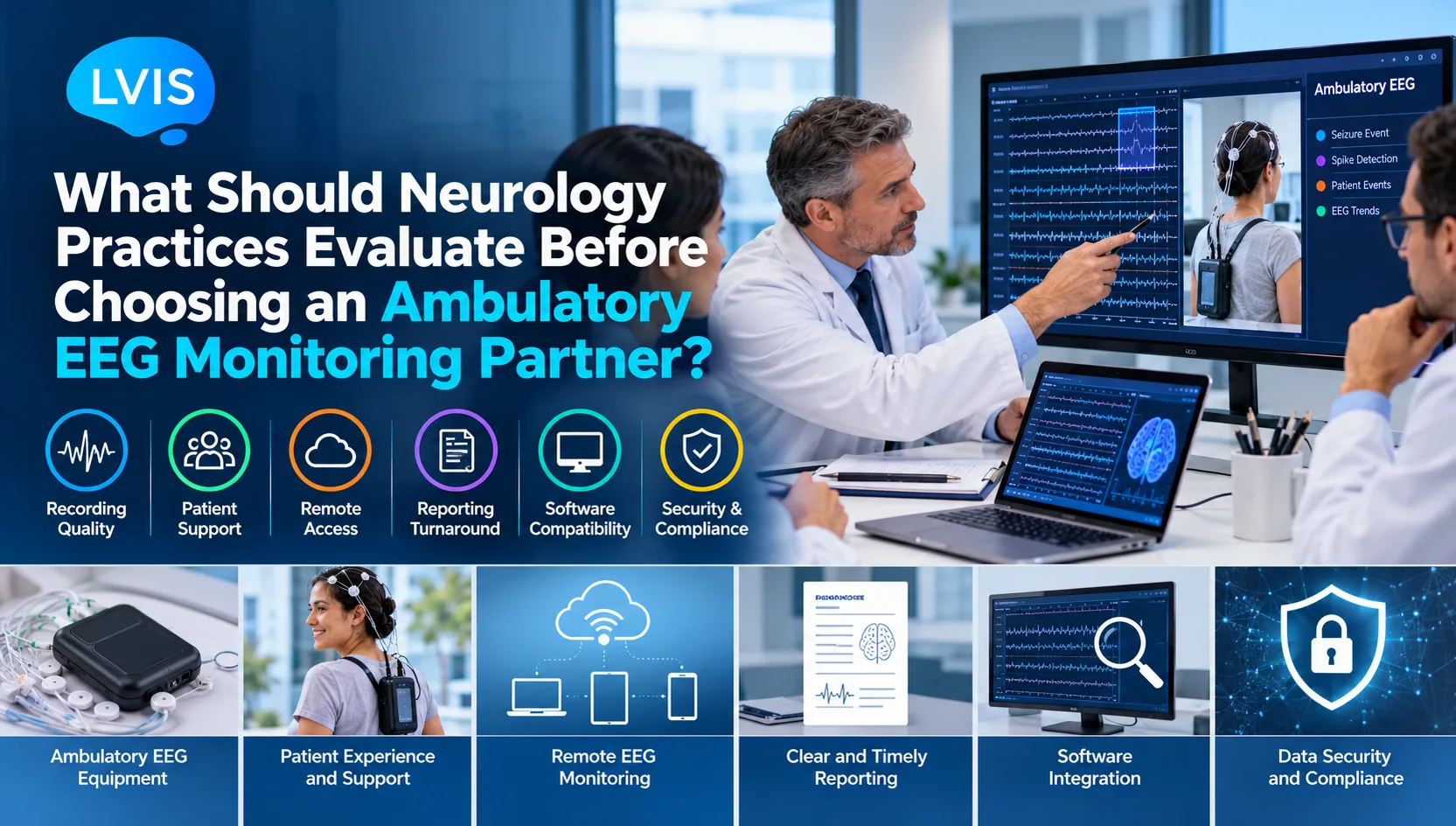
Selecting an ambulatory EEG monitoring partner is an important decision for neurology practices seeking to expand diagnostic services without significantly increasing internal operational demands. Ambulatory electroencephalography allows brain activity to be recorded over an extended period while patients continue many of their usual daily activities outside a traditional hospital environment. However, recording quality, patient preparation, technical support, data accessibility, and clinical interpretation responsibilities can vary between service providers. Practices evaluating ambulatory eeg services should examine the complete diagnostic workflow rather than focusing only on equipment availability or service pricing. A structured evaluation helps neurologists, clinical neurophysiologists, and healthcare administrators identify partners that align with their clinical and operational requirements.
Outsourcing EEG recording services can provide additional operational flexibility, but it also introduces dependencies on external organizations. Delays in equipment setup, recording retrieval, technical troubleshooting, or report delivery may affect patient care and clinical scheduling. Neurology practices must therefore understand how responsibilities are divided between their staff and the external provider. Data security, software compatibility, patient communication, and quality assurance should also be considered before signing a service agreement. Establishing clear expectations early can help reduce workflow disruptions and improve accountability throughout the monitoring process.
Why Does Choosing the Right Ambulatory EEG Partner Matter?
Ambulatory EEG monitoring can support the investigation of intermittent neurological events that may not occur during a routine EEG recording. Depending on the clinical indication, longer recording periods may provide additional opportunities to capture relevant electrical activity. However, the diagnostic usefulness of the recording depends on signal quality, appropriate electrode placement, patient adherence, and expert interpretation. External monitoring partners may provide equipment, technologist support, data management, or other services depending on their business model. Neurology practices should verify exactly which services are included and how they support the practice's diagnostic workflow.
How Can an External Monitoring Partner Affect Clinical Operations?
An external provider may coordinate equipment delivery, patient setup, recording retrieval, and technical assistance. These activities can reduce certain administrative demands on a neurology practice when they are managed effectively. However, poorly defined responsibilities may create confusion about scheduling, patient instructions, or technical problems. Practices should identify which tasks remain with their clinicians and which are handled by the provider. Written workflow documentation can help establish accountability and reduce unnecessary communication delays.
Why Should Practices Evaluate More Than Service Pricing?
Service pricing is important, but the lowest quoted rate does not necessarily represent the best overall value. A provider with limited technical support or inconsistent reporting procedures may create additional work for clinical staff. Equipment failures, repeat recordings, delayed reports, and administrative complications can also affect total service costs. Practices should evaluate operational performance, service reliability, and clinical requirements alongside financial terms. A comprehensive comparison supports more informed purchasing decisions.
What Recording Quality Standards Should Neurology Practices Review?
EEG recording quality directly affects the ability of clinicians to identify and interpret relevant neurological activity. Ambulatory recordings can be affected by movement artifacts, electrode displacement, electrical interference, and inconsistent patient adherence. Practices should ask providers how recording quality is maintained throughout the monitoring period. Technical specifications should be evaluated alongside actual procedures for identifying and addressing recording problems. A reliable partner should be able to explain its quality assurance processes and the limitations of its monitoring approach.
How Is Signal Quality Maintained During Extended Recordings?
Extended EEG recordings require equipment and electrode arrangements suitable for use outside a controlled laboratory environment. Providers should explain how electrodes are applied, secured, and checked before monitoring begins. They should also describe how patients are instructed to manage daily activities while protecting recording quality. Some systems may support technical quality checks during monitoring, while others rely on retrospective review. Practices should confirm which capabilities are available and how technical problems are escalated.
What Happens if Electrodes Become Disconnected?
Electrode disconnection can introduce artifacts or result in periods of incomplete recording. Patients may not always recognize these problems without clear instructions or appropriate technical support. Neurology practices should ask whether the provider offers troubleshooting assistance and how quickly issues can be addressed. The agreement should also clarify whether recording extensions or repeat studies are available when technical problems significantly affect data quality. These procedures can help practices manage patient expectations and avoid uncertainty about incomplete recordings.
Should Providers Follow Standardized Recording Protocols?
Standardized protocols support more consistent data collection and facilitate comparisons between recordings. Practices should review electrode placement methods, recording configurations, sampling parameters, and procedures for documenting relevant patient events. The protocol should be appropriate for the intended clinical indications and compatible with the interpreting clinician's requirements. Providers should also explain how deviations from standard procedures are documented. Consistent acquisition practices can support reliable clinical review and quality assurance.
How Important Is Patient Support During Ambulatory EEG Monitoring?
Patients may need to wear EEG recording equipment for an extended period while managing normal activities, sleep, and personal routines. Clear instructions are essential because confusion about equipment handling can affect recording quality and patient experience. Providers should explain what patients can expect before, during, and after monitoring. Neurology practices should also verify how patients can obtain assistance when questions or technical problems arise. Reliable support procedures help reduce avoidable interruptions and improve coordination between patients and clinical teams.
What Instructions Should Patients Receive Before Monitoring?
Patients should understand the purpose of the test, expected recording duration, equipment precautions, and procedures for documenting symptoms or events. Instructions should explain any relevant restrictions involving bathing, equipment handling, or activities that could interfere with the recording. Providers should also clarify whether patients need to maintain an event diary or activate an event marker. Information should be presented in language patients can understand and should be accessible when questions arise. Clinical instructions concerning medications or other medical decisions must come from the responsible healthcare professional.
How Should Technical Support Be Provided?
Technical assistance may be needed when patients experience equipment alarms, loose electrodes, or uncertainty about recording procedures. Practices should ask whether support is available during evenings, weekends, or other periods when monitoring is underway. They should also confirm whether assistance is provided by trained technical personnel and how unresolved issues are escalated. Support availability should match the provider's service commitments rather than rely on informal expectations. Clear contact procedures can reduce delays when problems occur.
Why Does Patient Communication Matter?
Patients may contact their neurology practice when they are uncertain about equipment instructions or monitoring arrangements. If the external provider manages some of these responsibilities, unclear communication channels can create unnecessary administrative work. Practices should establish who handles scheduling questions, technical concerns, and clinical inquiries. Patients should also understand when symptoms require contacting their healthcare professional rather than the equipment provider. Coordinated communication helps maintain appropriate boundaries between technical support and medical care.
How Should Practices Evaluate Remote EEG Monitoring Capabilities?
Remote access to EEG recordings can support collaboration between acquisition teams and authorized clinicians working at different locations. However, remote eeg monitoring capabilities differ depending on the equipment, software architecture, and service arrangement. Some providers may offer access to recordings during acquisition, while others make data available only after monitoring ends. Practices should confirm whether the proposed service provides live technical oversight, remote clinical review, or retrospective access. These functions should not be treated as interchangeable because they support different operational and clinical requirements.
Is Real-Time Access Necessary for Every Practice?
Not every ambulatory EEG service requires continuous live review of incoming recordings. The appropriate workflow depends on the clinical indication, monitoring model, and responsibilities of the treating team. Practices should determine whether access during recording is necessary or whether retrospective review meets their needs. They should also understand whether the provider actively monitors incoming data or simply makes recordings available for authorized access. Clear definitions help prevent misunderstandings about the level of clinical oversight being provided.
What Should Practices Ask About Data Availability?
Neurologists may need timely access to completed recordings, associated annotations, and relevant patient event information. Providers should explain when data becomes available and whether access depends on proprietary systems or additional processing. Practices should also ask about file download options, data retention periods, and procedures for retrieving archived recordings. Any limitations involving simultaneous access or multiple clinical users should be clarified. Reliable data availability supports efficient interpretation and continuity of care.
What Should Practices Know About EEG Review Software Compatibility?
External monitoring services may use recording formats and platforms that differ from those already used by a neurology practice. Incompatibility can create additional conversion steps or limit access to relevant recording information. Practices evaluating EEG review software should determine whether the platform supports the formats and workflows required by their clinicians. They should also confirm whether annotations, event markers, and recording metadata remain accessible when data is transferred. Compatibility testing before implementation can help identify technical limitations that would otherwise disrupt routine review.
Why Are EEG File Formats Important?
EEG recording systems may store data using different file structures, metadata conventions, and proprietary formats. A file that can be opened in another application may not preserve every annotation or acquisition detail. Practices should therefore test representative recordings rather than assume compatibility based on general format support. Export and import procedures should be documented, particularly when multiple systems are involved. This evaluation helps protect data integrity and reduces unnecessary manual processing.
Can Software Integration Reduce Administrative Work?
Software integration may help practices coordinate data retrieval, review assignments, and reporting workflows. However, integration requirements vary depending on the external provider and the practice's existing systems. Healthcare administrators should ask whether information must be transferred manually or whether supported interfaces are available. They should also evaluate the security and maintenance requirements of any proposed integration. Effective implementation planning helps avoid introducing new administrative burdens while attempting to improve efficiency.
How Can EEG Analysis Software Support Clinical Review Efficiency?
Extended recordings can generate substantial amounts of data that require careful interpretation. EEG analysis software may provide tools for organizing recordings, reviewing annotations, and identifying segments that warrant further attention. Some platforms incorporate automated analytical capabilities that can assist with event identification or prioritization. However, the accuracy and suitability of these functions depend on the specific product and its validated intended use. Practices should evaluate software capabilities through demonstrations, technical documentation, and appropriate clinical review.
Can Automated Analysis Reduce Review Workload?
Automated analysis may help clinicians identify candidate events within lengthy recordings. This can support a more focused review process when the system performs adequately for the intended population and recording conditions. However, false-positive detections may increase the number of segments requiring verification. Missed events are also possible, making expert interpretation and appropriate quality controls essential. Practices should assess actual workflow performance rather than assume that automation always reduces review time.
Why Is Clinician Oversight Still Necessary?
EEG interpretation requires consideration of waveform characteristics, artifacts, clinical history, and the circumstances surrounding recorded events. Automated findings may provide useful information but cannot independently establish every diagnosis or clinical conclusion. Neurologists and qualified clinical neurophysiologists remain responsible for interpretation within their professional scope. Practices should define how automated outputs are reviewed, corrected, and incorporated into clinical reports. Clear oversight procedures help maintain accountability and appropriate patient care standards.
How Should Neurology Practices Evaluate Reporting Turnaround Times?
Reporting turnaround can influence follow-up scheduling, clinical communication, and the overall patient experience. Practices should distinguish between the time needed to retrieve a recording, prepare it for interpretation, and complete the final clinical report. Different providers may handle only certain parts of this process. Service agreements should clearly identify which organization is responsible for each stage. Defined turnaround expectations can help practices plan follow-up appointments and manage patient communication.
What Should Be Included in Reporting Agreements?
A reporting agreement should specify the services provided, expected turnaround times, and any circumstances that may affect delivery. It should also clarify whether reports are preliminary or final and who is authorized to interpret the recordings. Practices should understand how urgent findings are communicated and which clinician is responsible for responding. Procedures for correcting reports or obtaining additional information should be documented. These details reduce uncertainty when multiple organizations participate in the diagnostic workflow.
How Should Urgent Findings Be Handled?
Certain EEG findings may require timely clinical attention depending on the patient's condition and monitoring context. Practices should establish whether the external provider has any responsibility for identifying or escalating urgent concerns. If the service is limited to recording acquisition, that limitation should be clearly understood by the practice and relevant clinicians. Communication pathways should identify the responsible healthcare professional and appropriate escalation procedures. Technical monitoring services should not be assumed to provide continuous clinical surveillance unless that responsibility is explicitly included and supported.
What Clinical Responsibilities Should Be Defined Before Outsourcing?
Outsourcing recording activities does not automatically transfer responsibility for clinical decisions or patient management. Neurology practices should determine who orders the study, selects the monitoring protocol, interprets results, and communicates findings to the patient. The external provider's responsibilities should be defined separately from those of the treating neurologist. These distinctions are especially important when services involve multiple organizations or remote personnel. Written agreements can help establish appropriate accountability throughout the process.
Who Is Responsible for Interpreting EEG Recordings?
The interpretation arrangement depends on the service model and the qualifications of the professionals involved. Some providers may supply recording acquisition and technical support without offering clinical interpretation. Others may have separate arrangements involving qualified interpreting clinicians. Practices should verify professional qualifications, applicable licensing requirements, and reporting responsibilities. These details should be established before patient referrals begin.
How Should Clinical Escalation Procedures Be Organized?
Clinical escalation procedures define how potentially important findings or patient concerns are communicated to the responsible healthcare team. They should identify appropriate contacts, communication methods, and expectations for urgent situations. Practices should also clarify how after-hours issues are handled when monitoring extends beyond normal office operations. The external provider's role must be consistent with its actual capabilities and contractual responsibilities. Clear procedures help reduce the risk of missed or delayed communication.
What Data Security and Patient Privacy Requirements Should Be Reviewed?
Ambulatory EEG services may involve transferring sensitive patient information between clinical practices, equipment providers, software platforms, and interpreting professionals. These workflows require appropriate security and privacy safeguards. In the United States, HIPAA obligations may apply depending on the organizations involved and their roles in handling protected health information. Practices should evaluate access controls, encryption, data retention, and vendor responsibilities before exchanging patient records. Security planning should reflect the complete data lifecycle rather than focus only on file transmission.
Should the Provider Sign a Business Associate Agreement?
A business associate agreement may be required when a service provider handles protected health information on behalf of a HIPAA-covered entity in a capacity that qualifies it as a business associate. The need for an agreement depends on the provider's role and the services performed. Practices should consult their privacy and legal teams to determine the appropriate contractual requirements. Agreements should clearly address relevant safeguards, incident reporting, and permitted uses of patient information. A signed agreement does not replace the need to evaluate the provider's actual security practices.
What Security Questions Should Practices Ask?
Practices should ask how patient information is stored, transmitted, accessed, and protected from unauthorized disclosure. They should also review user authentication, audit logging, backup procedures, and incident response arrangements. If cloud services are involved, the provider should explain relevant hosting and subcontractor relationships. Data retention and secure deletion procedures should be documented. These questions help practices assess whether the proposed service aligns with institutional security requirements.
How Can EMU Software Relate to Ambulatory EEG Workflows?
Epilepsy monitoring units and outpatient ambulatory EEG services operate in different clinical environments, but both involve managing recordings and associated clinical information. Practices reviewing EMU Software may consider whether relevant capabilities can support their broader EEG data management requirements. However, software designed for inpatient monitoring should not automatically be assumed suitable for outpatient acquisition or external provider integration. The supported recording formats, workflows, and intended uses must be verified. Evaluating these differences helps practices avoid selecting technology that does not match their service model.
Can One Platform Support Multiple EEG Workflows?
Some healthcare organizations seek consistent data access and review processes across different EEG recording environments. A shared platform may offer operational advantages when it supports the required data types and clinical workflows. However, ambulatory, inpatient, and routine EEG services may have distinct acquisition and interpretation requirements. Practices should evaluate each workflow separately before consolidating systems. Vendor demonstrations and compatibility testing can help determine whether a proposed platform meets those needs.
Why Is Data Continuity Important?
Patients may undergo different EEG studies during their diagnostic evaluation or ongoing neurological care. Clinicians may benefit from access to prior recordings and associated reports when reviewing new findings. However, data continuity depends on appropriate access permissions, reliable record identification, and compatible systems. Practices should clarify how historical recordings can be retrieved and compared. Maintaining organized clinical information supports more efficient review and continuity of care.
What Should Practices Ask About Service Agreements and Pricing?
External EEG monitoring agreements may include charges for equipment use, patient setup, technical services, data processing, software access, or other activities. Practices should request a detailed explanation of the pricing structure before entering a contract. They should also understand whether costs vary by recording duration, service volume, or additional support requirements. Cancellation terms, equipment replacement procedures, and responsibility for repeat recordings may affect total expenses. Transparent agreements help practices evaluate the financial implications of outsourcing.
Are There Additional Costs Beyond the Initial Quote?
A quoted service price may not include every activity required to complete the monitoring workflow. Additional charges could relate to equipment shipping, technical assistance, software subscriptions, recording extensions, or data storage. Practices should request written clarification of what is included and what may be billed separately. Financial evaluations should also consider staff time required for scheduling, coordination, and clinical follow-up. Understanding the full cost structure supports more accurate budgeting.
What Service-Level Commitments Should Be Documented?
Service-level commitments may address equipment availability, technical response times, data delivery, and support coverage. Practices should determine which commitments are operationally important and whether the provider can document them. Agreements should also explain how service failures or unresolved technical problems are handled. Performance review procedures can help identify recurring issues after implementation. Clear expectations support accountability and more effective vendor management.
How Can Practices Compare Ambulatory EEG Monitoring Partners?
A structured comparison helps neurology practices evaluate providers using consistent clinical, technical, and operational criteria. Rather than relying on promotional claims, decision-makers should request demonstrations, service documentation, and references where appropriate. Evaluation should include the complete patient journey from referral and setup through recording retrieval and final interpretation. Practices should also identify which requirements are essential and which are optional. A documented assessment supports more transparent procurement decisions.
Ambulatory EEG Monitoring Partner Evaluation Checklist
Before selecting a provider, neurology practices should review the following considerations:
- Recording equipment quality and supported monitoring durations.
- Electrode application procedures and signal quality checks.
- Patient preparation, instructions, and technical support availability.
- Procedures for handling electrode disconnections and incomplete recordings.
- Remote access capabilities and limitations.
- Compatibility with existing EEG recording and review systems.
- Data export options and preservation of recording metadata.
- Availability of automated analysis and associated validation evidence.
- Reporting turnaround times and interpretation responsibilities.
- Urgent finding communication and clinical escalation procedures.
- HIPAA-related responsibilities and patient data security.
- Service pricing, additional charges, and contract conditions.
- Equipment replacement and repeat recording policies.
- Implementation support and ongoing vendor communication.
These criteria provide a practical starting point for comparing potential monitoring partners. The importance of individual requirements will depend on the practice's patient population, clinical services, and staffing arrangements. A provider that works well for one organization may not be suitable for another. Practices should therefore conduct demonstrations and review sample workflows before making a final decision. A limited pilot may also help identify operational challenges before expanding the service.
How Can LVIS Corporation's Technology Fit Into EEG Workflow Evaluation?
LVIS Corporation develops EEG-related technology, including the NeuroMatch platform, for neurological analysis and review workflows. Neurology practices evaluating external monitoring services may also need to assess the software used to access and interpret recordings. The capabilities of the acquisition provider and the analytical software platform should be considered separately. Practices can review LVIS Corporation's published product information to understand its approach to EEG technology. Specific compatibility, integration, and deployment requirements should be confirmed directly with the company.
What Is the Relevance of Digital Twin Brain Technology?
LVIS Corporation's broader technology interests include the concept of a digital twin brain. This concept relates to computational approaches for representing or analyzing aspects of brain activity and neurological information. However, practices should distinguish research and technology concepts from the specific capabilities available in a commercial EEG product. Procurement decisions should be based on documented functionality, clinical suitability, and applicable validation evidence. Product demonstrations can help clarify which capabilities are relevant to the intended workflow.
Why Should Practices Evaluate Acquisition and Analysis Separately?
An external monitoring partner may provide recording equipment and technical services, while a separate software platform supports data review or analysis. These components may be supplied by different organizations and may have different contractual and technical requirements. Practices should determine whether the proposed combination is compatible and whether responsibilities are clearly defined. They should also consider how recordings, annotations, and reports move between systems. Evaluating the complete workflow helps identify integration problems before clinical deployment.
What Should Neurology Practices Do Before Selecting a Partner?
The final selection process should involve clinical leadership, EEG technologists, healthcare administrators, and relevant IT personnel. Each group can identify requirements that may not be apparent from a single operational perspective. Practices should compare providers against predefined criteria and document any unresolved questions. Pilot testing can provide useful evidence about patient support, recording quality, data access, and workflow compatibility. Contract terms should be reviewed only after the organization understands the proposed service model and its responsibilities.
Should Practices Conduct a Pilot Program?
A pilot program allows a neurology practice to evaluate a provider under realistic operating conditions. The pilot may include a limited number of studies selected to reflect common clinical workflows. Teams can assess equipment reliability, patient communication, technical support, recording accessibility, and administrative coordination. Findings should be documented using consistent measures and reviewed by the relevant stakeholders. This approach can reveal problems that are difficult to identify through demonstrations alone.
What Performance Measures Should Be Tracked?
Useful measures may include recording completion rates, technical problem frequency, support response times, and time required to make recordings available for interpretation. Practices may also evaluate repeat study rates, patient feedback, and staff workload. Measures should be clearly defined so that results can be compared consistently. Clinical outcomes should not be inferred solely from operational performance metrics. Regular review helps determine whether the service continues to meet the practice's requirements.
How Can Neurology Practices Explore LVIS Corporation's EEG Technology?
Neurology practices seeking to improve EEG review and analysis workflows can explore LVIS Corporation's technology and published product information. Discussions with the company may help clarify supported recording formats, analytical capabilities, and technical requirements. Practices should explain their existing acquisition systems, expected recording volumes, and clinical workflow objectives. Any proposed integration should be evaluated through appropriate technical and clinical testing. Visit https://lviscorp.com/en/neuromatch to learn more about NeuroMatch and available contact options.
Request Information About EEG Review and Analysis Capabilities
Before selecting an external monitoring partner, practices should understand how recordings will be accessed, reviewed, and incorporated into their clinical systems. LVIS Corporation can be contacted to discuss relevant EEG technology capabilities and available product documentation. Procurement teams may request a demonstration to evaluate whether the platform aligns with their requirements. Product compatibility and specific functionality should be confirmed rather than assumed. A coordinated evaluation of monitoring services and analytical tools can support a more reliable implementation process.
Conclusion
Choosing an external ambulatory EEG monitoring partner requires careful evaluation of recording quality, patient support, data access, reporting procedures, and clinical responsibilities. Neurology practices should also assess software compatibility, privacy safeguards, service agreements, and the provider's ability to support consistent operations. A structured comparison and pilot evaluation can help identify practical limitations before long-term commitments are made. LVIS Corporation's EEG technology may be considered when practices evaluate the analytical and review components of their broader diagnostic workflows. The most appropriate solution is one that meets the organization's clinical requirements while maintaining clear accountability, reliable data handling, and appropriate patient care standards.